Stellarator coils
CoilStellaration is a dataset of
optimized stellarator coilsets for the plasma boundaries of
ConStellaration. A coilset is
stored by its unique coils: closed curves given by the Fourier coefficients of x, y and z
(the layout of DESC’s FourierXYZCoil), one current per coil, the number of field periods and
whether it is stellarator symmetric. A boundary is a Fourier series of R and Z
(SurfaceRZFourier). plasma-plots reads both from the plain JSON the datasets store, without DESC
or the coilstellaration package:
import plasma_plotsfrom plasma_plots.coils import coil_to_coil_distance, distance_to_surface
# every coil of the device, over (coil, s)coils = plasma_plots.from_coilset(coilset)# the plasma surface, with its minor radiusplasma = plasma_plots.from_boundary(boundary)a = plasma.attrs["minor_radius"]
coils["plasma_distance"] = distance_to_surface(coils, plasma) / acoils.plasma.plot.coils_3d(color_by="plasma_distance", surface=plasma).show()
From the datasets
Section titled “From the datasets”The results subset of CoilStellaration has one row per sample, with the IDs of its coilsets and
of its ConStellaration boundary. A coilset is fetched by ID through the subset’s
id_to_file_map.parquet; the json of its row is what from_coilset reads. ConStellaration’s
boundary.json is what from_boundary reads. This block is what
scripts/fetch_coilstellaration_sample.py runs to get the coilset drawn
further down. It downloads from Hugging Face (about 0.7 GB,
mostly the boundary column), so it is not run when the docs are built:
import json
import pandas as pd
coilstellaration = "hf://datasets/proxima-fusion/coilstellaration"constellaration = "hf://datasets/proxima-fusion/constellaration"
results = pd.read_parquet(f"{coilstellaration}/results/eval-part-0.parquet")# a third of the samples have no DESC coilsethas_desc = results["desc_coilset_id"].notna()tight = results["benchmark/stratification"] == "tight"chosen = results[has_desc & results["benchmark/fixed_shape_track"] & tight]sample = chosen.sort_values("constellaration_boundary_id").iloc[0]
where = [("id", "==", sample["desc_coilset_id"])]index = pd.read_parquet(    f"{coilstellaration}/coilsets/id_to_file_map.parquet", filters=where)row = pd.read_parquet(    f"{coilstellaration}/{index['path'].iloc[0]}", filters=where)coilset = json.loads(row["json"].iloc[0])
for part in range(3):    rows = pd.read_parquet(        f"{constellaration}/data/train-{part:05d}-of-00003.parquet",        columns=["plasma_config_id", "boundary.json"],        filters=[            ("plasma_config_id", "==", sample["constellaration_boundary_id"])        ],    )    if len(rows):        boundary = json.loads(rows["boundary.json"].iloc[0])
coils = plasma_plots.from_coilset(coilset)plasma = plasma_plots.from_boundary(boundary)
from_coilset also takes the coilstellaration library’s Coilset and a DESC CoilSet of
FourierXYZCoil (coilset.to_FourierXYZ() converts other DESC coils); from_boundary also takes
ConStellaration’s SurfaceRZFourier.
Reading a coilset
Section titled “Reading a coilset”from_coilset(coilset, n_points=128) expands the unique coils into every coil of the device as
DESC’s CoilSet does: for a stellarator-symmetric coilset their mirror images in the second half
of the field period, then all of these rotated into every field period. Coil i of the Dataset is
coil i of DESC’s expanded coilset (checked point by point in the tests).
| In the Dataset | What it is |
|---|---|
dims coil, s | every coil of the device; the curve parameter s in [0, 2π) |
coordinates X, Y, Z (m) | the points along each coil |
coordinates unique_coil, mirrored, field_period | which stored coil each one copies, and how |
current (A) | per coil, the current of the coil it copies, reversed on its mirror image |
length (m) | per coil |
curvature (1/m) | along each coil, exact from the Fourier series: ` |
attributes nfp, stellarator_symmetric, fourier_order | from the coilset |
The plasma boundary
Section titled “The plasma boundary”from_boundary(boundary, theta=64, zeta=None) evaluates
R = Σ r_cos[m, n] cos(m θ − nfp n φ), Z = Σ z_sin[m, n] sin(m θ − nfp n φ) on a grid of θ
and the cylindrical angle φ (by default over the whole torus) and returns one surface in the
layout of DESC’s Datasets: dims rho (the single value 1), theta,
zeta, coordinates X, Y, Z and the variable R. Its attributes hold the major radius and
the minor radius a = sqrt(A / π) of the mean cross-section area A, the length that
CoilStellaration’s normalized_* metrics divide by.
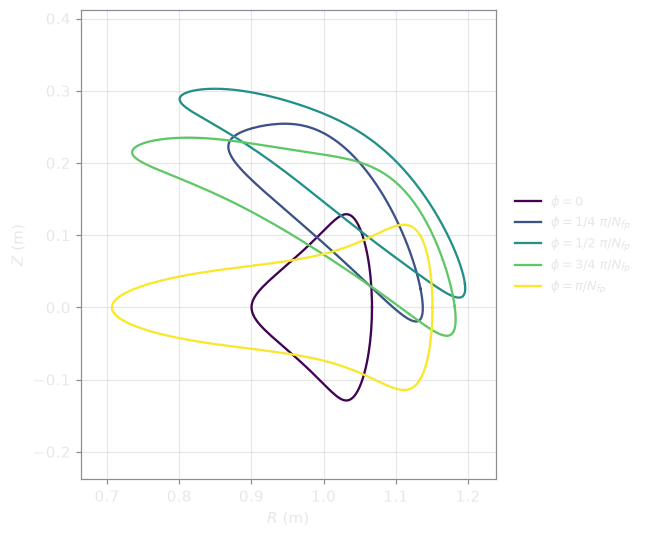
plasma.plasma.plot.boundary_sections() (or plasma_plots.coils.plot_boundary_sections, which
also takes a boundary.json directly) draws the cross-sections in the (R, Z) plane at five
toroidal angles from phi = 0 to half a field period, π / N_fp. This is the view
ConStellaration uses for its boundaries. For a stellarator-symmetric surface these angles show
every shape it takes. Here is the example boundary of the ConStellaration benchmark
(hugging_face_competition/inputs/boundary.json in the
constellaration repository, four field
periods, kept in scripts/data):
import json
from plasma_plots.coils import plot_boundary_sections
boundary = json.loads(open("constellaration_boundary.json").read())plot_boundary_sections(boundary)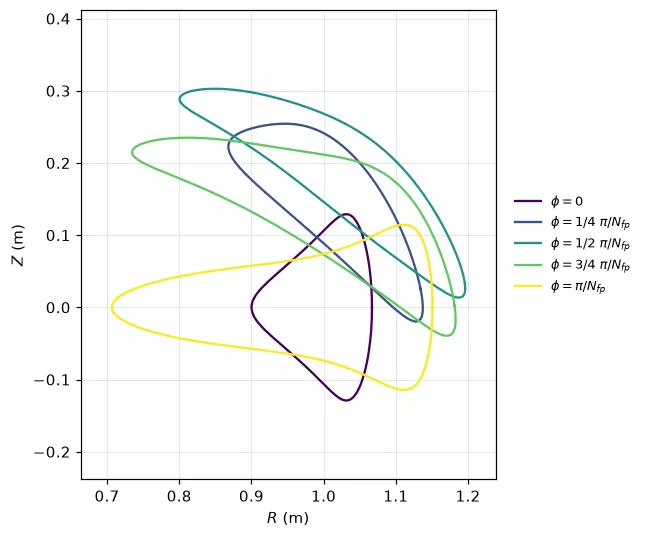
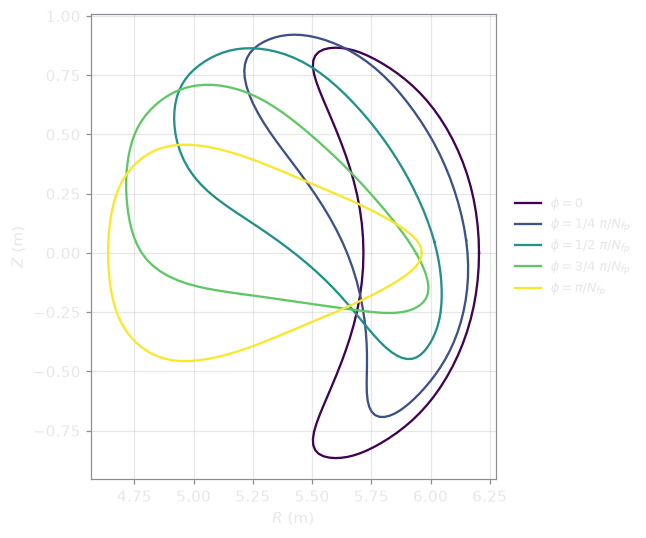
The same for W7-X’s last surface, through from_boundary, at the Dataset’s nearest angles:
plasma.plasma.plot.boundary_sections(planes=5)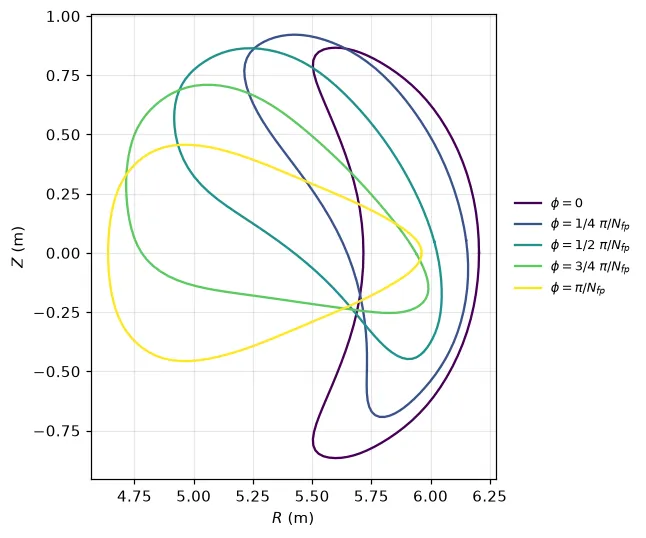
plasma_plots.coils.boundary_from_desc(eq) goes the other way: it writes the last surface of any
stellarator-symmetric DESC equilibrium as a ConStellaration boundary.json, exact to round-off.
The figures below use it on DESC’s W7-X example.
Distances, curvature and field error
Section titled “Distances, curvature and field error”The benchmark scores a coilset by four metrics. Three of them are geometry, and plasma-plots gives them at every point of every coil, so they can be plotted where they are reached:
a = plasma.attrs["minor_radius"]coils["plasma_distance"] = distance_to_surface(coils, plasma) / acoils["coil_distance"] = coil_to_coil_distance(coils) / a
float(coils.curvature.max()) * a  # normalized_coil_curvatures/max# normalized_coil_to_plasma_min_distances/minfloat(coils.plasma_distance.min())float(coils.coil_distance.min())  # normalized_coil_to_coil_min_distances/min
Both distances are taken between sampled points, so they converge from above as the grids are
refined (n_points of the coils, theta and zeta of the surface). The fourth metric, the field
error |B·n| / |B| on the plasma, needs the field of the coils; DESC computes it:
import numpy as npimport xarray as xrfrom desc.grid import LinearGrid
surface = plasma_plots.from_desc(    eq,    "n_rho",    rho=[1.0],    theta=64,    zeta=np.linspace(0, 2 * np.pi, 240, endpoint=False),)points = np.stack([surface[axis].values.ravel() for axis in "XYZ"], axis=-1)B = desc_coils.compute_magnetic_field(    points, basis="xyz", source_grid=LinearGrid(N=64))n = surface.n_rho  # the unit normal, Cartesian components along "component"B = xr.DataArray(    np.asarray(B).T.reshape(n.shape), dims=n.dims, coords=n.coords)field_error = abs((B * n).sum("component")) / np.sqrt((B**2).sum("component"))
The figures on this page use two coilsets around DESC’s W7-X example, five coils per half
period. These are not W7-X’s real coils. The first is a starting set
(desc.coils.initialize_modular_coils): identical circles around the magnetic axis, each in
the plane normal to the axis. A coil optimization begins from coils like these, so their field
error is large. The second is what a short DESC optimization makes of them: fifteen iterations
against the field error, with bounds on the curvature (bends no sharper than the minor radius),
the length and the distances to the plasma and between coils. The coils become non-planar, like
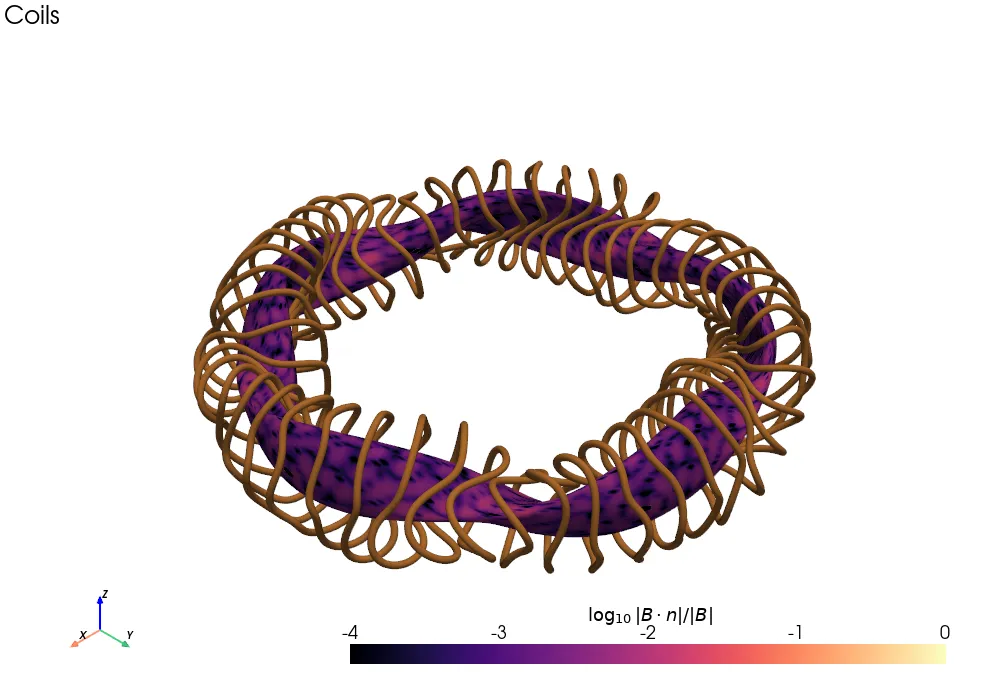
W7-X’s own, and the field error drops by a factor of about fifty. A longer optimization, or
CoilStellaration’s REGCOIL and DESC pipeline, goes further. The numbers, from the script at the end
of the page:
minor radius a from from_boundary (m)    0.505871
minor radius a, DESC's own (m)           0.505871
coils (unique, all)                      5, 50
                                         start      optimized
max curvature * a                        0.400000   1.047760
min coil-plasma distance / a             0.664068   0.826273
min coil-coil distance / a               0.720231   0.322098
mean field error |B.n|/|B|               0.118429   0.002461
max field error |B.n|/|B|                0.348287   0.014992
In 3-D
Section titled “In 3-D”coils.plasma.plot.coils_3d() (or plasma_plots.pyvista_plots.pyvista_coils) draws the coils as
tubes. color_by takes any variable over coil or (coil, s), and surface the plasma: a
Dataset such as from_boundary’s is drawn in grey, a DataArray colored by its values
(surface_clim fixes its color limits, to compare scenes).
The first scene shows the starting coils, and they are circles on purpose. A coil
optimization needs a first guess, and the simplest one is a ring of identical planar circles
around the magnetic axis, each in the plane normal to the axis there. DESC’s
initialize_modular_coils makes exactly that, and the optimization below starts from it.
Circles ignore the plasma’s shape, so the field they make is not tangent to W7-X’s surface: the
field error averages 12 % and reaches 35 %. Their field error on W7-X’s last surface,
on a logarithmic scale:
log_error = np.log10(field_error)coils.plasma.plot.coils_3d( surface=log_error, surface_cmap="magma", surface_clim=(-4, 0)).show()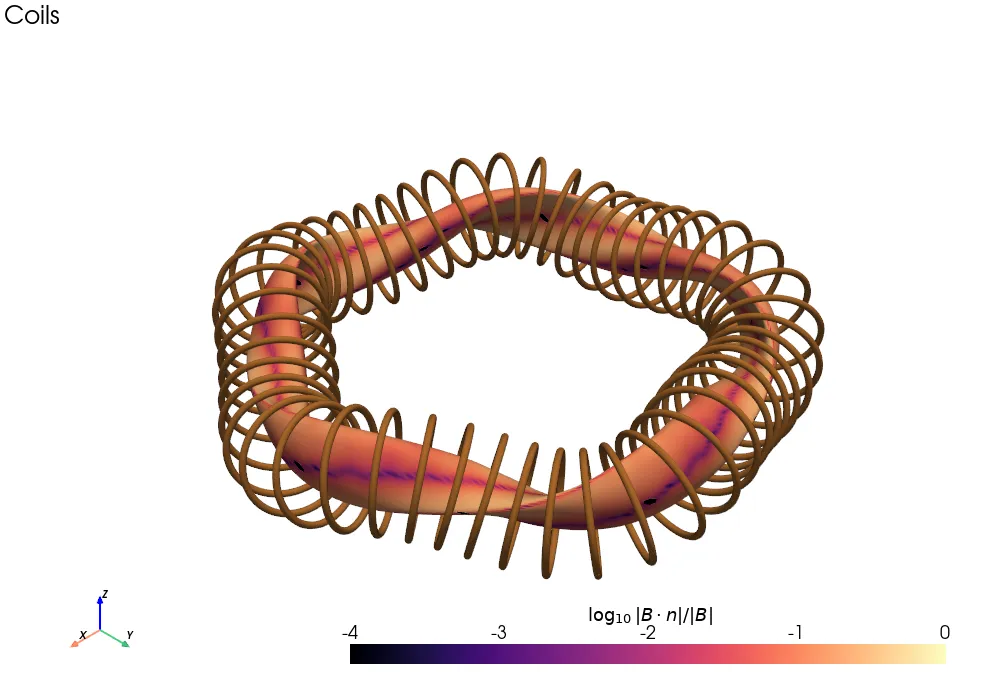
The optimized coils, on the same scale: after fifteen iterations they bend around the plasma, and the field error falls to 0.25 % on average (dark purple):
Two quantities in one scene, each with its own color bar: the optimized coils colored by their
distance to the plasma in minor radii, and the plasma by the field error. With both color_by
and a DataArray surface, the two color bars stand on either side:
coils.plasma.plot.coils_3d( color_by="plasma_distance", surface=log_error, surface_cmap="magma", surface_clim=(-4, 0),).show()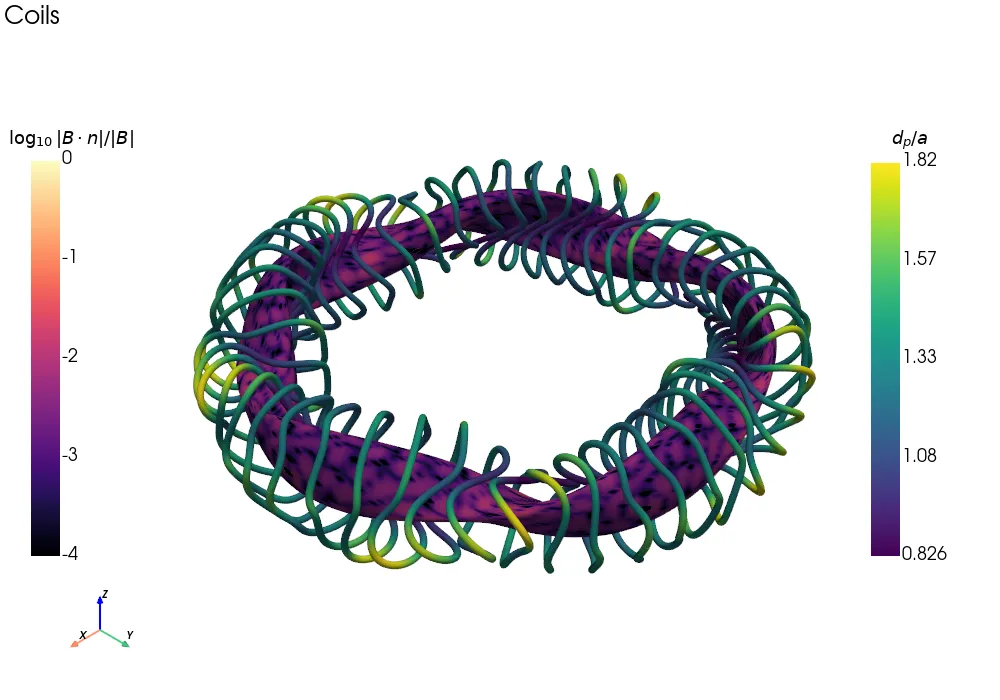
The interactive scenes leave out the color bars (vtk.js would label them 0 to 255); the pictures have them.
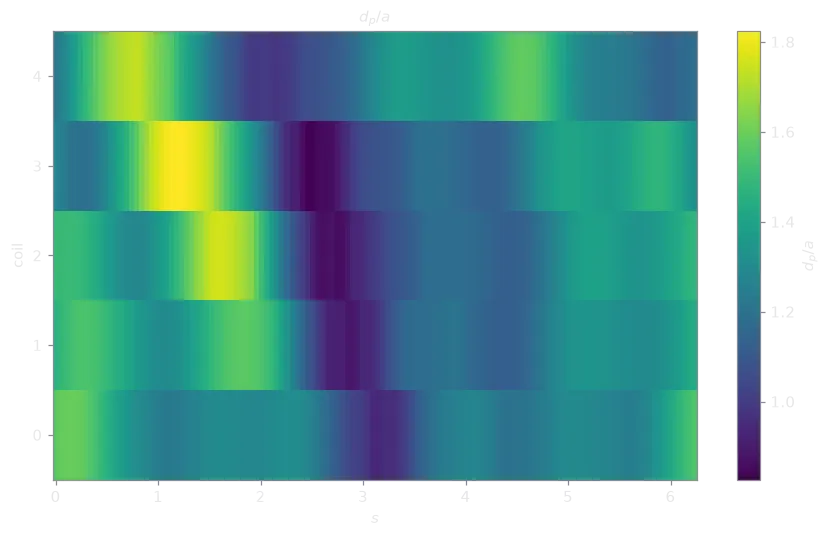
The same along the five unique optimized coils, as a map over s:
unique = coils.isel(coil=slice(0, 5))unique.plasma_distance.plasma.plot.slice(x="s", y="coil")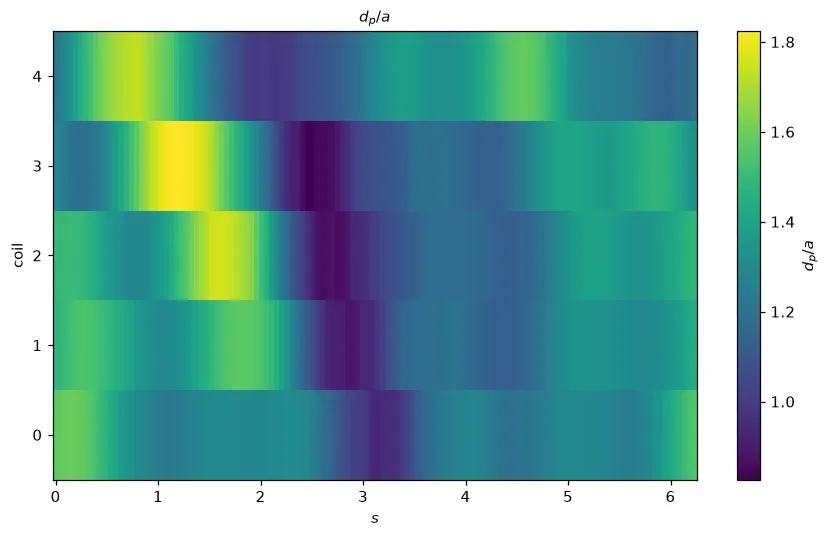
A coilset from CoilStellaration
Section titled “A coilset from CoilStellaration”A real coilset of the dataset, fetched as above and kept in
scripts/data: the DESC-optimized coilset of one benchmark instance of the eval split, in the
fixed_shape track (three field periods, five coils per half period) and the tight stratum, the
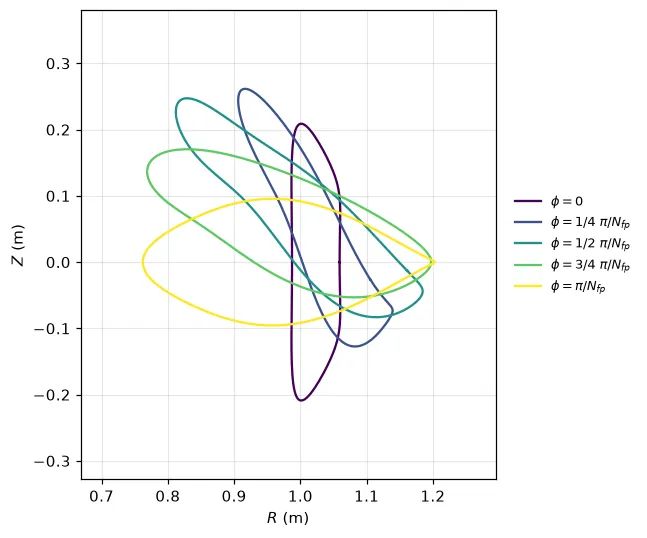
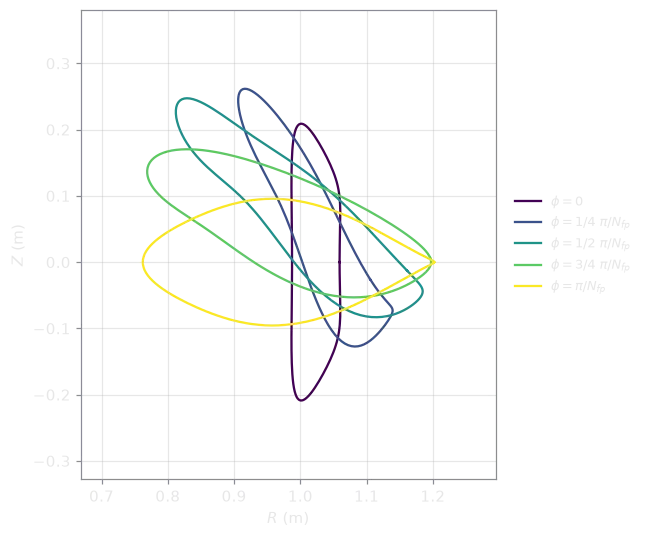
third of the instances with the smallest field error. Its plasma is a ConStellaration boundary,
in five cross-sections over half a field period:
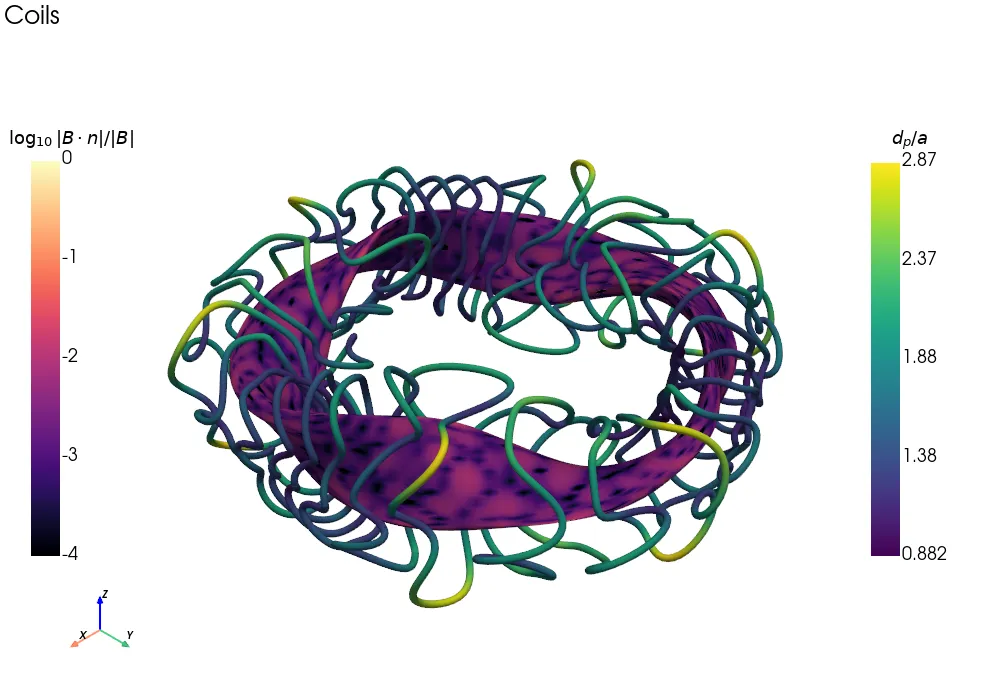
The coils colored by their distance to the plasma, the plasma by the field error, on the same
scale as the W7-X coils above. The field error comes from DESC’s Biot-Savart field of the coils
on from_boundary’s surface, with the normal from the surface points. The dataset’s coils wind
far more than the fifteen-iteration W7-X coils above: they are what a full REGCOIL and DESC
optimization makes to meet tight targets on the field error and the distances.
The dataset’s metrics of the coilset next to plasma-plots’ own. The geometric ones agree to a few percent; they are sampled on different grids, and the dataset measures from DESC’s equilibrium of the boundary. The mean field error depends on how the surface is sampled: here uniformly in the boundary’s own angles.
boundary (ConStellaration)               D2CGds64NiqPgdkgrt8MqV5
coilset (CoilStellaration, DESC)         D8g9wcixnhFsjJTS38bbdxi
field periods, coils per half period     3, 5
minor radius a from from_boundary (m)    0.114350
                                         dataset    here
max curvature * a                        3.994332   4.113694
min coil-plasma distance / a             0.859758   0.882338
min coil-coil distance / a               0.632782   0.634977
mean field error |B.n|/|B|               0.002736   0.002893
The script behind this page
Section titled “The script behind this page”It builds the coilsets and the boundary, runs the optimization, computes the metrics and writes
every figure above, in about two minutes. The CoilStellaration sample comes from
scripts/data, so the script downloads nothing.
scripts/generate_coil_figures.py, unedited
"""Generate the figures of the "Stellarator coils" guide (docs/src/assets/figures/coils_*).

The guide is about coilsets in the layout of the CoilStellaration dataset and plasma boundaries
in the layout of ConStellaration. So that the docs build needs no download, the coilsets here
are made by DESC itself around its W7-X example: circular planar coils
(``desc.coils.initialize_modular_coils``, converted to ``FourierXYZCoil``), the start of a coil
optimization, and what a short DESC optimization makes of them (fifteen iterations against the
field error, with bounds on the curvature, the length and the distances, the kinds of
CoilStellaration's DESC stage; about a minute and a half on four cores). Both go through the
same functions as a coilset from the dataset: written out in the dataset's layout, read back
with ``plasma_plots.from_coilset``; the boundary goes through ``boundary_from_desc`` and
``plasma_plots.from_boundary``. The field error on the plasma (the benchmark's first metric)
comes from DESC's Biot-Savart field of the coils. It needs ``pip install desc-opt`` and PyVista
(see .github/workflows/docs.yml). The cross-sections also draw ConStellaration's example
boundary, and the last section a real CoilStellaration coilset with its boundary, all kept in
scripts/data (see the .md files there; scripts/fetch_coilstellaration_sample.py fetched the
coilset), so this script downloads nothing.

Run from the repo root: python scripts/generate_coil_figures.py (or: make figures).
"""

from __future__ import annotations

import json
import sys
import warnings
from pathlib import Path

import matplotlib

matplotlib.use("Agg")

import desc.examples
import matplotlib.pyplot as plt
import numpy as np
import xarray as xr
from desc.coils import CoilSet, FourierXYZCoil, initialize_modular_coils
from desc.grid import LinearGrid
from desc.objectives import (
    CoilCurvature,
    CoilLength,
    CoilSetMinDistance,
    FixCoilCurrent,
    ObjectiveFunction,
    PlasmaCoilSetMinDistance,
    QuadraticFlux,
)
from desc.optimize import Optimizer

sys.path.insert(0, str(Path(__file__).resolve().parents[1] / "src"))
import plasma_plots  # noqa: E402
from plasma_plots.coils import (  # noqa: E402
    boundary_from_desc,
    coil_to_coil_distance,
    distance_to_surface,
    plot_boundary_sections,
)
from plasma_plots.plotting import save_figure  # noqa: E402

warnings.filterwarnings("ignore", module="desc")

ROOT = Path(__file__).resolve().parents[1]
DOCS = ROOT / "docs"
OUT = DOCS / "src" / "assets" / "figures"
NUMBERS = DOCS / "src" / "assets" / "coils" / "numbers.txt"
SAMPLE_NUMBERS = NUMBERS.with_name("coilstellaration_numbers.txt")
DATA = ROOT / "scripts" / "data"
PYVISTA_OUT = DOCS / "public" / "pyvista"
for folder in (OUT, NUMBERS.parent, PYVISTA_OUT):
    folder.mkdir(parents=True, exist_ok=True)


def save(result, filename):
    """Save a figure with a dark variant ``<stem>.dark.<ext>`` for the theme's dark mode."""
    stem, ext = str(filename).rsplit(".", 1)
    for path in save_figure(result, OUT / stem, formats=(ext,), dark=True):
        print(f"wrote {path}")
    plt.close(result.fig)


# =============================================================================
# Coilsets and a boundary in the datasets' layouts
# =============================================================================
with warnings.catch_warnings():
    warnings.simplefilter("ignore")
    w7x = desc.examples.get("W7-X")
a_desc = float(w7x.compute("a")["a"])

# circles around the magnetic axis, five per half period; N=4 leaves the optimizer room
start_coils = initialize_modular_coils(
    w7x, num_coils=5, r_over_a=2.5
).to_FourierXYZ(N=4)


def optimize_coils(coils, maxiter=15):
    """A short DESC coil optimization: the field error, with the benchmark's kinds of bounds."""
    coil_grid = LinearGrid(N=24)
    plasma_grid = LinearGrid(M=12, N=12, NFP=w7x.NFP, sym=w7x.sym)
    length = float(np.mean(coils.compute("length")[0]["length"]))
    absolute = {"normalize": False, "normalize_target": False}
    objective = ObjectiveFunction(
        (
            QuadraticFlux(
                w7x,
                coils,
                eval_grid=plasma_grid,
                field_grid=coil_grid,
                vacuum=True,
                weight=50,
            ),
            # bends no sharper than the minor radius, so the coils stay smooth
            CoilCurvature(
                coils,
                bounds=(-np.inf, 1 / a_desc),
                grid=coil_grid,
                weight=100,
                **absolute,
            ),
            CoilLength(
                coils,
                bounds=(0, 1.1 * length),
                grid=coil_grid,
                weight=10,
                **absolute,
            ),
            CoilSetMinDistance(
                coils,
                bounds=(0.4 * a_desc, np.inf),
                grid=coil_grid,
                weight=10,
                **absolute,
            ),
            PlasmaCoilSetMinDistance(
                w7x,
                coils,
                bounds=(a_desc, np.inf),
                plasma_grid=plasma_grid,
                coil_grid=coil_grid,
                eq_fixed=True,
                weight=10,
                **absolute,
            ),
        ),
        deriv_mode="batched",
        jac_chunk_size=32,  # the full Jacobian of the Biot-Savart field needs ~20 GB
    )
    (optimized,), _ = Optimizer("lsq-exact").optimize(
        coils,
        objective=objective,
        constraints=(FixCoilCurrent(coils),),
        maxiter=maxiter,
        ftol=1e-6,
        xtol=1e-8,
        verbose=1,
        copy=True,
    )
    return optimized


def as_coilset(desc_coils):
    """A row of CoilStellaration's "coilsets" subset holds this dict as JSON."""
    return {
        "coil_x_n": [np.asarray(c.X_n).tolist() for c in desc_coils.coils],
        "coil_y_n": [np.asarray(c.Y_n).tolist() for c in desc_coils.coils],
        "coil_z_n": [np.asarray(c.Z_n).tolist() for c in desc_coils.coils],
        "currents": [float(c.current) for c in desc_coils.coils],
        "n_field_periods": int(desc_coils.NFP),
        "is_stellarator_symmetric": bool(desc_coils.sym),
    }


optimized_coils = optimize_coils(start_coils)
coilsets = {
    "start": as_coilset(start_coils),
    "optimized": as_coilset(optimized_coils),
}
# and ConStellaration's "boundary.json" this one
boundary = boundary_from_desc(w7x)
plasma = plasma_plots.from_boundary(json.dumps(boundary), theta=96)
a = plasma.attrs["minor_radius"]

# =============================================================================
# The benchmark's metrics
# =============================================================================
# the field error |B.n| / |B| on the plasma, with DESC's field of the coils
surface = plasma_plots.from_desc(
    w7x,
    "n_rho",
    rho=[1.0],
    theta=64,
    zeta=np.linspace(0, 2 * np.pi, 48 * w7x.NFP, endpoint=False),
)
points = np.stack([surface[axis].values.ravel() for axis in "XYZ"], axis=-1)
n = surface.n_rho  # the unit normal, Cartesian components along "component"


def field_error_of(desc_coils):
    B = np.asarray(
        desc_coils.compute_magnetic_field(
            points, basis="xyz", source_grid=LinearGrid(N=64)
        )
    )
    B = xr.DataArray(B.T.reshape(n.shape), dims=n.dims, coords=n.coords)
    error = abs((B * n).sum("component")) / np.sqrt((B**2).sum("component"))
    error.attrs = {"label": r"$|B \cdot n| / |B|$", "units": "1"}
    return error


coils, field_error = {}, {}
for name, desc_coils in (
    ("start", start_coils),
    ("optimized", optimized_coils),
):
    ds = plasma_plots.from_coilset(json.dumps(coilsets[name]), n_points=128)
    ds["plasma_distance"] = distance_to_surface(ds, plasma) / a
    ds["plasma_distance"].attrs.update(label="$d_p / a$", units="1")
    ds["coil_distance"] = coil_to_coil_distance(ds) / a
    ds["coil_distance"].attrs.update(label="$d_c / a$", units="1")
    coils[name] = ds
    field_error[name] = field_error_of(desc_coils)
print(coils["optimized"])

rows = [
    ("minor radius a from from_boundary (m)", a),
    ("minor radius a, DESC's own (m)", a_desc),
    (
        "coils (unique, all)",
        f"{len(coilsets['start']['currents'])}, {coils['start'].sizes['coil']}",
    ),
    ("", "start      optimized"),
]
for label, metric in (
    ("max curvature * a", lambda c, e: float(c.curvature.max()) * a),
    (
        "min coil-plasma distance / a",
        lambda c, e: float(c.plasma_distance.min()),
    ),
    ("min coil-coil distance / a", lambda c, e: float(c.coil_distance.min())),
    ("mean field error |B.n|/|B|", lambda c, e: float(e.mean())),
    ("max field error |B.n|/|B|", lambda c, e: float(e.max())),
):
    values = [metric(coils[k], field_error[k]) for k in ("start", "optimized")]
    rows.append((label, "   ".join(f"{v:.6f}" for v in values)))
NUMBERS.write_text(
    "".join(
        f"{label:<40} {value:.6f}\n"
        if isinstance(value, float)
        else f"{label:<40} {value}\n"
        for label, value in rows
    )
)
print(NUMBERS.read_text())

# =============================================================================
# Metrics along the coils (Matplotlib)
# =============================================================================
unique = coils["optimized"].isel(
    coil=slice(0, len(coilsets["optimized"]["currents"]))
)
save(
    unique.plasma_distance.plasma.plot.slice(x="s", y="coil"),
    "coils_plasma_distance_map.png",
)

# =============================================================================
# Cross-sections of boundaries (Matplotlib)
# =============================================================================
# ConStellaration's example boundary (scripts/data/constellaration_boundary.md), and W7-X's
constellaration_boundary = json.loads(
    (DATA / "constellaration_boundary.json").read_text()
)
save(
    plot_boundary_sections(constellaration_boundary),
    "coils_boundary_sections.png",
)
save(plasma.plasma.plot.boundary_sections(planes=5), "coils_w7x_sections.png")

# =============================================================================
# A coilset from CoilStellaration
# =============================================================================
# a DESC-optimized coilset of the benchmark and its ConStellaration boundary, fetched once by
# scripts/fetch_coilstellaration_sample.py (see scripts/data/coilstellaration_sample.md)
sample_meta = json.loads((DATA / "coilstellaration_sample.json").read_text())
sample_coilset = json.loads(
    (DATA / "coilstellaration_coilset.json").read_text()
)
sample_boundary = json.loads(
    (DATA / "coilstellaration_boundary.json").read_text()
)
sample = plasma_plots.from_coilset(sample_coilset, n_points=128)
sample_plasma = plasma_plots.from_boundary(sample_boundary, theta=96)
a_sample = sample_plasma.attrs["minor_radius"]
sample["plasma_distance"] = (
    distance_to_surface(sample, sample_plasma) / a_sample
)
sample["plasma_distance"].attrs.update(label="$d_p / a$", units="1")
sample["coil_distance"] = coil_to_coil_distance(sample) / a_sample

# the field error on the boundary; its normal from central differences over the whole torus
error_grid = plasma_plots.from_boundary(
    sample_boundary,
    theta=64,
    zeta=np.linspace(
        0, 2 * np.pi, 48 * sample_coilset["n_field_periods"], endpoint=False
    ),
)
xyz = np.stack([error_grid[axis].values[0] for axis in "XYZ"], axis=-1)
tangents = [np.roll(xyz, -1, axis) - np.roll(xyz, 1, axis) for axis in (0, 1)]
normal = np.cross(*tangents)
normal /= np.linalg.norm(normal, axis=-1, keepdims=True)
sample_desc = CoilSet(
    [
        FourierXYZCoil(current=current, X_n=x_n, Y_n=y_n, Z_n=z_n)
        for x_n, y_n, z_n, current in zip(
            sample_coilset["coil_x_n"],
            sample_coilset["coil_y_n"],
            sample_coilset["coil_z_n"],
            sample_coilset["currents"],
        )
    ],
    NFP=sample_coilset["n_field_periods"],
    sym=sample_coilset["is_stellarator_symmetric"],
)
B_sample = np.asarray(
    sample_desc.compute_magnetic_field(
        xyz.reshape(-1, 3), basis="xyz", source_grid=LinearGrid(N=64)
    )
).reshape(xyz.shape)
sample_error = xr.DataArray(
    np.abs((B_sample * normal).sum(-1)) / np.linalg.norm(B_sample, axis=-1),
    dims=("theta", "zeta"),
    coords={"theta": error_grid.theta, "zeta": error_grid.zeta},
).expand_dims(rho=error_grid.rho)
for axis in "XYZ":
    sample_error.coords[axis] = error_grid[axis]

rows = [
    ("boundary (ConStellaration)", sample_meta["constellaration_boundary_id"]),
    ("coilset (CoilStellaration, DESC)", sample_meta["desc_coilset_id"]),
    (
        "field periods, coils per half period",
        f"{sample_meta['n_field_periods']}, {sample_meta['n_coils_per_half_period']}",
    ),
    ("minor radius a from from_boundary (m)", f"{a_sample:.6f}"),
    ("", "dataset    here"),
]
for label, key, value in (
    (
        "max curvature * a",
        "desc_metrics/normalized_coil_curvatures/max",
        float(sample.curvature.max()) * a_sample,
    ),
    (
        "min coil-plasma distance / a",
        "desc_metrics/normalized_coil_to_plasma_min_distances/min",
        float(sample.plasma_distance.min()),
    ),
    (
        "min coil-coil distance / a",
        "desc_metrics/normalized_coil_to_coil_min_distances/min",
        float(sample.coil_distance.min()),
    ),
    (
        "mean field error |B.n|/|B|",
        "desc_metrics/normalized_field_error/mean",
        float(sample_error.mean()),
    ),
):
    rows.append((label, f"{sample_meta[key]:.6f}   {value:.6f}"))
SAMPLE_NUMBERS.write_text(
    "".join(f"{label:<40} {value}\n" for label, value in rows)
)
print(SAMPLE_NUMBERS.read_text())
save(plot_boundary_sections(sample_boundary), "coils_sample_sections.png")

# =============================================================================
# Interactive 3-D: the coils around the plasma
# =============================================================================
try:
    import pyvista as pv

    pv.OFF_SCREEN = True

    def shot(plotter, filename, *, zoom=1.0):
        plotter.camera_position = "iso"
        plotter.camera.zoom(zoom)
        plotter.screenshot(str(OUT / filename), window_size=[1000, 700])
        print(f"wrote {OUT / filename}")
        html = PYVISTA_OUT / filename.replace(".png", ".html")
        # vtk.js would show them 0-255
        for title in list(plotter.scalar_bars.keys()):
            plotter.remove_scalar_bar(title)
        try:
            plotter.trame.export_html(str(html))
            print(f"wrote {html}")
        except Exception as exc:  # needs trame-pyvista
            print(
                f"skipped {html.name} (interactive export unavailable): {exc}"
            )
        plotter.close()

    # one logarithmic color scale for both, so the two field errors compare
    log_error = {
        name: np.log10(error).assign_attrs(
            label=r"$\log_{10} |B \cdot n| / |B|$", units="1"
        )
        for name, error in field_error.items()
    }
    clim = (-4.0, 0.0)  # 1e-4 to 1; the error passes through zero along lines
    for name, filename in (
        ("start", "coils_3d_field_error.png"),
        ("optimized", "coils_3d_field_error_optimized.png"),
    ):
        shot(
            coils[name].plasma.plot.coils_3d(
                surface=log_error[name],
                surface_cmap="magma",
                surface_clim=clim,
            ),
            filename,
            zoom=1.3,
        )
    # two color bars: the coils by their distance to the plasma, the plasma by the field error
    shot(
        coils["optimized"].plasma.plot.coils_3d(
            color_by="plasma_distance",
            cmap="viridis",
            surface=log_error["optimized"],
            surface_cmap="magma",
            surface_clim=clim,
        ),
        "coils_3d_distance.png",
        zoom=1.3,
    )
    shot(
        sample.plasma.plot.coils_3d(
            color_by="plasma_distance",
            surface=np.log10(sample_error).assign_attrs(
                label=r"$\log_{10} |B \cdot n| / |B|$", units="1"
            ),
            surface_cmap="magma",
            surface_clim=clim,
        ),
        "coils_3d_coilstellaration.png",
        zoom=1.3,
    )
except ImportError as exc:  # pragma: no cover - optional
    print(f"skipped the 3-D views (pyvista unavailable): {exc}")