TikZ tokens
Arrow tips, fill patterns, plot marks, node shapes, path decorations and styles are
short TikZ strings such as -stealth or crosshatch. tikzfigure gives each kind a
small type, all built on TikzToken: named constants for the common values, a
function for any other, and the same behavior for all of them. Plain strings keep
working everywhere a token is accepted.
from tikzfigure import TikzFigure, arrows, decorations, marks, patterns, shapes, stylesfrom tikzfigure.core.tikz_token import TikzTokenThe kinds of tokens
Section titled “The kinds of tokens”| Module | Type | Examples | Used as |
|---|---|---|---|
arrows | TikzArrow | forward, stealth, latex_both | arrows= |
patterns | TikzPattern | crosshatch, dots, north_east_lines | pattern= |
marks | TikzMark | circle, square_filled, x | mark= of a plot |
shapes | TikzShape | diamond, ellipse, star | shape= of a node |
decorations | TikzDecoration | snake, zigzag, brace | decoration= |
styles | TikzStyle | dashed, decorate, line_width(1.2) | options=[...] |
for token in ( arrows.stealth, patterns.crosshatch, marks.square_filled, shapes.diamond, decorations.snake, styles.dashed,): print( f"{type(token).__name__:15} {token.spec!r:18} a TikzToken: {isinstance(token, TikzToken)}" )TikzArrow '-stealth' a TikzToken: TrueTikzPattern 'crosshatch' a TikzToken: TrueTikzMark 'square*' a TikzToken: TrueTikzShape 'diamond' a TikzToken: TrueTikzDecoration 'snake' a TikzToken: TrueTikzStyle 'dashed' a TikzToken: TrueIn a figure
Section titled “In a figure”Some tokens need a TikZ library: shape= beyond circles and rectangles needs
shapes.geometric, patterns patterns, and decorations the matching
decorations.* library.
fig = TikzFigure()fig.usetikzlibrary("shapes.geometric", "patterns", "decorations.pathmorphing")
a = fig.add_node(    0, 0, label="a", content="A", shape=shapes.diamond, draw="black", fill="blue!20")b = fig.add_node(4, 0, label="b", content="B", shape=shapes.ellipse, draw="black")edge = fig.draw([a, b], arrows=arrows.stealth, options=[styles.line_width(1.2)])
box = fig.filldraw(    [(0, -1), (4, -1), (4, -2), (0, -2)], cycle=True, pattern=patterns.crosshatch)wave = fig.draw(    [(0, -3), (4, -3)], options=[styles.decorate], decoration=decorations.snake)corner = fig.draw(    [(0, -4), (2, -4), (2, -5)], options=[styles.dashed, styles.rounded_corners(4)])fig.show()
/home/runner/work/tikzfigure/tikzfigure/.venv/lib/python3.12/site-packages/fitz/__init__.py:17: FutureWarning: The `fitz` API is deprecated and will be removed in future. Use `import pymupdf` instead. warnings.warn(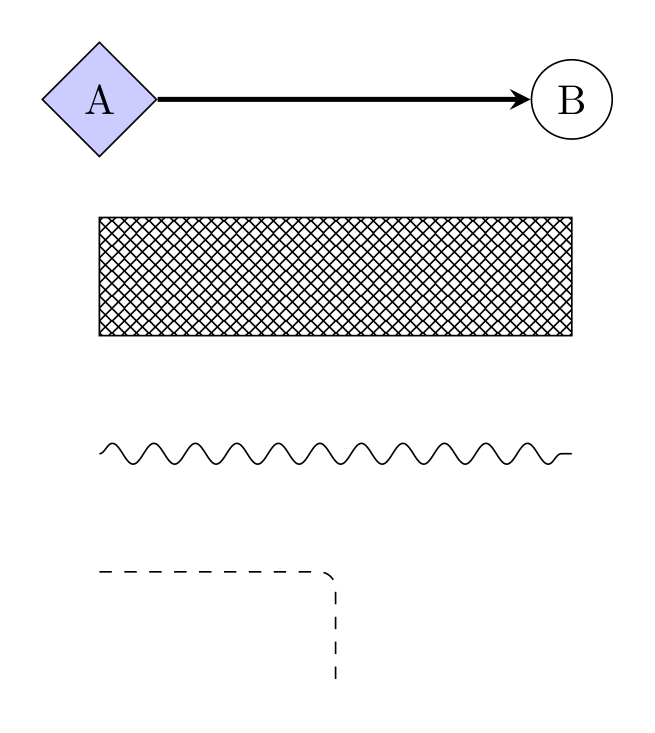
print(fig)% --------------------------------------------- %% Tikzfigure generated by tikzfigure v0.5.0 %% https://github.com/max-models/tikzfigure %% --------------------------------------------- %\begin{tikzpicture} \node[shape=diamond, fill=blue!20, draw=black] (a) at ({0}, {0}) {A}; \node[shape=ellipse, draw=black] (b) at ({4}, {0}) {B}; \draw[line width=1.2pt, -stealth] (a) to (b); \filldraw[pattern=crosshatch] (0, -1) to (4, -1) to (4, -2) to (0, -2) -- cycle; \draw[decorate, decoration=snake] (0, -3) to (4, -3); \draw[dashed, rounded corners=4pt] (0, -4) to (2, -4) to (2, -5);\end{tikzpicture}Your own values
Section titled “Your own values”Each module has a function for any other value: arrows.tip, patterns.pattern,
marks.mark, shapes.shape, decorations.decoration and styles.style. The
styles module also builds measured options: line_width, rounded_corners,
dash_pattern, bend_left and bend_right.
big_tip = arrows.tip("-{Latex[length=3mm]}")print(big_tip)print(styles.line_width(0.8), styles.dash_pattern(on=3, off=2), styles.bend_left(30))-{Latex[length=3mm]}line width=0.8pt dash pattern=on 3pt off 2pt bend left=30Comparing and reusing
Section titled “Comparing and reusing”Two tokens of the same kind are equal when their specs are, and they hash the
same, so they work as dictionary keys or in sets, for a palette of styles shared
between figures. str(token) and token.to_tikz() give the raw string.
print(arrows.forward == arrows.tip("->"))print(styles.dashed == styles.style("dashed"))print(arrows.forward == styles.style("->"))  # different kinds are never equal
line_styles = {"measured": styles.solid, "fit": styles.dashed, "theory": styles.dotted}print({name: str(style) for name, style in line_styles.items()})TrueTrueFalse{'measured': 'solid', 'fit': 'dashed', 'theory': 'dotted'}