Stellarator wall
A first wall around a stellarator plasma as a 3D surface, and where straight lines meet it:
neutral-beam markers entering the plasma, and their shine-through reaching the wall.
FourierSurface holds a toroidal surface in VMEC’s and ConStellaration’s SurfaceRZFourier
layout, FourierSurface.offset builds a wall at a given distance outside a plasma boundary,
and first_hit finds the first crossing of many segments at once.
The search runs on a triangulation of the surface with a compiled kernel (a grid of cells, Möller–Trumbore in the cells each segment passes), and every hit is then moved onto the exact Fourier surface by Newton steps.
A W7-X-shaped stand-in
Section titled “A W7-X-shaped stand-in”simgeometry.data.w7x_boundary() is the plasma boundary of DESC’s W7-X example equilibrium
(standard configuration, five field periods). W7-X’s real first wall (heat shield, baffles,
divertor targets, NBI armour) is IPP’s CAD and not public, so w7x_like_wall stands in for it:
the boundary moved outward along its normal by a uniform gap of 10 cm. The gap is a round
number, not a W7-X value, and there are no ports. A real wall would be loaded as a triangle mesh
with TriangleMesh.read, with the same queries.
import numpy as np
from simgeometry.data import w7x_boundary, w7x_like_wall
plasma = w7x_boundary()wall = w7x_like_wall(gap=0.10)print(    f"plasma: M = {plasma.n_poloidal}, N = {plasma.n_toroidal}, V = {plasma.volume():.2f} m^3")print(    f"wall:   M = {wall.n_poloidal}, N = {wall.n_toroidal}, V = {wall.volume():.2f} m^3")print(f"offset misfit: {1e3 * wall.offset_residual:.2f} mm")print(    f"{wall.mesh.n_faces} triangles, within {1e3 * wall.triangulation_error:.1f} mm "    "of the surface")
plasma: M = 12, N = 12, V = 27.85 m^3wall: M = 24, N = 12, V = 42.47 m^3offset misfit: 0.83 mm81920 triangles, within 4.3 mm of the surfaceoffset moves every point of a fine grid along the outward normal and fits the moved
surface again as a Fourier series, with the fewest modes that keep the misfit below a
hundredth of the gap. closest (Newton steps on the distance) checks the result: the gap
holds to the misfit everywhere.
theta, phi = np.meshgrid( np.linspace(0, 2 * np.pi, 96, endpoint=False), np.linspace(0, 2 * np.pi / 5, 24, endpoint=False),)_, _, gap = plasma.closest(wall.point(theta, phi))print(f"gap from {1e3 * gap.min():.2f} mm to {1e3 * gap.max():.2f} mm")assert np.allclose(gap, 0.10, atol=2e-3)gap from 99.31 mm to 100.57 mmCross-sections
Section titled “Cross-sections”The plasma boundary and the wall at three toroidal angles of a field period: the bean-shaped section at , the triangular one at half a period, and one between.
import matplotlib.pyplot as plt
angles = np.linspace(0, 2 * np.pi, 400)fig, axes = plt.subplots(1, 3, figsize=(10, 4), sharey=True)for ax, fraction in zip(axes, (0.0, 0.25, 0.5)):    phi0 = fraction * 2 * np.pi / 5    for surface, label in ((plasma, "plasma boundary"), (wall, "wall (stand-in)")):        r, z = surface.rz(angles, phi0)        ax.plot(r, z, label=label)    ax.set_aspect("equal")    ax.set_title(f"$\\varphi$ = {np.degrees(phi0):.0f}°")    ax.set_xlabel("R [m]")axes[0].set_ylabel("Z [m]")axes[0].legend(loc="lower left", fontsize=8)plt.show()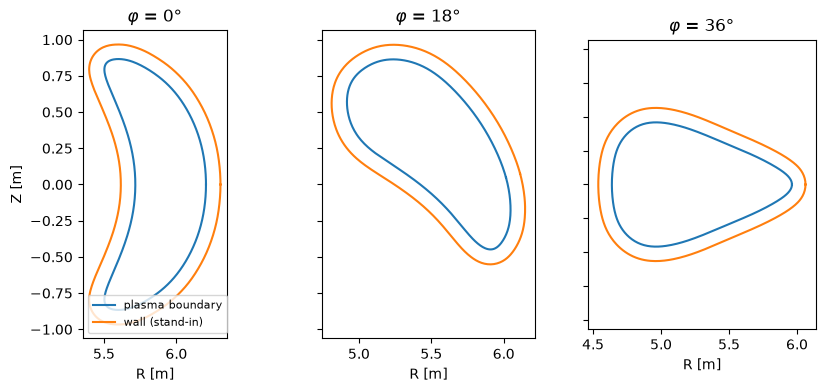
Lines through the vessel
Section titled “Lines through the vessel”A fan of horizontal lines starts 2 cm inside the wall at the outboard midplane, as from a
port, and aims at tangency radii from 4.6 m to 6 m. On the plasma, first_hit gives where
each line enters it; on the wall, where it leaves the vessel: the spot that the shine-through
heats. Points and segments are (..., 3) arrays, as freeofcharge keeps its markers. The
length inside the plasma comes from inside_at on points along the lines.
r_start = float(wall.rz(0.0, 0.0)[0]) - 0.02tangency = np.linspace(4.6, 6.0, 8)beta = np.arcsin(tangency / r_start)direction = np.stack((-np.cos(beta), np.sin(beta), np.zeros_like(beta)), axis=1)start = np.broadcast_to([r_start, 0.0, 0.0], direction.shape)end = start + 14.0 * direction
entry = plasma.first_hit(start, end)spot = wall.first_hit(start, end)assert spot.hit.all() and spot.refined.all()
s = np.linspace(0.0, 14.0, 2801)inside = plasma.inside_at(start[:, None, :] + s[None, :, None] * direction[:, None, :])path = np.asarray(inside).sum(axis=1) * (s[1] - s[0])
print("R_t [m]  plasma entry [m]  in plasma [m]  wall hit [m]  phi [deg]  theta [deg]")for i, r_t in enumerate(tangency):    first = f"{entry.distance[i]:16.3f}" if entry.hit[i] else f"{'missed':>16}"    print(        f"{r_t:6.2f} {first} {path[i]:14.2f} {spot.distance[i]:13.3f}"        f" {np.degrees(spot.phi[i]):10.1f} {np.degrees(spot.theta[i]):12.1f}"    )
R_t [m] plasma entry [m] in plasma [m] wall hit [m] phi [deg] theta [deg] 4.60 0.119 2.27 1.205 9.2 156.5 4.80 0.126 3.66 1.379 11.0 152.0 5.00 0.135 4.54 5.241 53.3 217.9 5.20 0.147 6.23 7.079 68.5 358.4 5.40 0.163 5.87 6.313 60.6 354.5 5.60 0.186 4.66 5.224 49.9 354.4 5.80 0.225 3.58 4.172 39.5 356.4 6.00 0.313 1.79 2.705 25.2 4.9SurfaceHits also gives the outward normal at each hit (here the exact surface’s) and
the triangle of the search (face). The angle between line and normal sets how the
shine-through power spreads on the wall.
incidence = np.degrees(np.arccos(np.abs(np.sum(spot.normal * direction, axis=1))))print("angle of incidence on the wall [deg]:", np.round(incidence, 1))angle of incidence on the wall [deg]: [69.1 76.3 78.3 57.6 67.4 73.3 72.7 80.4]Top view
Section titled “Top view”The outlines of the plasma and the wall in the plane (from their inside tests on a grid), the lines, where they enter the plasma and where they hit the wall.
x, y = np.meshgrid(np.linspace(-6.6, 6.6, 500), np.linspace(-6.6, 6.6, 500))plane = np.stack((x, y, np.zeros_like(x)), axis=-1)fig, ax = plt.subplots(figsize=(6, 6))for surface, color in ((plasma, "C0"), (wall, "C1")): inside = np.asarray(surface.inside_at(plane), dtype=float) ax.contour(x, y, inside, levels=[0.5], colors=color)for i in range(len(tangency)): ax.plot( [start[i, 0], spot.point[i, 0]], [start[i, 1], spot.point[i, 1]], "0.5", lw=0.8 )ax.scatter( *entry.point[entry.hit, :2].T, color="C2", s=14, zorder=3, label="plasma entry")ax.scatter(*spot.point[:, :2].T, color="C3", s=14, zorder=3, label="wall hit")ax.plot([], [], "C0", label="plasma boundary")ax.plot([], [], "C1", label="wall (stand-in)")ax.set_aspect("equal")ax.set_xlabel("x [m]")ax.set_ylabel("y [m]")ax.legend(loc="center", fontsize=8)ax.set_title("Lines from the outboard midplane, z = 0")plt.show()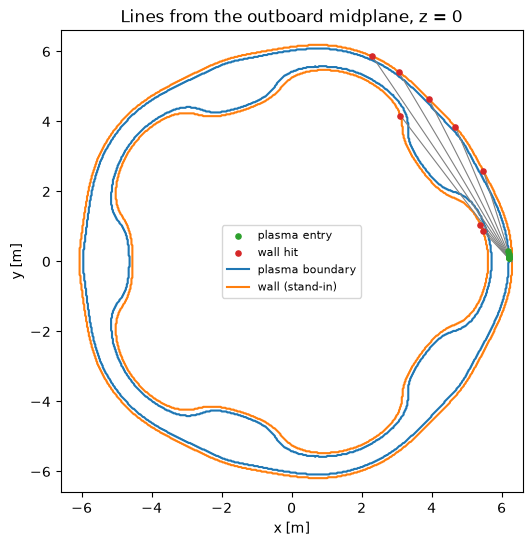
show_3d draws the triangulation; a coarser one keeps the figure light. The hits are drawn
with their normals.
from simgeometry import FourierSurface
coarse = FourierSurface(wall.r_cos, wall.z_sin, wall.nfp, resolution=(24, 12))ax = coarse.show_3d(    display=False,    opacity=0.15,    show_bounds=False,    points={        "plasma entry": entry.point[entry.hit].T,        "wall hit": {"points": spot.point.T, "vectors": spot.normal.T},    },)ax.view_init(elev=40, azim=-60)ax.set_title("Stand-in wall with the wall hits and their normals")plt.show()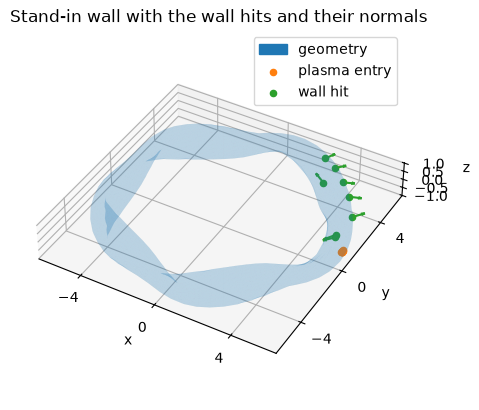
Accuracy and speed
Section titled “Accuracy and speed”- Whether a segment hits is decided by the triangles: within
triangulation_error(here about 4 mm) of the surface, a grazing line may hit the triangles but not the surface or the other way round. Raiseresolutionto shrink it, quadratically in the spacing. - The hits are then exact for the Fourier surface: against the closed form of a circular
torus, to m (see the tests). With
refine=Falsethey stay on the triangles. - The compiled search takes about 0.1–0.2 s for lines against triangles on one core; the Newton steps onto the surface cost a few seconds more for hits with the wall’s several hundred modes. The inside test takes about 0.1 s for points.