Examples
Run these notebooks to explore simgeometry with real grids and shapes. Each page includes its source notebook for download.
-
Grids and coordinates explains node locations, masks, and periodic axes.
-
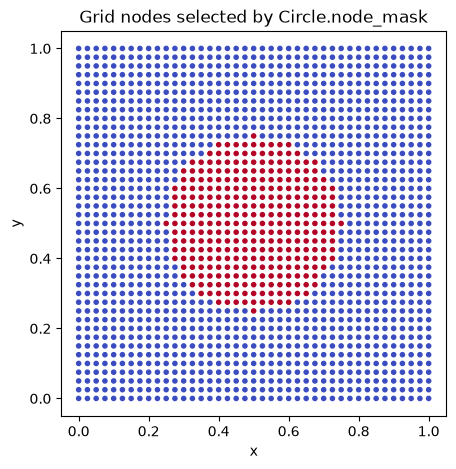
Shapes and node masks selects grid nodes, tests point batches, and plots a circle.
-
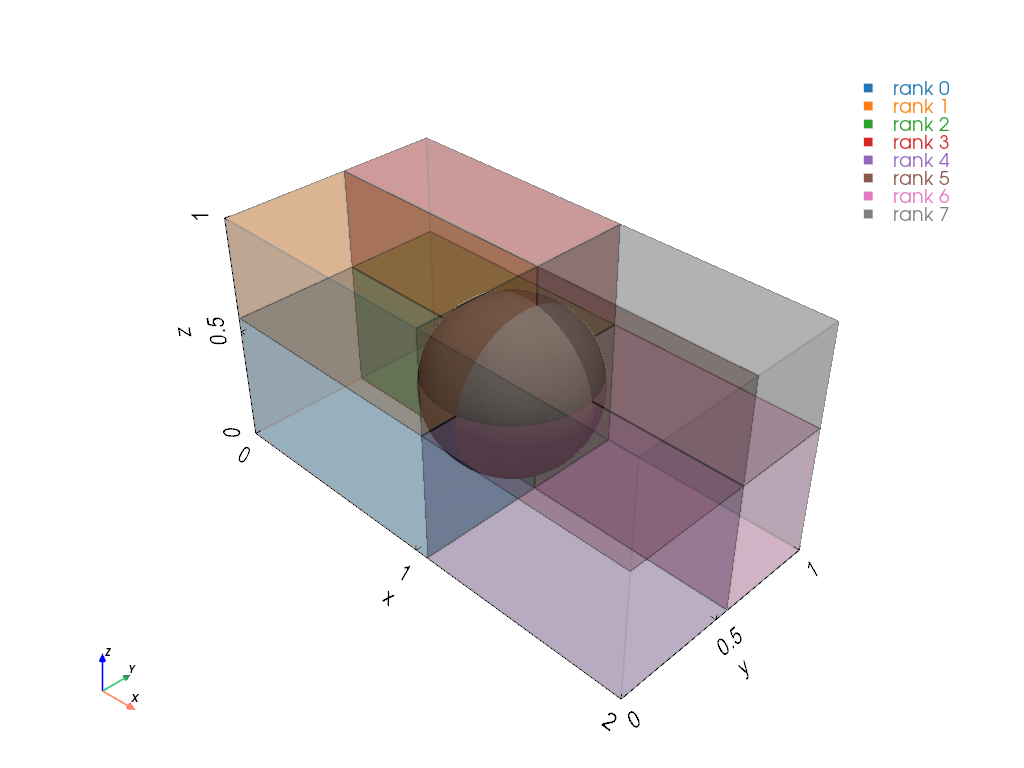
Parallel grids covers MPI decomposition metadata, local index ranges, and neighbouring ranks.
-
Inspecting geometry covers plotting, 3D surfaces and interactive clipping.
-
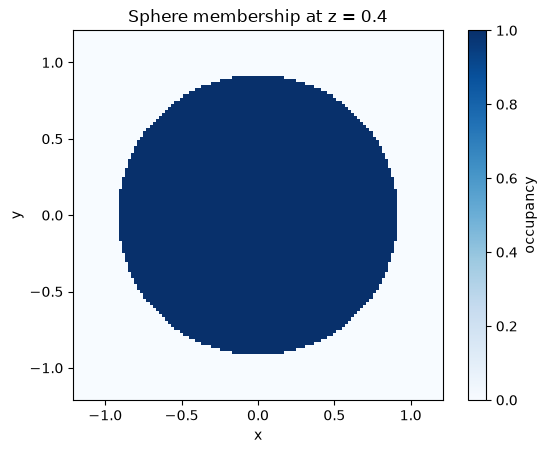
Slices and coordinate sampling covers labelled evaluation and arbitrary planes.
-
Building composite shapes combines, transforms and names objects.
-
Grid intersections and cut edges covers surface crossings and cell fractions.
-
Sampling, export and diagnostics covers point clouds, portable meshes and resolution checks.
-
Boundary outlines turns 2D shapes into vertex loops and panels for boundary-element solvers, and finds where particle steps cross a boundary.
-
Conductors and level sets builds an Einzel lens from ring electrodes with voltages, reads Dirichlet values on a grid, and uses level sets for exact distances and edge crossings.
See Building the docs to add an example.
Grids and coordinates
Create a structured grid, inspect its node coordinates, and see how periodic axes change spacing.
Shapes and node masks
Test points against a shape, select the nodes it covers, and visualize the result.
Parallel grids
Inspect the MPI decomposition of a structured grid. The first example runs on one process; the same constructor accepts an MPI communicator for parallel runs.
Inspecting geometry
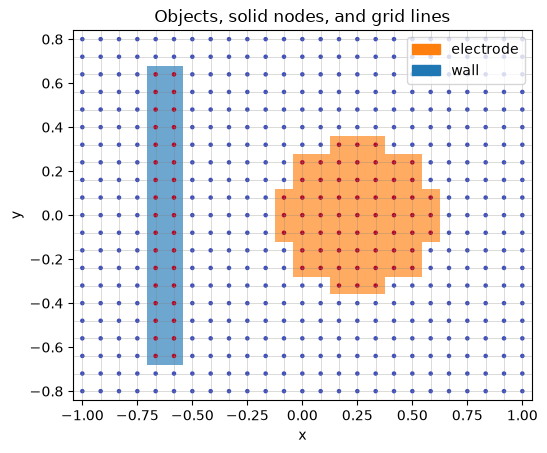
Explore 2D objects, named collections, grids and 3D surfaces with show(), plot() and show3d(). All examples run without Picnic.
Slices and coordinate sampling
Evaluate geometry with Picnic-like coordinate selections, then reuse axis-aligned and oblique sections for queries and plotting. Unlike an interpolated field, membership is evaluated directly at each…
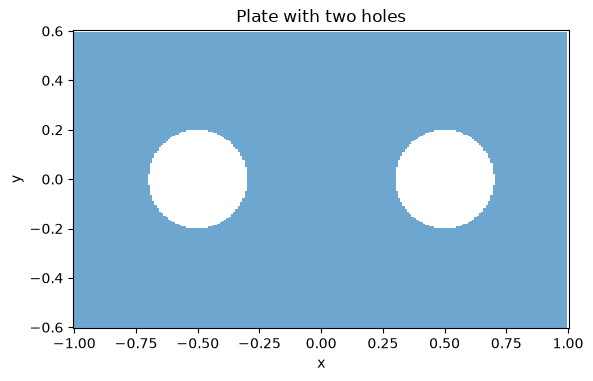
Building composite shapes
Build apertures and chambers from Boolean operations, position independent copies, and assign names to objects. Membership remains independent of any plotting resolution.
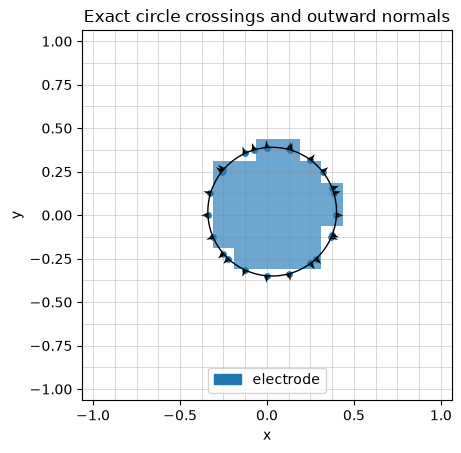
Cut edges
Inspect the geometric input to a cut-cell solver: crossing positions, edge fractions, distances, object identity, and outward normals. Simgeometry computes geometry; Picnic applies its…
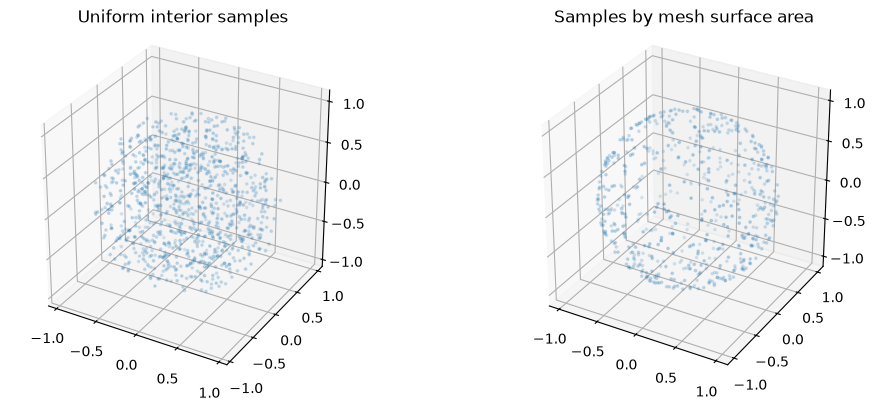
Sampling, export and diagnostics
Sample interior and boundary points, export contours and surface meshes, and inspect geometric resolution before running a simulation. All meshes and quadrature results carry a sampling resolution;…
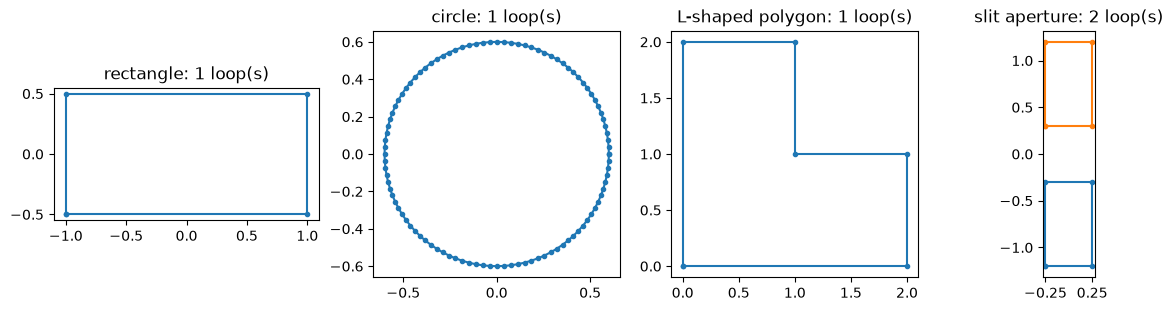
Boundary outlines
Turn a 2D shape into closed loops of boundary vertices, at a resolution you choose. Boundary-element and panel solvers discretise electrodes and walls from these loops; they also give perimeters,…
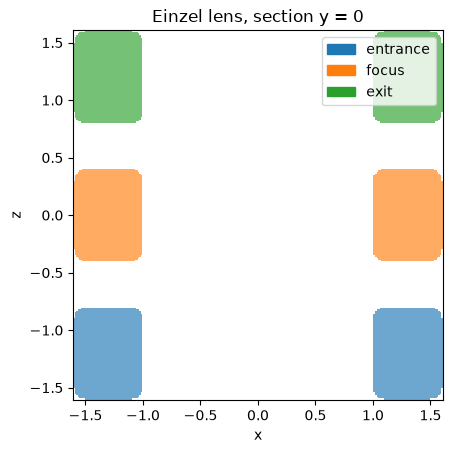
Conductors and level sets
Build an Einzel lens from ring electrodes, give the electrodes voltages, and read the Dirichlet values a field solver needs. The rings are Tube solids; their level sets locate the surface between…
Nothing matches.