Aperture2D
Two plates mirrored about a beam axis: a slit, or the 2D cut through a round aperture.
Aperture2D(axis, position, vertices) takes the profile of one plate as (axial, radial)
vertices, the coordinate along the beam and the distance from the centre line at
position; the second plate is its mirror image. Aperture2D.slit builds the common
rectangular plates.
import matplotlib.pyplot as pltimport numpy as np
from simgeometry import Aperture2Dfrom simgeometry.crossings import crossings
slit = Aperture2D.slit(axial_position=0.3, half_width=0.1, thickness=0.05, length=0.4)# a knife edge with a narrower bore: thin at the bore, thicker outsideknife = Aperture2D(    axis=0,    position=0.0,    vertices=[(0.8, 0.05), (0.84, 0.05), (0.95, 0.5), (0.7, 0.5)],)print(    "on the axis:", slit.contains((0.3, 0.0)), " in a plate:", slit.contains((0.3, 0.2)))assert not slit.contains((0.3, 0.0)) and slit.contains((0.3, -0.2))
on the axis: False in a plate: TrueA beam through both apertures
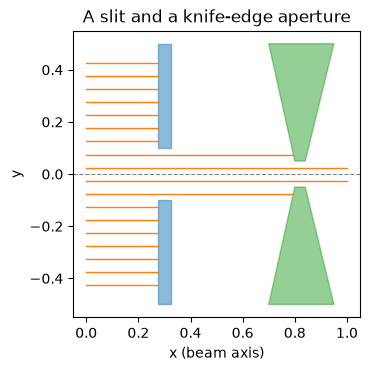
Section titled “A beam through both apertures”Steps along the beam axis (x) at different heights: the slit stops those with , the knife edge those with that got through the slit.
y = np.linspace(-0.425, 0.425, 18)start = np.stack((np.zeros_like(y), y))end = np.stack((np.ones_like(y), y))first = crossings(slit, start, end)end_after_slit = np.where(first.hit, first.point, end)second = crossings(knife, start, end_after_slit)stopped = np.where(second.hit, second.point, end_after_slit)assert first.hit.sum() == np.sum(np.abs(y) > 0.1)assert second.hit.sum() == np.sum((np.abs(y) > 0.05) & (np.abs(y) < 0.1))
fig, ax = plt.subplots(figsize=(6, 3.6), layout="constrained")for shape, color in ((slit, "tab:blue"), (knife, "tab:green")):    for loop in shape.outlines():        ax.fill(*loop, color=color, alpha=0.5)for i in range(len(y)):    ax.plot([start[0, i], stopped[0, i]], [y[i], y[i]], color="tab:orange", lw=1)ax.axhline(0.0, color="0.5", lw=0.8, ls="--")ax.set(xlabel="x (beam axis)", ylabel="y", title="A slit and a knife-edge aperture")ax.set_aspect("equal")plt.show()