Polyline
An open curve of zero thickness through a list of vertices: a thin plate, a wire or a grid electrode.
Polyline(vertices) encloses no area, so contains is always false and it takes no part in
Boolean shapes. Its geometry is its outline, one open curve from the first vertex to the last,
which boundary_panels and crossings use directly.
import matplotlib.pyplot as pltimport numpy as np
from simgeometry import Polylinefrom simgeometry.crossings import crossings
deflector = Polyline([(0.0, 0.3), (0.5, 0.7), (1.0, 0.3)])(curve,) = deflector.outlines()panels = deflector.boundary_panels(max_spacing=0.1)print("closed:", deflector.closed, " vertices:", curve.shape[1])print("panels:", len(panels), " total length:", panels.length.sum())assert not deflector.contains((0.5, 0.5))assert np.isclose(panels.length.sum(), 2 * np.hypot(0.5, 0.4))
closed: False vertices: 3panels: 14 total length: 1.28062484748657Particle steps
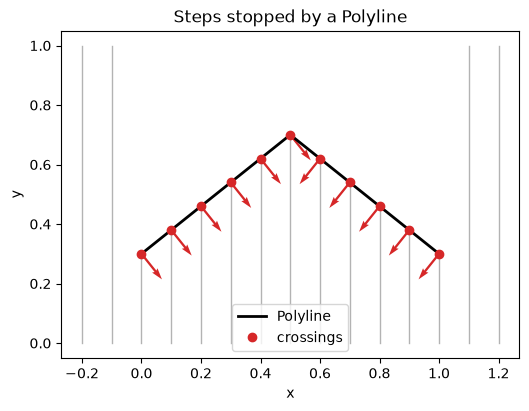
Section titled “Particle steps”A particle step that passes through the curve stops on it: crossings returns, for each step
from start to end, whether it hits, where, and the normal there. Here vertical steps rise
from below the deflector.
x = np.linspace(-0.2, 1.2, 15)start = np.stack((x, np.zeros_like(x)))end = np.stack((x, np.ones_like(x)))hits = crossings(deflector, start, end)print("steps stopped:", int(hits.hit.sum()), "of", len(x), " analytic:", hits.exact)
fig, ax = plt.subplots(figsize=(5.5, 4), layout="constrained")for i in range(len(x)):    stop = hits.point[:, i] if hits.hit[i] else end[:, i]    ax.plot(*np.stack((start[:, i], stop), axis=1), color="0.7", lw=1)ax.plot(*curve, color="k", lw=2, label="Polyline")ax.plot(*hits.point[:, hits.hit], "o", color="tab:red", label="crossings")ax.quiver(    *hits.point[:, hits.hit],    *hits.normal[:, hits.hit],    color="tab:red",    scale=14,    width=0.005,)ax.set(xlabel="x", ylabel="y", title="Steps stopped by a Polyline")ax.set_aspect("equal")ax.legend(loc="lower center")plt.show()
steps stopped: 11 of 15 analytic: True