Circle
A disc of a given radius: the cross-section of a wire, a rod or a round electrode.
Circle(midpoint, radius) has an exact level set, the signed distance
|p - midpoint| - radius, so distances, closest points and normals are analytic.
import matplotlib.pyplot as pltimport numpy as np
from simgeometry import Circle, Grid
rod = Circle(midpoint=(0.0, 0.0), radius=0.5)points = np.array([[0.0, 0.4, 1.0], [0.0, 0.0, 1.0]])  # (2, n): one point per columnprint("inside:", rod.contains_points(points))print("signed distance:", rod.signed_distance(points))print("closest point to (1, 1):", rod.closest_point((1.0, 1.0)))print("normal at (0.5, 0):", rod.surface_normal((0.5, 0.0)))assert np.isclose(rod.signed_distance((1.0, 1.0)), np.sqrt(2) - 0.5)
inside: [ True True False]signed distance: [-0.5 -0.1 0.91421356]closest point to (1, 1): [0.35355339 0.35355339]normal at (0.5, 0): [1. 0.]Distance field and node mask
Section titled “Distance field and node mask”The level set sampled around the rod: its contours are circles, one per distance. The grid
nodes inside the rod are those node_mask selects.
x = np.linspace(-1.0, 1.0, 201)X, Y = np.meshgrid(x, x, indexing="ij")distance = rod.signed_distance(np.stack((X.ravel(), Y.ravel()))).reshape(X.shape)
grid = Grid(2, (-1.0, -1.0), (1.0, 1.0), (21, 21))mask = rod.node_mask(grid).ravel()nodes = grid.node_points()
fig, ax = plt.subplots(figsize=(5.5, 4.5), layout="constrained")image = ax.contourf(X, Y, distance, levels=np.linspace(-0.5, 1.0, 16), cmap="RdBu_r")ax.contour(X, Y, distance, levels=[0.0], colors="k")ax.scatter(*nodes[:, mask], s=8, color="k", label="nodes inside")fig.colorbar(image, ax=ax, label="signed distance")ax.set(xlabel="x", ylabel="y", title="The level set of a Circle")ax.set_aspect("equal")ax.legend(loc="upper right")plt.show()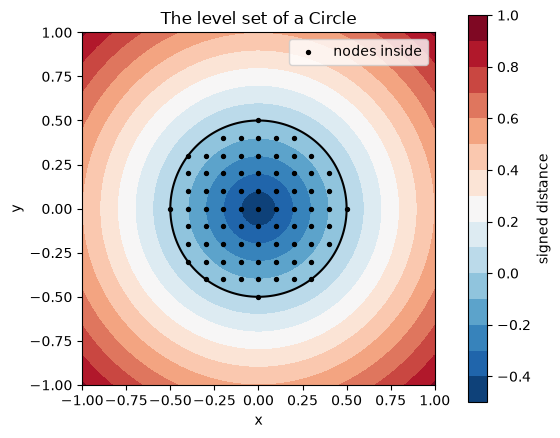
Outlines and inversion
Section titled “Outlines and inversion”outlines(max_spacing) gives the boundary as a counter-clockwise vertex loop, for
boundary-element solvers and for plotting. An inverted circle is everything outside it: the
wall of a round chamber.
(loop,) = rod.outlines(max_spacing=0.05)print("outline vertices:", loop.shape[1])
chamber = Circle(midpoint=(0.0, 0.0), radius=0.5, inverted=True)assert np.array_equal(chamber.node_mask(grid).ravel(), ~mask)assert np.isclose(chamber.signed_distance((1.0, 1.0)), -rod.signed_distance((1.0, 1.0)))
outline vertices: 63