Line
An interval of the real line: a wall, an electrode or an absorber in a 1D domain.
Line(midpoint, side_lengths) covers midpoint ± side_lengths / 2. Both are one-element
sequences, as for Rectangle and Cuboid in two and three dimensions. Points are (1, n)
arrays, component-major like every query in simgeometry.
import matplotlib.pyplot as pltimport numpy as np
from simgeometry import Grid, Line
wall = Line(midpoint=(0.6,), side_lengths=(0.25,))print("from", float(wall.lower_bound[0]), "to", float(wall.upper_bound[0]))print("x = 0.6 inside:", wall.contains((0.6,)))print("points inside:", wall.contains_points(np.array([[0.1, 0.5, 0.7, 0.9]])))assert wall.contains((0.6,)) and not wall.contains((0.2,))
from 0.475 to 0.725x = 0.6 inside: Truepoints inside: [False True True False]Node mask and level set
Section titled “Node mask and level set”node_mask(grid) marks the grid nodes inside the line. Its level set is the exact signed
distance to the interval: negative inside, zero at both ends, growing with slope one outside.
grid = Grid(1, (0.0,), (1.0,), (21,))mask = wall.node_mask(grid)nodes = grid.node_points()[0]print("nodes inside:", nodes[mask])
x = np.linspace(0.0, 1.0, 401)distance = wall.signed_distance(x[None, :])assert np.isclose(wall.signed_distance((0.2,)), 0.6 - 0.125 - 0.2)
fig, ax = plt.subplots(figsize=(6, 3), layout="constrained")ax.axvspan(wall.lower_bound[0], wall.upper_bound[0], color="tab:orange", alpha=0.25)ax.plot(x, distance, label="signed distance")ax.axhline(0.0, color="0.5", lw=0.8)ax.plot(    nodes[~mask], np.zeros((~mask).sum()), "o", mfc="none", color="0.5", label="nodes")ax.plot(    nodes[mask], np.zeros(mask.sum()), "o", color="tab:orange", label="nodes inside")ax.set(xlabel="x", ylabel="signed distance", title="A Line and its level set")ax.legend(loc="upper center")plt.show()
nodes inside: [0.5 0.55 0.6 0.65 0.7 ]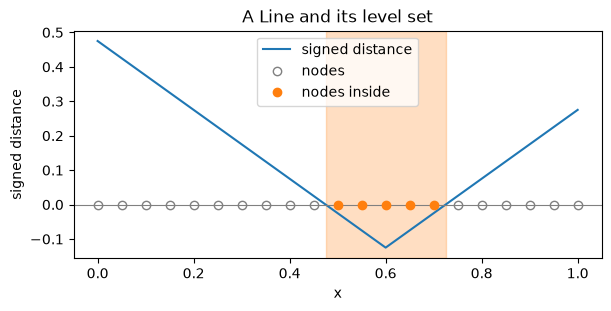
Inverted lines
Section titled “Inverted lines”inverted=True covers everything except the interval, for example the walls on both sides of
a gap. The node mask is the complement and the level set changes sign.
gap = Line(midpoint=(0.6,), side_lengths=(0.25,), inverted=True)assert np.array_equal(gap.node_mask(grid), ~mask)assert np.isclose(gap.signed_distance((0.2,)), -wall.signed_distance((0.2,)))print("walls at x = 0.2:", gap.contains((0.2,)))walls at x = 0.2: True