Kernel backends
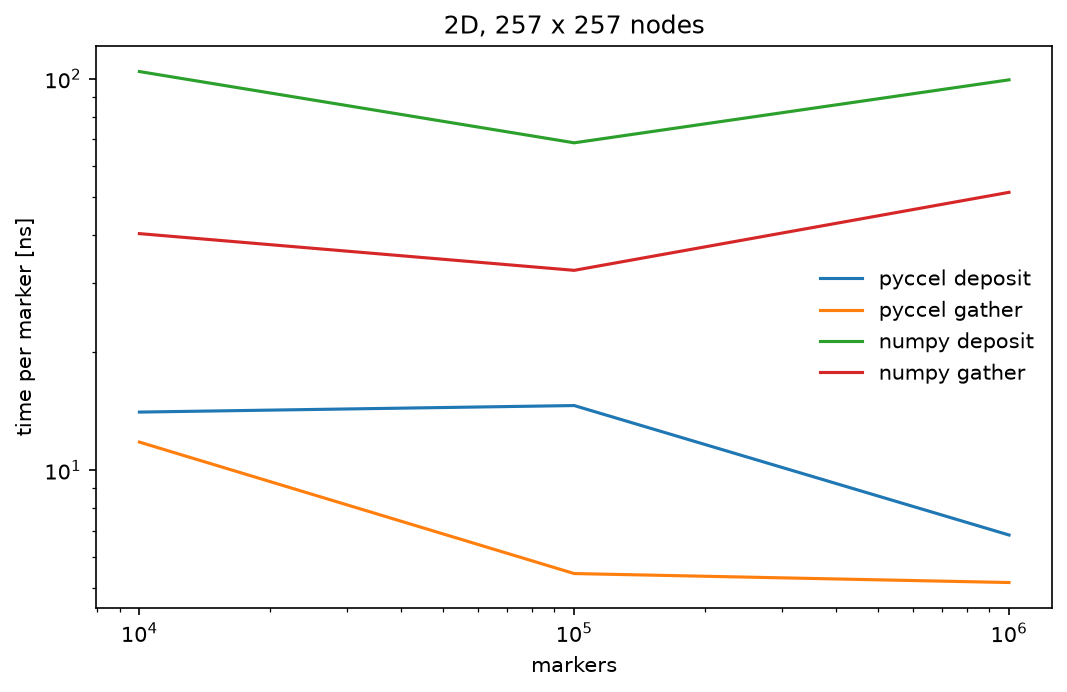
The same deposit and gather through the compiled Pyccel kernels and their NumPy versions, timed.
Every kernel has a Pyccel version (compiled with OpenMP on first use), a NumPy version (used
without Pyccel), a CUDA version (for CuPy arrays) and a Metal version (Apple-silicon GPUs,
float32). cunumpy.kernels.use_host_kernel_implementation picks the host version; the
results agree to round-off. The plot shows the time per marker of a 2D deposit and gather
for both host versions as the marker count grows, the best of five runs, measured where
the docs were built.
Python source
Section titled “Python source”"""Kernel backends
The same deposit and gather through the compiled Pyccel kernels and their NumPy versions, timed.
Every kernel has a Pyccel version (compiled with OpenMP on first use), a NumPy version (usedwithout Pyccel), a CUDA version (for CuPy arrays) and a Metal version (Apple-silicon GPUs,float32). `cunumpy.kernels.use_host_kernel_implementation` picks the host version; theresults agree to round-off. The plot shows the time per marker of a 2D deposit and gatherfor both host versions as the marker count grows, the best of five runs, measured wherethe docs were built."""
import timefrom functools import partial
import cunumpy as xpimport matplotlib.pyplot as pltimport numpy as npimport plasma_plots # noqa: F401import xarray as xr
from mpifield import Field
rng = np.random.default_rng(12)
def best(call, repeats=5): """The shortest of a few timings, the least disturbed by the machine.""" durations = [] for _ in range(repeats): start = time.perf_counter() call() durations.append(time.perf_counter() - start) return min(durations)
kwargs = {"ndim": 2, "lower_bound": (0.0, 0.0), "upper_bound": (1.0, 1.0)}counts = np.array([10_000, 100_000, 1_000_000])times = np.zeros((2, 2, counts.size)) # implementation, operation, countfor c, count in enumerate(counts): positions = rng.random((2, count)) values = np.ones((1, count)) for i, implementation in enumerate(("pyccel", "numpy")): with xp.kernels.use_host_kernel_implementation(implementation): field = Field(num_gridpoints=(257, 257), **kwargs) field.scatter(positions, values) # compile and warm up times[i, 0, c] = best(partial(field.scatter, positions, values)) / count times[i, 1, c] = best(partial(field.gather, positions)) / count
per_marker = xr.DataArray( times * 1e9, dims=("implementation", "operation", "markers"), coords={ "implementation": ["pyccel", "numpy"], "operation": ["deposit", "gather"], "markers": counts, }, name="time per marker", attrs={"units": "ns"},)print(per_marker.sel(markers=counts[-1]).to_pandas())fig, ax = plt.subplots(figsize=(7, 4.5), layout="constrained")for implementation in ("pyccel", "numpy"): for operation in ("deposit", "gather"): selected = per_marker.sel(implementation=implementation, operation=operation) selected.plasma.plot.lineout(x="markers", ax=ax) ax.lines[-1].set_label(f"{implementation} {operation}")ax.set(xscale="log", yscale="log", title="2D, 257 x 257 nodes")ax.legend(frameon=False)plt.show()