Adjoint deposit and gather
Deposit and gather are transposes: the scatter of marker values and the gather of a field use the same weights, so they are adjoint.
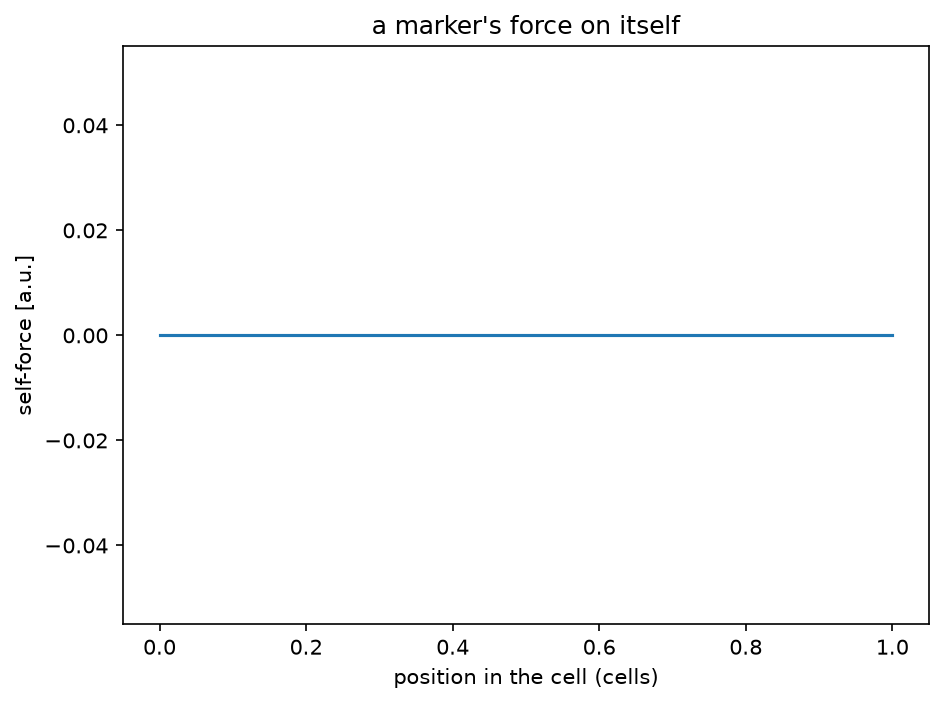
For any field on the nodes and charges at positions , with the deposit of the charges. That is what makes a PIC code with linear weights momentum-conserving and free of self-forces on a uniform grid. The script checks the identity on random data, then moves one marker across a cell and gathers the field of its own (smoothed) deposit at it: the self-force vanishes to round-off, about , wherever the marker is.
Python source
Section titled “Python source”"""Adjoint deposit and gather
Deposit and gather are transposes: the scatter of marker values and the gather of a field use the same weights, so they are adjoint.
For any field $g$ on the nodes and charges $q_i$ at positions $x_i$,$\\sum_i q_i\\, g(x_i) = \\sum_n g_n \\rho_n$ with $\\rho$ the deposit of the charges. That iswhat makes a PIC code with linear weights momentum-conserving and free of self-forces on auniform grid. The script checks the identity on random data, then moves one marker across acell and gathers the field of its own (smoothed) deposit at it: the self-force vanishes toround-off, about $10^{-17}$, wherever the marker is."""
import matplotlib.pyplot as pltimport numpy as npimport plasma_plots # noqa: F401import xarray as xr
from mpifield import Field
rng = np.random.default_rng(4)shape = (33, 25)kwargs = {"ndim": 2, "lower_bound": (0.0, 0.0), "upper_bound": (1.0, 0.75)}g = Field(num_gridpoints=shape, **kwargs)g.set_field_data(rng.normal(size=shape))rho = Field(num_gridpoints=shape, **kwargs)positions = rng.random((2, 1000)) * np.array([[1.0], [0.75]])charges = rng.normal(size=1000)rho.scatter(positions, charges)
left = float(np.dot(g.gather(positions)[0], charges))right = float((g * rho).sum())print(f"sum_i q_i g(x_i) = {left:.12f}")print(f"sum_n g_n rho_n = {right:.12f} (difference {abs(left - right):.1e})")
# the gather of a marker's own 'potential': the deposit smoothed by a stenciloffsets = np.linspace(0.0, 1.0, 101)dx = float(g.grid_spacing[0])force = []for offset in offsets: one = Field(num_gridpoints=shape, **kwargs) x = np.array([[0.5 + offset * dx], [0.375]]) one.scatter(x, 1.0) potential = one.smooth_binomial(passes=1, in_place=False) field = -potential.gradient() force.append(float(field.gather(x)[0, 0]))self_force = xr.DataArray( force, dims="offset", coords={"offset": offsets}, name="self-force")result = self_force.plasma.plot.lineout(x="offset")result.ax.set(xlabel="position in the cell (cells)", title="a marker's force on itself")plt.show()