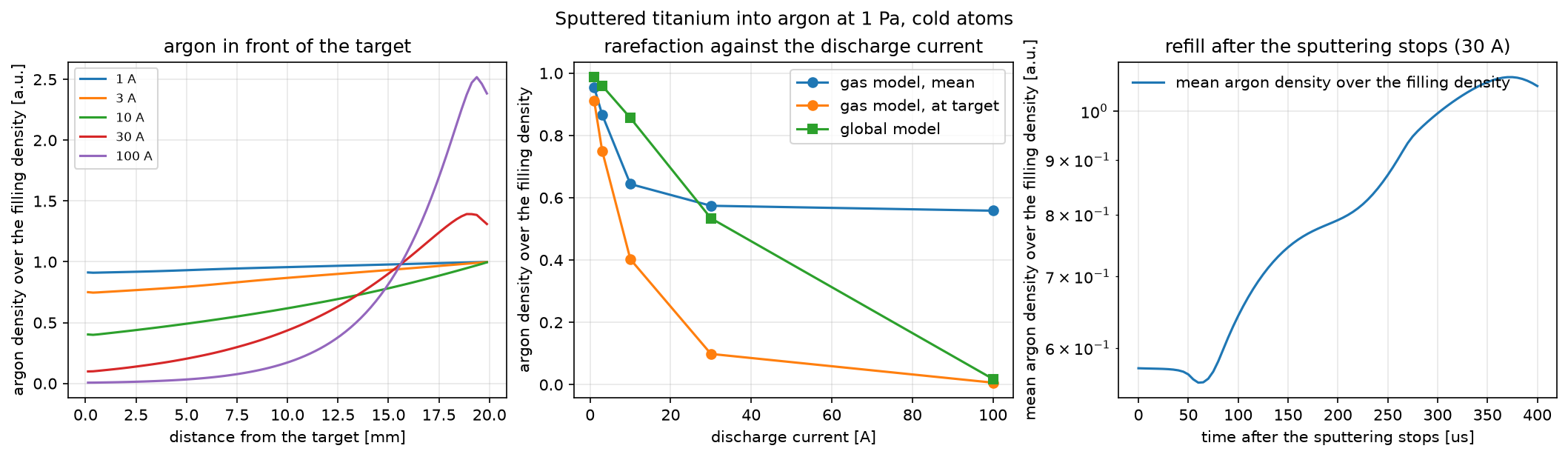
The sputter wind: the argon in front of a sputtering target, as a compressible gas.
The target of a magnetron is a wall in front of a gas at 1 Pa that emits sputtered metal atoms
and, at the same time, the ions that hit it return as neutrals. Here only the sputtered
titanium is emitted, at the flux the global model (:class:wellbalanced.Magnetron) finds for a
discharge current of 1 to 100 A on a target of 10 cm^2, into 2 cm of argon that is refilled
from a reservoir at the far end (wellbalanced.gasdynamics, the argon and the titanium as one
compressible gas with one velocity and temperature and the diffusion of the titanium through
the argon). Two cases of the energy of the sputtered atoms: cold atoms (they leave at the gas
temperature, as the global model assumes: only their number and momentum push the gas) and
5 eV atoms (a mean energy of the order of the one of sputtered metals, a placeholder: their
heat goes into the gas).
The first figure is the argon density profile in front of the target for several currents with cold atoms; the second its mean value against the global model’s rarefaction; the third how the argon returns once the sputtering stops.
This is a demonstration of the model, not a validation. The model is the continuum limit (Euler with species diffusion): at 1 Pa the mean free path of argon is a few mm, so the Knudsen number of the region is of order 0.1 to 1 and a kinetic (DSMC) calculation is due. A continuum gas thermalizes the 5 eV atoms in the cell next to the target, whereas at this Knudsen number energetic atoms leave ballistically: with them the model overestimates the heating of the gas by an order of magnitude, and the 5 eV result at 10 A and above (the gas heated to thousands of kelvin) is that overestimate, not a prediction. The sputtered flux of the global model uses its placeholder yields and the diffusion coefficient a placeholder hard-sphere diameter of titanium.
Python source
Section titled “Python source”"""The sputter wind: the argon in front of a sputtering target, as a compressible gas.
The target of a magnetron is a wall in front of a gas at 1 Pa that emits sputtered metal atomsand, at the same time, the ions that hit it return as neutrals. Here only the sputteredtitanium is emitted, at the flux the global model (:class:`wellbalanced.Magnetron`) finds for adischarge current of 1 to 100 A on a target of 10 cm^2, into 2 cm of argon that is refilledfrom a reservoir at the far end (`wellbalanced.gasdynamics`, the argon and the titanium as onecompressible gas with one velocity and temperature and the diffusion of the titanium throughthe argon). Two cases of the energy of the sputtered atoms: cold atoms (they leave at the gastemperature, as the global model assumes: only their number and momentum push the gas) and5 eV atoms (a mean energy of the order of the one of sputtered metals, a placeholder: theirheat goes into the gas).
The first figure is the argon density profile in front of the target for several currents withcold atoms; the second its mean value against the global model's rarefaction; the third howthe argon returns once the sputtering stops.
This is a demonstration of the model, not a validation. The model is the continuum limit(Euler with species diffusion): at 1 Pa the mean free path of argon is a few mm, so theKnudsen number of the region is of order 0.1 to 1 and a kinetic (DSMC) calculation is due. Acontinuum gas thermalizes the 5 eV atoms in the cell next to the target, whereas at thisKnudsen number energetic atoms leave ballistically: with them the model overestimates theheating of the gas by an order of magnitude, and the 5 eV result at 10 A and above (the gasheated to thousands of kelvin) is that overestimate, not a prediction. The sputtered flux ofthe global model uses its placeholder yields and the diffusion coefficient a placeholderhard-sphere diameter of titanium."""
import warnings
import numpy as npimport plasma_plotsimport xarray as xrfrom plasmacoll.constants import ATOMIC_MASS, BOLTZMANN
from wellbalanced import MATERIALS, Magnetronfrom wellbalanced.gasdynamics import ( ARGON_MASS, Boundary, GasDynamics, ThermalRelaxation, binary_diffusion,)
warnings.filterwarnings("ignore", message=".*placeholders, not data")
LENGTH = 0.02 # m: the height of the ionization region, the refill reservoir above itPRESSURE, TEMPERATURE = 1.0, 300.0 # Pa, KTITANIUM = 47.867 * ATOMIC_MASSFILL_DENSITY = PRESSURE / (BOLTZMANN * TEMPERATURE)CURRENTS = (1.0, 3.0, 10.0, 30.0, 100.0)
def voltage(current: float) -> float: """A placeholder current-voltage characteristic, 400 V at 0.1 A rising slowly.""" return 400.0 + 60.0 * np.log10(1.0 + current)
def diffusion(temperature: np.ndarray, pressure: np.ndarray) -> np.ndarray: """Ar-Ti diffusion: hard spheres of 3.6 and 3.0 angstrom (PLACEHOLDER diameters).""" return binary_diffusion(ARGON_MASS, TITANIUM, 3.3e-10, temperature, pressure)
def gas(flux: float, energy: float, cells: int = 80) -> GasDynamics: """The gas in front of a target that emits ``flux`` atoms/m^2/s of ``energy`` eV.""" mean_speed = np.sqrt(8.0 * BOLTZMANN * TEMPERATURE / (np.pi * ARGON_MASS)) model = GasDynamics( LENGTH, cells, diffusion=diffusion, thermal_conductivity=0.02, # PLACEHOLDER: argon at 300 K, to check boundaries={ "left": Boundary.wall(TEMPERATURE, metal_flux=flux, metal_energy=energy), "right": Boundary.inflow(PRESSURE, TEMPERATURE), }, ) # the side walls of a 1 cm channel, free-molecular exchange (PLACEHOLDER closure) model.relaxation.append(ThermalRelaxation(2.0 * mean_speed / (3.0 * 0.01))) model.set_uniform(PRESSURE, TEMPERATURE) return model
# the sputtered flux and the rarefaction of the global model at each currentmagnetron = Magnetron(material=MATERIALS["Ti"], wind_efficiency=0.3)magnetron = magnetron.calibrate_heating(2.0, voltage(2.0))fluxes, global_rarefaction = [], []for current in CURRENTS: state = magnetron.steady_state(current, voltage(current)) sputtered = magnetron.target_currents(state)["sputtered"] / magnetron.target_area fluxes.append(sputtered) global_rarefaction.append(magnetron.diagnostics(state)["rarefaction"])
# cold atoms: the argon in front of the target, brought to its steady stateprofiles, rows = [], []for current, flux in zip(CURRENTS, fluxes, strict=True): model = gas(flux, energy=0.05) model.run(3.0e-4) state = model.state() argon = state.gas_number[:, 0] / FILL_DENSITY profiles.append(argon) rows.append( (current, flux, argon.mean(), argon[0], state.temperature[0, 0], state.u[-1, 0]) )profile = xr.DataArray( np.array(profiles), dims=("current", "x"), coords={"current": [f"{c:g} A" for c in CURRENTS], "x": model.x * 1e3}, attrs={"long_name": "argon density over the filling density"},)profile.x.attrs.update(long_name="distance from the target", units="mm")
# 5 eV atoms at the two lowest currents: the heat of the sputtered atomshot = []for current, flux in list(zip(CURRENTS, fluxes, strict=True))[:3:2]: model = gas(flux, energy=5.0, cells=60) model.run(3.0e-4) state = model.state() hot.append( ( current, state.gas_number.mean() / FILL_DENSITY, state.temperature[0, 0], state.u[-1, 0], ) )
print("1D gas model with cold sputtered atoms against the global model's rarefaction")print(" I [A] flux [1/m^2/s] 1D mean 1D at target global model")for (current, flux, mean, near, _t, _u), rarefaction in zip( rows, global_rarefaction, strict=True): print( f" {current:5.0f} {flux:12.2e} {mean:7.3f} {near:11.3f} {rarefaction:11.3f}" )print("with 5 eV atoms (the heat of the sputtered atoms goes into the gas):")for current, mean, temperature, velocity in hot: print( f" {current:5.0f} A: argon {mean:.3f} of the filling density on average, " f"{temperature:.0f} K at the target, outflow {velocity:.0f} m/s" )
# refill: stop the sputtering at 30 A (cold atoms) and follow the argon backmodel = gas(fluxes[3], energy=0.05)model.run(3.0e-4)deficit = 1.0 - model.state().gas_number.mean() / FILL_DENSITYmodel.boundaries["left"].metal_flux = 0.0step, stop = 5.0e-6, 4.0e-4times, mean_argon = [0.0], [1.0 - deficit]for k in range(1, int(round(stop / step)) + 1): model.run(3.0e-4 + k * step) times.append(k * step) mean_argon.append(model.state().gas_number.mean() / FILL_DENSITY)mean_argon = np.array(mean_argon)refill = xr.DataArray( mean_argon, dims=("t",), coords={"t": np.array(times) * 1e6}, attrs={"long_name": "mean argon density over the filling density"},)refill.t.attrs.update(long_name="time after the sputtering stops", units="us")recovered = np.nonzero(mean_argon >= 1.0 - 0.5 * deficit)[0]refill_time = times[recovered[0]] if recovered.size else float("nan")print( f"30 A: half of the mean argon deficit of {deficit:.2f} is back after " f"{refill_time * 1e6:.0f} us, with an overshoot from the sound waves (the global " f"model's placeholder refill time is {magnetron.refill_time * 1e6:.0f} us)")
with plasma_plots.figure( 1, 3, title="Sputtered titanium into argon at 1 Pa, cold atoms") as fig: profile.plasma.plot.profiles(x="x", over="current", ax=fig[0]) fig[0].set_title("argon in front of the target") fig[1].plot(CURRENTS, [r[2] for r in rows], marker="o", label="gas model, mean") fig[1].plot( CURRENTS, [r[3] for r in rows], marker="o", label="gas model, at target" ) fig[1].plot(CURRENTS, global_rarefaction, marker="s", label="global model") fig[1].set_xlabel("discharge current [A]") fig[1].set_ylabel("argon density over the filling density") fig[1].set_title("rarefaction against the discharge current") fig[1].legend() refill.plasma.plot.timeseries(ax=fig[2]) fig[2].set_title("refill after the sputtering stops (30 A)")