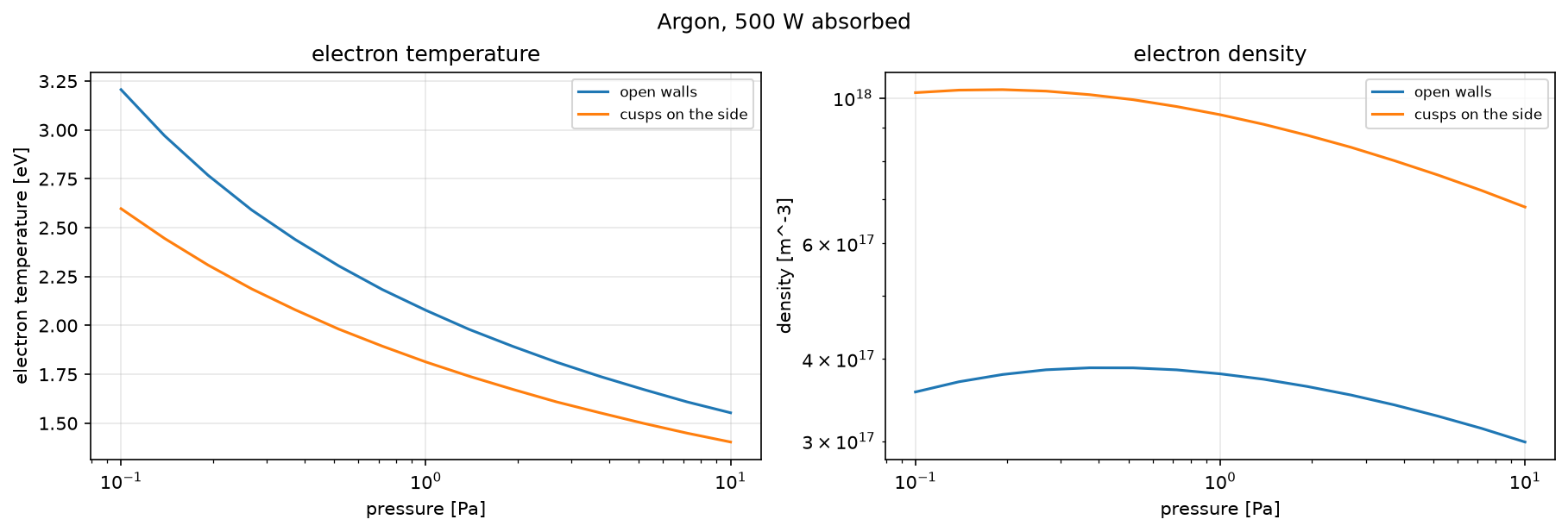
A global model of an argon discharge: electron temperature and density against pressure.
The textbook global model (Lieberman and Lichtenberg, ch. 10): one ion species,
ionization from a step cross section averaged over a Maxwellian (with plasmacoll),
elastic losses, ions leaving at the Bohm speed. The particle balance alone sets the
electron temperature, which falls with the pressure; the power balance then sets the
density. Magnetic cusps that cover most of the wall lower both the losses and the
electron temperature. The cross sections are illustrative step functions, not
argon data. Every scan is one xarray dataset (:func:wellbalanced.stack), plotted
with plasma-plots.
Python source
Section titled “Python source”"""A global model of an argon discharge: electron temperature and density against pressure.
The textbook global model (Lieberman and Lichtenberg, ch. 10): one ion species,ionization from a step cross section averaged over a Maxwellian (with plasmacoll),elastic losses, ions leaving at the Bohm speed. The particle balance alone sets theelectron temperature, which falls with the pressure; the power balance then sets thedensity. Magnetic cusps that cover most of the wall lower both the losses and theelectron temperature. The cross sections are illustrative step functions, notargon data. Every scan is one xarray dataset (:func:`wellbalanced.stack`), plottedwith plasma-plots."""
import numpy as npimport plasma_plotsimport xarray as xrfrom plasmacoll import CrossSectionfrom plasmacoll.constants import BOLTZMANN, ELECTRON_MASS
from wellbalanced import ELECTRON, Chamber, Cusp, GlobalModel, Reaction, Species, stack
argon = Species.atomic("Ar", 39.948)argon_ion = Species.atomic("Ar+", 39.948, 1)reactions = [ Reaction.from_cross_section( ("e", "Ar"), ("e", "e", "Ar+"), CrossSection.constant(2.0e-20, threshold=15.76), ELECTRON_MASS, electron_energy_loss=15.76, name="ionization", ), Reaction.from_cross_section( ("e", "Ar"), ("e", "Ar"), CrossSection.constant(1.0e-20, threshold=11.5), ELECTRON_MASS, electron_energy_loss=11.5, name="excitation", ), Reaction( ("e", "Ar"), ("e", "Ar"), 1.0e-13, elastic_mass=argon.mass, name="elastic" ),]# a cylinder of 10 cm radius and 20 cm lengthradius, length = 0.1, 0.2volume = np.pi * radius**2 * lengthwall = 2 * np.pi * radius * (radius + length)chambers = { "open walls": Chamber(volume, wall, h_factor=0.3), "cusps on the side": Chamber( volume, wall, ion_loss_area=2 * np.pi * radius**2, h_factor=0.3, cusp=Cusp(field=0.1, line_length=16 * length), ),}
pressures = np.geomspace(0.1, 10.0, 15) # Pagas = pressures / (BOLTZMANN * 300.0) # m^-3scans = []for chamber in chambers.values(): model = GlobalModel( species=[ELECTRON, argon, argon_ion], reactions=reactions, chamber=chamber, power=500.0, fixed={"Ar": float(gas[0])}, ) states = model.scan("fixed", [{"Ar": float(n)} for n in gas]) scans.append(stack(states, "pressure", pressures, units="Pa"))result = xr.concat(scans, dim="case").assign_coords(case=list(chambers))
with plasma_plots.figure(1, 2, title="Argon, 500 W absorbed") as fig: result.electron_temperature.plasma.plot.profiles( x="pressure", over="case", logx=True, ax=fig[0] ) result.density.sel(species="e").plasma.plot.profiles( x="pressure", over="case", logx=True, logy=True, title="electron density", ax=fig[1], )