Beam markers
Describe a neutral beam as markers: streams of fast atoms with a position, a velocity and a weight in atoms per second. Aim the beam with tangential_injection, give it a width, a divergence and a halo, and combine energy components.
A NeutralBeam holds its markers in a plasmacoll ParticleArrays (positions and velocities (N, 3) in Cartesian coordinates with z vertical, weights (N,)) and the isotope’s mass number. Its power is sum(weight * energy).
import matplotlib.pyplot as pltimport numpy as np
import freeofcharge as foc
origin, direction = foc.tangential_injection(5.3, 12.0)closest = origin[:2] - (origin[:2] @ direction[:2]) * direction[:2]print("start", origin.round(2), "direction", direction.round(3))assert abs(np.hypot(*closest) - 5.3) < 1e-12assert abs(np.hypot(*origin[:2]) - 12.0) < 1e-12
start [ 5.3 -10.77 0. ] direction [-0. 1. 0.]tangential_injection(tangency_radius, start_radius) returns the start point and direction of a horizontal axis that starts at R = start_radius and passes closest to the machine’s axis at R = tangency_radius: the tangency radius is the injector’s main aiming choice. sense=-1 injects against +phi (counter-injection), height and toroidal_angle move the axis.
equilibrium = foc.Equilibrium.solovev(6.2, 1.8, 1.7, 5.3, wall_psi_n=1.3)r_in, r_out = (    equilibrium.boundary.vertices[:, 0].min(),    equilibrium.boundary.vertices[:, 0].max(),)wall_out = equilibrium.wall.vertices[:, 0].max()
phi = np.linspace(0, 2 * np.pi, 400)fig, ax = plt.subplots(figsize=(7.5, 5.5), layout="constrained")ax.fill(    r_out * np.cos(phi),    r_out * np.sin(phi),    color="C1",    alpha=0.25,    label="plasma (midplane)",)ax.fill(r_in * np.cos(phi), r_in * np.sin(phi), color="white")ax.plot(wall_out * np.cos(phi), wall_out * np.sin(phi), color="0.5", label="outer wall")ax.plot(5.3 * np.cos(phi), 5.3 * np.sin(phi), ":", color="0.4", label="tangency radius")for tangency in (4.5, 5.3, 6.0):    start, axis = foc.tangential_injection(tangency, 12.0)    path = start[:, None] + np.linspace(0, 20, 2) * axis[:, None]    ax.plot(path[0], path[1], label=f"axis, tangent to R = {tangency} m")ax.set_aspect("equal")ax.set_xlabel("x [m]")ax.set_ylabel("y [m]")ax.legend(loc="upper left", bbox_to_anchor=(1.02, 1.0), fontsize=8)ax.set_title("Top view")plt.show()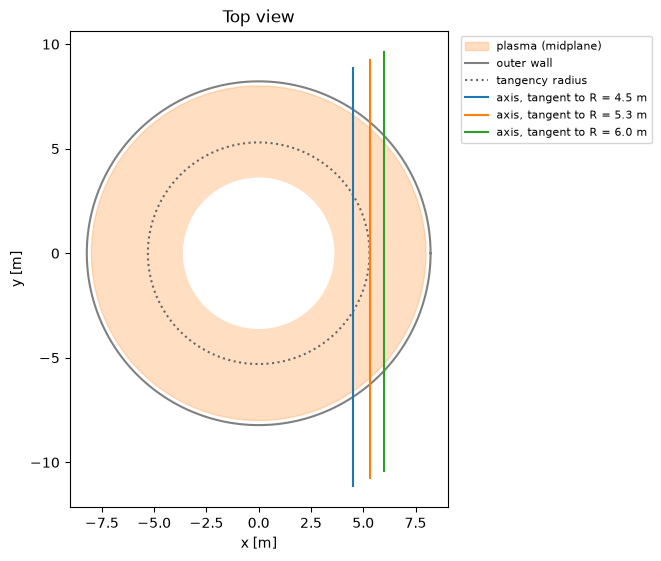
Width, divergence and halo
Section titled “Width, divergence and halo”NeutralBeam.gaussian spreads the markers’ start points about the axis with a standard deviation width [m], and their directions with a standard deviation divergence [rad], each a scalar or a (horizontal, vertical) pair. A share halo_fraction of the markers gets the larger halo_divergence instead: the core and halo of a beamlet, as BBNBI describes it. All markers carry the same weight, power / (energy e) / markers atoms per second.
def angles(beam, axis):    """The horizontal and vertical angles of the markers' directions to the axis."""    horizontal = np.cross(axis, [0.0, 0.0, 1.0])    horizontal /= np.linalg.norm(horizontal)    vertical = np.cross(horizontal, axis)    d = np.asarray(beam.directions)    along = d @ axis    return np.arctan(d @ horizontal / along), np.arctan(d @ vertical / along)

core = foc.NeutralBeam.gaussian(    origin,    direction,    1.0e6,    16.5e6,    width=0.3,    divergence=(0.005, 0.01),    markers=20000,    seed=1,)horizontal, vertical = angles(core, direction)print(    f"core divergence: {horizontal.std() * 1e3:.2f} mrad horizontal, {vertical.std() * 1e3:.2f} mrad vertical")print(    f"power {core.power() / 1e6:.2f} MW, {core.size} markers of {np.asarray(core.markers.weights)[0]:.3e} atoms/s")assert (    abs(horizontal.std() / 0.005 - 1) < 0.03 and abs(vertical.std() / 0.01 - 1) < 0.03)assert abs(core.power() / 16.5e6 - 1) < 1e-12
with_halo = foc.NeutralBeam.gaussian(    origin,    direction,    1.0e6,    16.5e6,    divergence=0.005,    halo_fraction=0.15,    halo_divergence=0.03,    markers=20000,    seed=1,)halo_horizontal, _ = angles(with_halo, direction)far = np.mean(np.abs(halo_horizontal) > 0.02)  # 4 core standard deviationsprint(f"{100 * far:.1f} % of the markers beyond 20 mrad")assert 0.15 * 0.45 < far < 0.15 * 0.60  # the halo's share beyond 2/3 of its sigma
bins = np.linspace(-0.08, 0.08, 81)fig, ax = plt.subplots(figsize=(6, 3.5), layout="constrained")ax.hist(horizontal, bins=bins, histtype="step", label="core only")ax.hist(halo_horizontal, bins=bins, histtype="step", label="core and 15 % halo")ax.set_yscale("log")ax.set_xlabel("horizontal angle to the axis [rad]")ax.set_ylabel("markers")ax.legend()plt.show()
core divergence: 5.00 mrad horizontal, 9.93 mrad verticalpower 16.50 MW, 20000 markers of 5.149e+15 atoms/s8.0 % of the markers beyond 20 mrad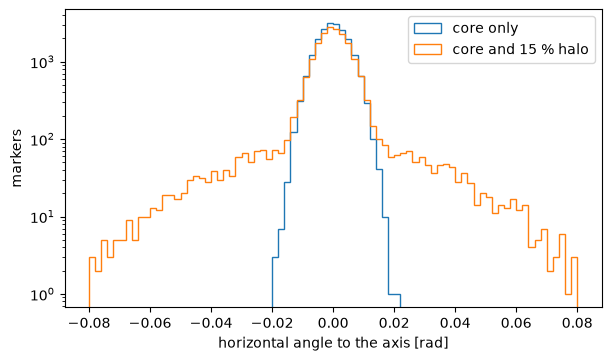
Energy components
Section titled “Energy components”A positive-ion source also extracts molecular ions, which leave atoms at a half and a third of the full energy. Build one beam per component and join them with NeutralBeam.concatenate (one isotope only). Here 70 %, 20 % and 10 % of the power are at the full, half and third energy:
full_energy, power = 120e3, 16.5e6components = [ foc.NeutralBeam.gaussian( origin, direction, full_energy / k, share * power, divergence=0.01, markers=2000, seed=k, ) for k, share in ((1, 0.7), (2, 0.2), (3, 0.1))]beam = foc.NeutralBeam.concatenate(components)energies = np.asarray(beam.energies)for k, component in enumerate(components, start=1): print( f"E/{k}: {component.power() / 1e6:.2f} MW, {np.asarray(component.markers.weights).sum():.2e} atoms/s" )assert abs(beam.power() / power - 1) < 1e-12assert sorted(np.unique(energies.round(3))) == sorted( [full_energy, full_energy / 2, round(full_energy / 3, 3)])E/1: 11.55 MW, 6.01e+20 atoms/sE/2: 3.30 MW, 3.43e+20 atoms/sE/3: 1.65 MW, 2.57e+20 atoms/sThe lower-energy components carry more atoms per watt and are stopped closer to the edge, as the next tutorial shows. With MPI, pass comm= to gaussian: each rank draws its own share of the markers and the deposition sums their profiles.