Tutorials
Each notebook is executed when the documentation is built; download it from its page to run it yourself. They build on each other, from the equilibrium to an injector design scan.
- Equilibria and flux coordinates: the Solov’ev solution and G-EQDSK files,
rho, the field, flux shells and the wall. - Beam markers: aiming with
tangential_injection, width, divergence and halo, energy components. - Stopping and shine-through: Suzuki’s cross sections, a check against Beer-Lambert, the shine-through against density and energy, birth profiles and wall hits.
- Slowing down, heating and current drive: the critical energy, the split of the heating, fast-ion pressure and the beam-driven current.
- Designing the injection: beam energy and tangency radius against shine-through and current-drive efficiency.
See Building the docs to add a tutorial.
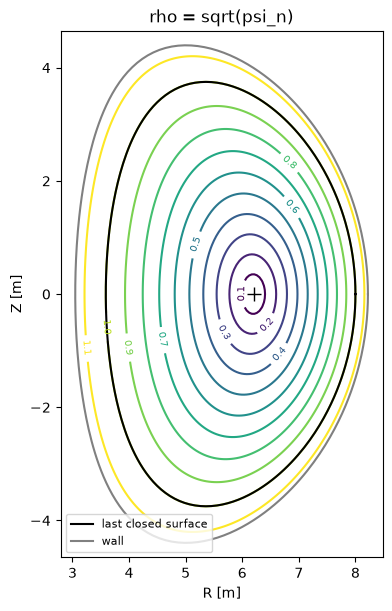
Equilibria and flux coordinates
Build an axisymmetric equilibrium, evaluate the flux and the field, and cut the plasma into flux shells. Every other step of freeofcharge (deposition, slowing down, current drive) works on these…
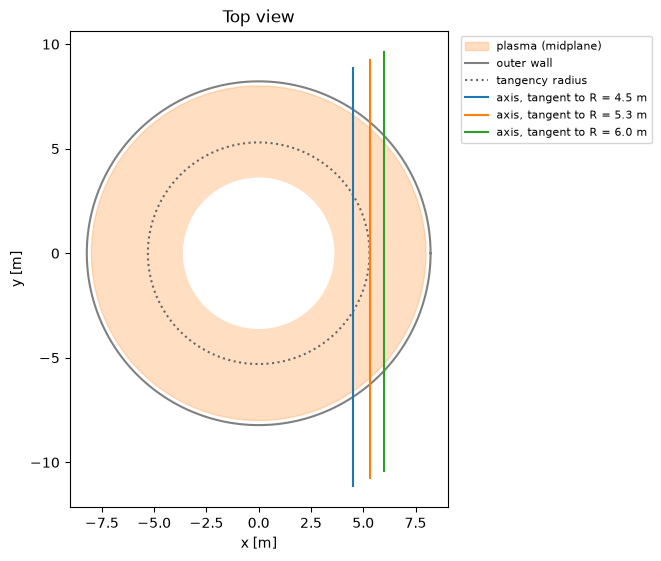
Beam markers
Describe a neutral beam as markers: streams of fast atoms with a position, a velocity and a weight in atoms per second. Aim the beam with tangentialinjection, give it a width, a divergence and a…
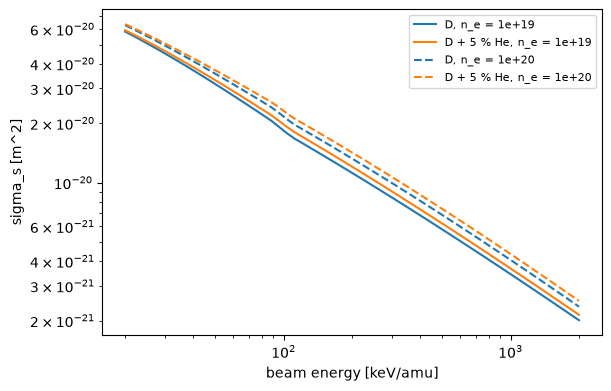
Stopping and shine-through
Attenuate a beam along its path through the plasma: where its atoms are ionised (the birth profile), how much shines through onto the wall, and how both depend on the density and the beam energy.
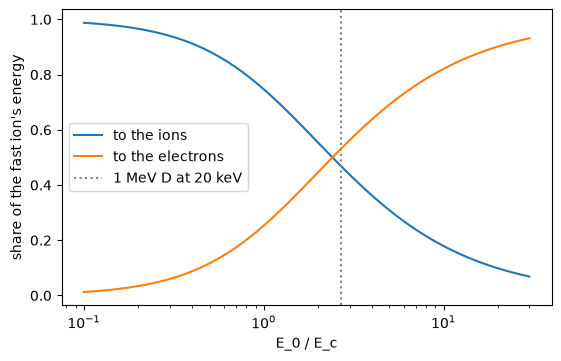
Slowing down, heating and current drive
Follow the fast ions from their birth until they join the thermal plasma: how their energy splits between electrons and ions, the fast-ion density and pressure they build up, and the current they…
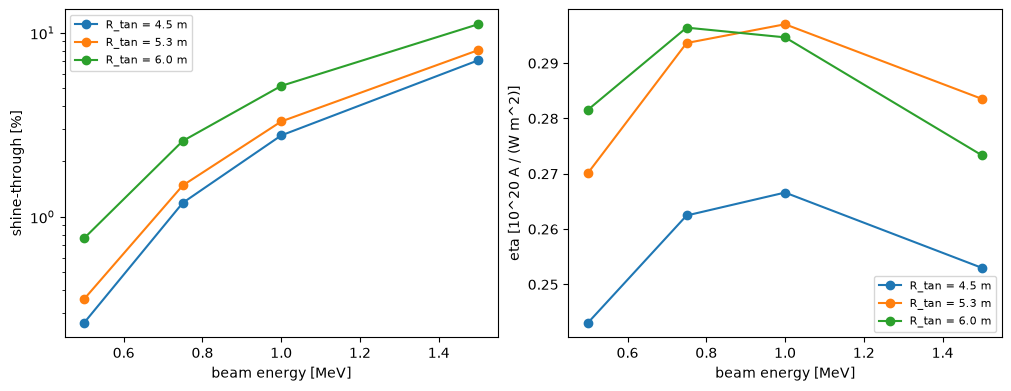
Designing the injection
Scan the beam energy and the tangency radius of an injector and weigh the shine-through onto the wall against the current the beam drives. This is the loop freeofcharge is built for: fast enough to…
Nothing matches.