Sources and gas heating
Two extensions of the global model of the first tutorial:
external volume sources (VolumeSource), such as the electrons and ions a fast beam
makes, and the gas temperature as a balance of heating by the reactions against
conduction to the walls (GasTemperature). The argon data are the same illustrative
step cross section.
from plasmacoll import CrossSectionfrom plasmacoll.constants import ELECTRON_MASS
from carafe import (    ELECTRON,    Chamber,    GasTemperature,    GlobalModel,    Reaction,    Species,    VolumeSource,)
argon = Species.atomic("Ar", 39.948)argon_ion = Species.atomic("Ar+", 39.948, 1)ionization = Reaction.from_cross_section(    ("e", "Ar"),    ("e", "e", "Ar+"),    CrossSection.constant(2.0e-20, threshold=15.76),    ELECTRON_MASS,    electron_energy_loss=15.76,    name="ionization",)chamber = Chamber(volume=1.0e-3, wall_area=0.06, h_factor=0.5)

def argon_model(**settings):    defaults = {        "species": [ELECTRON, argon, argon_ion],        "reactions": [ionization],        "chamber": chamber,        "power": 100.0,        "fixed": {"Ar": 1.0e20},    }    return GlobalModel(**{**defaults, **settings})
1. A beam as the only source
Section titled “1. A beam as the only source”A VolumeSource adds rate * prod(n_per) events per m³ and s, each changing the
densities by changes and giving the electrons electron_energy (eV). Here a beam strips
electrons at a fixed rate, 300 eV each, and ionizes the gas at a rate per gas atom; no
power is absorbed otherwise.
stripping = VolumeSource({"e": 1}, 1.0e19, electron_energy=300.0, name="stripping")pairs = VolumeSource({"e": 1, "Ar+": 1}, 1.0e-2, per=("Ar",), name="beam ionization")beam = argon_model(power=0.0, sources=[stripping, pairs]).steady_state()beam.converged, beam.electron_temperature, beam.electron_density(True, 3.0381180865858726, 926884774581957.9)The stripped electrons are a net negative charge: more electrons than ions reach the walls, and the sheath is lower. The power terms still sum to zero.
beam.wall_losses["e"] - beam.wall_losses["Ar+"], beam.power(1e+19, {'absorbed': 0.0, 'ionization': -0.18767126103592202, 'stripping': 0.48065299019999996, 'walls': -0.2929817291640781})A source’s rate may also be a function of the temperatures, rate(T_e, T_g), for a source
that follows the plasma (sputtering by the ion flux to a target, say), or an array on the
cells in a Fluid1D.
2. The gas temperature
Section titled “2. The gas temperature”With gas_temperature=GasTemperature(...) the gas temperature is an unknown: the heating
of the reactions (their gas_heating per event, in eV) against the conduction
. A reaction that heats the gas by 0.5 eV per event:
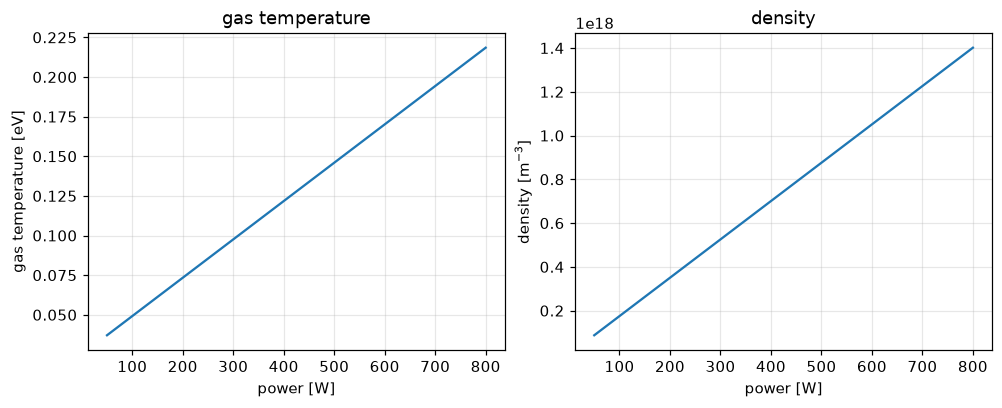
heating = Reaction( ("e", "Ar"), ("e", "Ar"), 1e-14, electron_energy_loss=0.5, gas_heating=0.5, name="gas heating collisions",)gas = GasTemperature(wall_temperature=0.025, conductivity=0.02, diffusion_length=0.02)heated = argon_model(reactions=[ionization, heating], gas_temperature=gas)state = heated.steady_state()state.converged, state.gas_temperature(True, 0.0491838029491625)state.power["gas heating"], state.power["gas conduction"](14.032068978577605, -14.032068978577625)The gas temperature rises with the absorbed power:
import plasma_plots
from carafe import stack
powers = [50.0, 100.0, 200.0, 400.0, 800.0]scan = stack(heated.scan("power", powers), "power", powers, units="W")with plasma_plots.figure(1, 2, figsize=(9, 3.6)) as fig:    scan.gas_temperature.plasma.plot.lineout(ax=fig[0])    scan.density.sel(species="e").plasma.plot.lineout(ax=fig[1])