OpenCR reaction sets
OpenCR derives effective rate coefficients of
hydrogen from collisional-radiative models with resolved excited states.
carafe.cr turns them into Reaction objects for the global and fluid models, in
place of ground-state cross sections and placeholders. It needs the cr extra
(pip install "plasma-carafe[cr]").
from carafe.cr import CR_TEMPERATURES, opencr_hydrogen_reactions
reactions = opencr_hydrogen_reactions(electron_density=1.0e17)[r.name for r in reactions]
['CR ionization of H', 'CR recombination of H+', 'CR energy loss on H (loss)', 'CR energy loss on H+ (loss)', 'CR energy loss on H+ (gain)', 'ionization of H2', 'dissociation of H2', 'dissociative ionization of H2', 'CR energy loss on H2 (loss)', 'elastic e-H2', 'elastic e-H', 'H3+ formation', 'dissociative recombination of H2+', 'dissociative recombination of H3+ to 3H', 'dissociative recombination of H3+']The effective rates depend on the electron density as well as the temperature; a
Reaction depends on the temperature only, so they are taken at electron_density, which
should be near the density of the solution (below about 1e18 m⁻³ the excited states are
coronal and the dependence is weak). The energy each electron loses per H, H+ and H2,
radiation included, is a pair of reactions that change no density.
import numpy as npimport plasma_plotsimport xarray as xr
temperature = xr.DataArray(    CR_TEMPERATURES,    dims="te",    attrs={"long_name": "electron temperature", "units": "eV"},)shown = ["CR ionization of H", "ionization of H2", "dissociation of H2",         "CR recombination of H+"]  # fmt: skiprates = xr.DataArray(    np.array(        [            [                next(r for r in reactions if r.name == name).coefficient(t, 0.03)                for t in CR_TEMPERATURES            ]            for name in shown        ]    ),  # fmt: skip    coords={"reaction": shown, "te": temperature},    name="rate",    attrs={"long_name": "rate coefficient", "units": "m^3/s"},)with plasma_plots.figure(1, 1, figsize=(6, 4)) as fig:    rates.plasma.plot.profiles(x="te", over="reaction", logx=True, logy=True, ax=fig[0])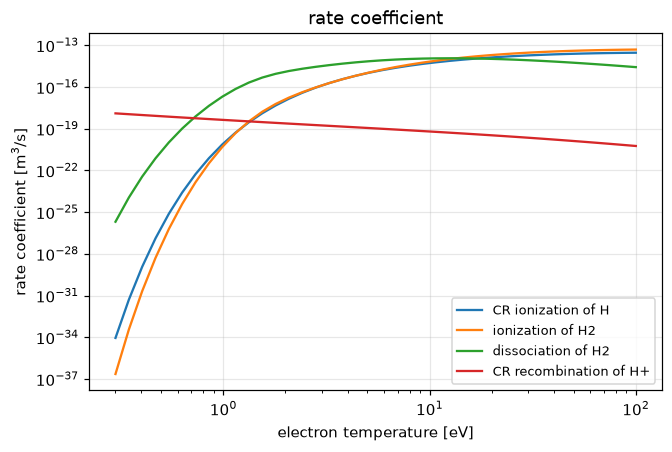
A driver with OpenCR’s rates
Section titled “A driver with OpenCR’s rates”hydrogen_driver is the 0D RF driver of the RF driver tutorial
with these reactions; deuterium_neutralizer does the same for the
neutralizer. Against the placeholder rates at
25 kW absorbed:
import warnings
from carafe.cr import hydrogen_driverfrom carafe.driver import illustrative_hydrogen_driver
with warnings.catch_warnings():    warnings.simplefilter("ignore", UserWarning)  # the placeholder-data warning    drivers = {        "placeholders": illustrative_hydrogen_driver(),        "OpenCR": hydrogen_driver(),    }for name, driver in drivers.items():    s = driver.solve(25e3)    print(        f"{name:>12}: n_e = {s.plasma.electron_density:.2e} m^-3, "        f"T_e = {s.plasma.electron_temperature:.2f} eV, efficiency {s.efficiency:.2f}"    )
placeholders: n_e = 1.87e+18 m^-3, T_e = 5.56 eV, efficiency 0.67 OpenCR: n_e = 1.16e+18 m^-3, T_e = 8.52 eV, efficiency 0.62The dissociation now heats the gas (gas_heating, a few eV per event from the
Franck-Condon fragments), which a GasTemperature balance takes up, see
Sources and gas heating.