RF driver neutrals
The BUG driver’s gas: H and H2 as Navier–Stokes fluids, depleted and heated by the plasma.
Step R3.5 of the RF-driver plan: :class:carafe.spatial.NeutralFluid2D, the neutral
model of Zielke et al. (PSST 31, 035019, 2022, section 2.3), coupled to the driver plasma
of :class:carafe.spatial.Fluid2D by :func:carafe.spatial.couple_neutrals.
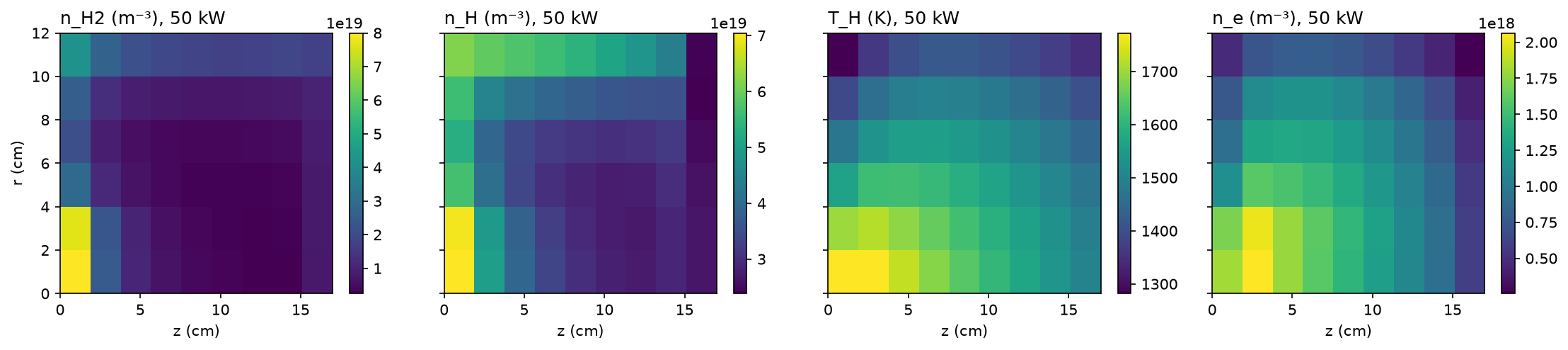
The driver is the r–z cylinder of :mod:examples.rf_driver_fluid2d (radius 12 cm, 17 cm
long), uniformly heated (no field here: the field coupling is
:func:carafe.spatial.fluid_plasma); H2 comes in through the backplate near the
axis at the rate that fills the driver to 0.3 Pa at 300 K without plasma, and both
species leave through the open end (the expansion region, here a grid of transparency
0.3); the atoms recombine on the walls with a probability of 0.1, the ions come back as
gas. At each power the plasma and the gas are iterated to a common steady state.
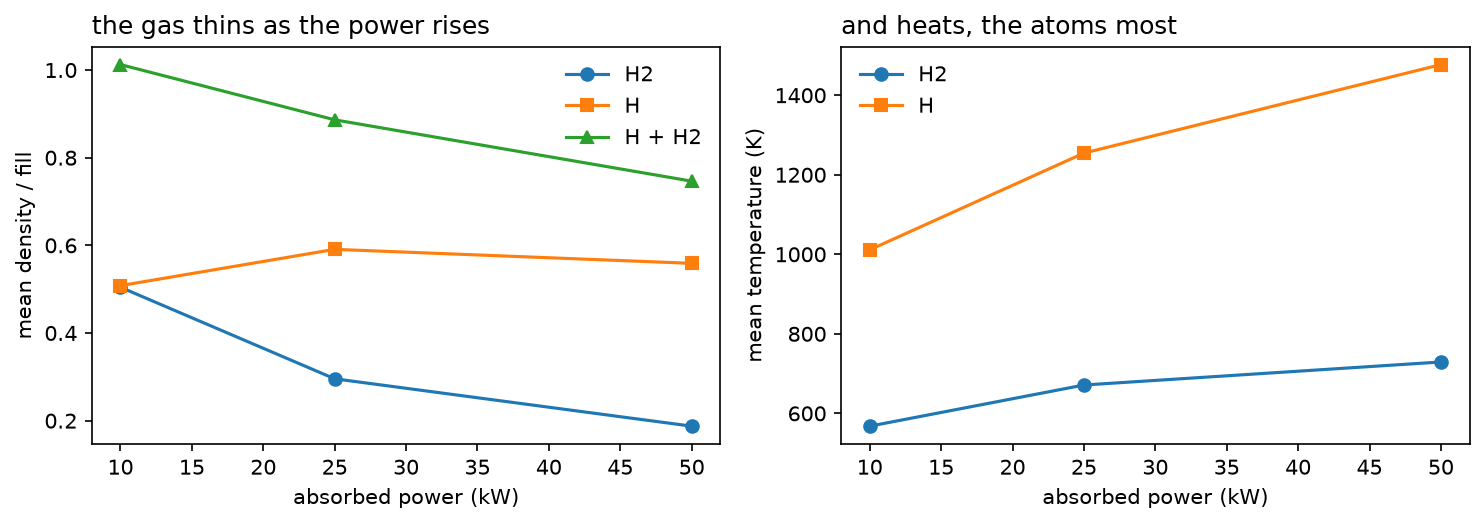
It shows what the fixed background of NIBS’22 leaves out: the gas thins where the plasma is, the atoms (Franck–Condon fragments, charge exchange with the drifting ions) are hotter than the molecules, and the plasma’s density follows.
Every rate is a placeholder: the plasma’s reactions are those of
:func:carafe.driver.illustrative_hydrogen_driver (constant cross sections), the
neutral collisions hard spheres (H2–H2 of the size that gives H2’s viscosity at 300 K),
the wall probability, transparency and Franck–Condon energies round numbers; the grid
is coarse (2 cm). The numbers show the model working, not the BUG driver.
Python source
Section titled “Python source”"""RF driver neutrals.
The BUG driver's gas: H and H2 as Navier–Stokes fluids, depleted and heated by the plasma.
Step R3.5 of the RF-driver plan: :class:`carafe.spatial.NeutralFluid2D`, the neutralmodel of Zielke et al. (PSST 31, 035019, 2022, section 2.3), coupled to the driver plasmaof :class:`carafe.spatial.Fluid2D` by :func:`carafe.spatial.couple_neutrals`.The driver is the r–z cylinder of :mod:`examples.rf_driver_fluid2d` (radius 12 cm, 17 cmlong), uniformly heated (no field here: the field coupling is:func:`carafe.spatial.fluid_plasma`); H2 comes in through the backplate near theaxis at the rate that fills the driver to 0.3 Pa at 300 K without plasma, and bothspecies leave through the open end (the expansion region, here a grid of transparency0.3); the atoms recombine on the walls with a probability of 0.1, the ions come back asgas. At each power the plasma and the gas are iterated to a common steady state.
It shows what the fixed background of NIBS'22 leaves out: the gas thins where the plasmais, the atoms (Franck–Condon fragments, charge exchange with the drifting ions) arehotter than the molecules, and the plasma's density follows.
Every rate is a placeholder: the plasma's reactions are those of:func:`carafe.driver.illustrative_hydrogen_driver` (constant cross sections), theneutral collisions hard spheres (H2–H2 of the size that gives H2's viscosity at 300 K),the wall probability, transparency and Franck–Condon energies round numbers; the gridis coarse (2 cm). The numbers show the model working, not the BUG driver."""
import timeimport warnings
import matplotlib.pyplot as pltimport numpy as npfrom plasmacoll.constants import BOLTZMANN, ELEMENTARY_CHARGE
from carafe import ELECTRON, WallReactionfrom carafe.driver import illustrative_hydrogen_driverfrom carafe.fluid1d import FluidSpeciesfrom carafe.spatial import ( CellGrid, Collision, Fluid2D, Inlet, NeutralFluid2D, NeutralSpecies, Opening, couple_neutrals, hard_sphere,)from carafe.spatial.neutrals import ROOM_TEMPERATURE
E = ELEMENTARY_CHARGEKELVIN = BOLTZMANN / EPOWERS = [10e3, 25e3, 50e3]RADIUS, LENGTH = 0.12, 0.17TRANSPARENCY, RECOMBINATION = 0.3, 0.1
with warnings.catch_warnings(): warnings.simplefilter("ignore", UserWarning) # placeholder rates, said above driver = illustrative_hydrogen_driver(radius=RADIUS, length=LENGTH)gas_temperature = driver.model_options["gas_temperature"]mass = {s.name: s.mass for s in driver.species}grid = CellGrid( np.linspace(0.0, RADIUS, 7), np.linspace(0.0, LENGTH, 10), geometry="cylindrical")volume = np.pi * RADIUS**2 * LENGTH
# the plasma: electrons, H+, H2+ and H3+, ions with a 3 cm mean free pathspecies = [FluidSpecies(ELECTRON, 1.0)]for s in driver.species: if s.charge and s.name != "e": thermal = np.sqrt(8 * E * gas_temperature / (np.pi * s.mass)) species.append( FluidSpecies(s, E * driver.ion_mean_free_path / (s.mass * thermal)) )plasma = Fluid2D( grid, species, driver.reactions, fixed=driver.fixed, gas_temperature=gas_temperature, momentum_transfer=driver.momentum_transfer, ion_mean_free_path=driver.ion_mean_free_path, heating=POWERS[0] / volume,)
# the gas: H2 (two rotational and one vibrational degree of freedom, as the paper) and Hfill = 0.3 / (E * ROOM_TEMPERATURE)mean_speed = np.sqrt(8 * E * ROOM_TEMPERATURE / (np.pi * mass["H2"]))feed = TRANSPARENCY * fill * mean_speed / 4 * np.pi * RADIUS**2collisions = [ Collision("H2", "H2", hard_sphere(2.6e-19, mass["H2"], mass["H2"])), Collision("H", "H2", hard_sphere(2.0e-19, mass["H"], mass["H2"])), Collision("H", "H", hard_sphere(1.5e-19, mass["H"], mass["H"])), Collision("H", "H+", 3e-15), # charge exchange: twice its rate coefficient] + [ Collision(n, ion, 2e-15) for n in ("H", "H2") for ion in ("H+", "H2+", "H3+") if (n, ion) != ("H", "H+")]gas = NeutralFluid2D( grid, [ NeutralSpecies(next(s for s in driver.species if s.name == "H2"), 3.0), NeutralSpecies(next(s for s in driver.species if s.name == "H"), 0.0), ], driver.reactions, plasma_species=[s for s in driver.species if s.charge], collisions=collisions, wall_reactions=[WallReaction("H", RECOMBINATION, {"H2": 0.5})], ion_wall_products=driver.model_options["ion_wall_products"], openings=[Opening(lambda r, z: z > LENGTH - 1e-9, TRANSPARENCY, "grid")], inlets=[Inlet(lambda r, z: (z < 1e-9) & (r < 0.04), "H2", feed)],)
# a first plasma in the fixed background, then the power scanshape = np.cos(0.4 * np.pi * grid.xx / RADIUS) * np.sin( np.pi * (0.9 * grid.yy / LENGTH + 0.05))ions = {"H+": 0.25, "H2+": 0.5, "H3+": 0.25}start = time.perf_counter()fixed_state = plasma.steady_state( plasma.pack({n: f * 1e18 * shape for n, f in ions.items()}, 6.0, 30.0))neutral_guess = gas.pack({"H2": fill, "H": 0.1 * fill}, ROOM_TEMPERATURE)plasma_guess = fixed_stateresults = []print(f"fill: {fill:.3g} m^-3 of H2 at 300 K (0.3 Pa), fed at {feed:.3g} /s")for power in POWERS: plasma.heating = np.full(plasma.size, power / volume) reference = plasma.steady_state(plasma_guess.unknowns) # in the fixed background coupled = couple_neutrals(plasma, gas, reference, neutral_guess, tolerance=3e-3) state, ions_state = coupled.neutrals, coupled.plasma results.append((power, reference, coupled)) total = state.densities["H"] + state.densities["H2"] print( f"{power / 1e3:4.0f} kW: {coupled.passes} passes (converged: {coupled.converged}); " f"n_H + n_H2 = {state.mean(total):.3g} m^-3 ({state.mean(total) / fill:.2f} of " f"the fill), n_H / n_H2 = {state.mean(state.densities['H']) / state.mean(state.densities['H2']):.2f}, " f"p = {state.mean(state.pressure):.2f} Pa; " f"T_H2 = {state.mean(state.temperatures['H2']) / KELVIN:.0f} K, " f"T_H = {state.mean(state.temperatures['H']) / KELVIN:.0f} K; " f"n_e = {ions_state.mean(ions_state.electron_density):.3g} m^-3 " f"(fixed gas: {reference.mean(reference.electron_density):.3g}), " f"T_e = {ions_state.mean(ions_state.electron_temperature):.2f} eV " f"(fixed gas: {reference.mean(reference.electron_temperature):.2f})" ) heat = gas.energy_balance(state) print( f" gas heating: reactions {heat['reactions']:.0f} W, collisions with " f"the ions {heat['collisions']:.0f} W, to the walls {-heat['walls']:.0f} W" ) neutral_guess, plasma_guess = state.unknowns, ions_stateprint(f"{time.perf_counter() - start:.0f} s")
# --- figures ------------------------------------------------------------------------------power, reference, coupled = results[-1]state = coupled.neutralsr, z = grid.x * 100, grid.y * 100fig, axes = plt.subplots(1, 4, figsize=(15, 3.4), sharey=True)panels = [ (state.densities["H2"], "n_H2 (m⁻³)"), (state.densities["H"], "n_H (m⁻³)"), (state.temperatures["H"] / KELVIN, "T_H (K)"), (coupled.plasma.electron_density, "n_e (m⁻³)"),]for ax, (values, title) in zip(axes, panels, strict=True): mesh = ax.pcolormesh(z, r, values, shading="auto") ax.set_xlabel("z (cm)") ax.set_title(f"{title}, {power / 1e3:.0f} kW", loc="left") fig.colorbar(mesh, ax=ax)axes[0].set_ylabel("r (cm)")fig.tight_layout()
fig, (left, right) = plt.subplots(1, 2, figsize=(10, 3.6))kw = [p / 1e3 for p, _, _ in results]for name, style in (("H2", "-o"), ("H", "-s")): left.plot( kw, [c.neutrals.mean(c.neutrals.densities[name]) / fill for _, _, c in results], style, label=name, ) right.plot( kw, [ c.neutrals.mean(c.neutrals.temperatures[name]) / KELVIN for _, _, c in results ], style, label=name, )left.plot( kw, [ c.neutrals.mean(c.neutrals.densities["H"] + c.neutrals.densities["H2"]) / fill for _, _, c in results ], "-^", label="H + H2",)left.set_xlabel("absorbed power (kW)")left.set_ylabel("mean density / fill")left.set_title("the gas thins as the power rises", loc="left")left.legend(frameon=False)right.set_xlabel("absorbed power (kW)")right.set_ylabel("mean temperature (K)")right.set_title("and heats, the atoms most", loc="left")right.legend(frameon=False)fig.tight_layout()