Wind efficiency
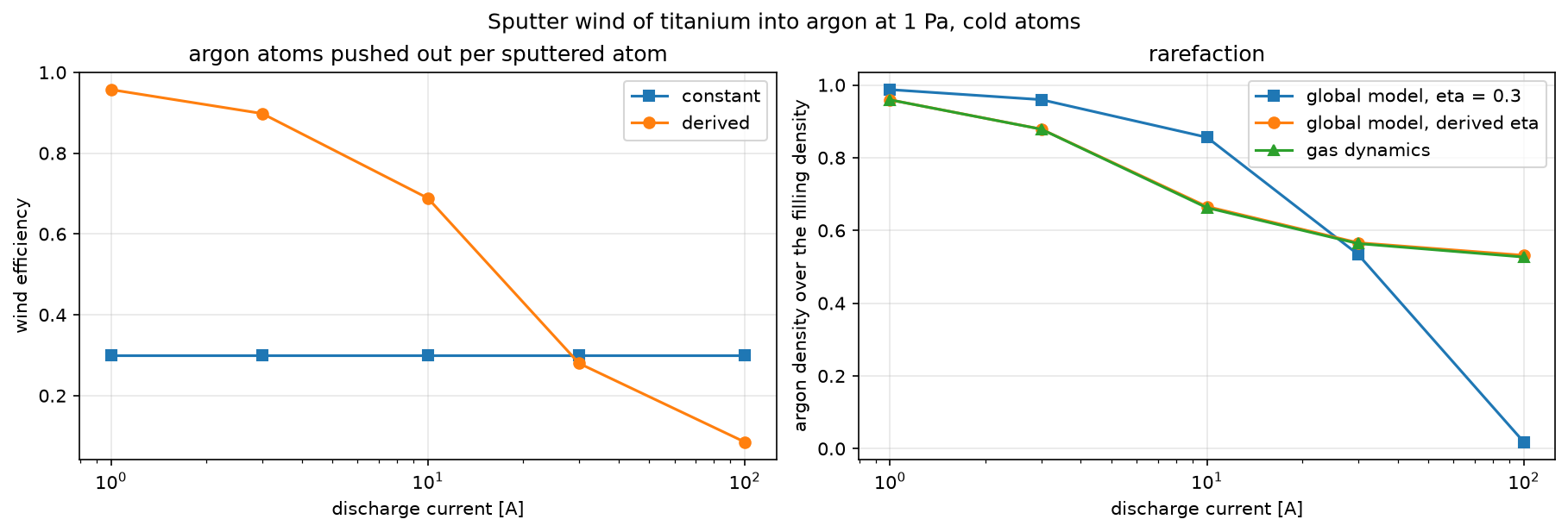
The global model’s sputter wind, with a wind efficiency derived from the compressible gas.
The global model (:class:carafe.Magnetron) rarefies the argon with a sputter wind
that pushes eta argon atoms out of the ionization region per sputtered atom. With a
constant eta = 0.3 the rarefaction at 100 A is far stronger than that of the argon as a
compressible gas in front of the target (examples/sputter_wind_gas_dynamics.py).
carafe.magnetron.wind_efficiency_from_gas_dynamics runs the gas
(carafe.magnetron.sputter_wind_gas: titanium sputtered cold into 2 cm of argon at 1
Pa, refilled from the far end) to its steady state at six sputtered fluxes and sets
eta(Gamma) so that the global model’s argon deficit is the gas’s mean deficit. The first
figure is eta against the discharge current; the second the rarefaction of the global
model with the constant and with the derived eta, and, as a check between the points
eta was derived at, the gas run at the sputtered flux the global model finds with it.
The gas model is the continuum (Euler) limit at Knudsen numbers near 1, so a kinetic (DSMC)
check is still due; its diffusion, conduction and side-wall cooling, the yields and the
refill time are placeholders, and the derived eta holds for this refill time and region
height.
Python source
Section titled “Python source”"""Wind efficiency.
The global model's sputter wind, with a wind efficiency derived from the compressible gas.
The global model (:class:`carafe.Magnetron`) rarefies the argon with a sputter windthat pushes ``eta`` argon atoms out of the ionization region per sputtered atom. With aconstant ``eta = 0.3`` the rarefaction at 100 A is far stronger than that of the argon as acompressible gas in front of the target (``examples/sputter_wind_gas_dynamics.py``).`carafe.magnetron.wind_efficiency_from_gas_dynamics` runs the gas(`carafe.magnetron.sputter_wind_gas`: titanium sputtered cold into 2 cm of argon at 1Pa, refilled from the far end) to its steady state at six sputtered fluxes and sets``eta(Gamma)`` so that the global model's argon deficit is the gas's mean deficit. The firstfigure is ``eta`` against the discharge current; the second the rarefaction of the globalmodel with the constant and with the derived ``eta``, and, as a check between the points``eta`` was derived at, the gas run at the sputtered flux the global model finds with it.
The gas model is the continuum (Euler) limit at Knudsen numbers near 1, so a kinetic (DSMC)check is still due; its diffusion, conduction and side-wall cooling, the yields and therefill time are placeholders, and the derived ``eta`` holds for this refill time and regionheight."""
import dataclassesimport warnings
import numpy as npimport plasma_plots
from carafe import MATERIALS, Magnetronfrom carafe.magnetron import sputter_wind_gas, wind_efficiency_from_gas_dynamics
warnings.filterwarnings("ignore", message=".*placeholders, not data")
CURRENTS = (1.0, 3.0, 10.0, 30.0, 100.0)
def voltage(current: float) -> float: """A placeholder current-voltage characteristic, 400 V at 0.1 A rising slowly.""" return 400.0 + 60.0 * np.log10(1.0 + current)
constant = Magnetron(material=MATERIALS["Ti"], wind_efficiency=0.3)constant = constant.calibrate_heating(2.0, voltage(2.0))efficiency = wind_efficiency_from_gas_dynamics(constant)derived = dataclasses.replace(constant, wind_efficiency=efficiency)
print("wind efficiency from the gas dynamics (cold sputtered atoms)")print(" flux [1/m^2/s] mean argon deficit eta")for flux, deficit, eta in zip( efficiency.flux, efficiency.deficit, efficiency.efficiency, strict=True): print(f" {flux:12.2e} {deficit:18.3f} {eta:5.3f}")
rows = []for current in CURRENTS: row = {"current": current} for label, magnetron in (("constant", constant), ("derived", derived)): state = magnetron.steady_state(current, voltage(current)) diagnostics = magnetron.diagnostics(state) row[f"{label}_rarefaction"] = diagnostics["rarefaction"] row[f"{label}_eta"] = diagnostics["wind_efficiency"] row[f"{label}_flux"] = ( magnetron.target_currents(state)["sputtered"] / magnetron.target_area ) gas = sputter_wind_gas(derived, row["derived_flux"]).steady_state( tolerance=1.0e-4, max_time=1.0e-2 ) row["gas_rarefaction"] = float(np.mean(gas.gas_number)) / derived.gas_density rows.append(row)
print("argon density over the filling density against the discharge current")print(" I [A] eta global, eta = 0.3 global, derived eta gas dynamics")for row in rows: print( f" {row['current']:5.0f} {row['derived_eta']:5.3f}" f" {row['constant_rarefaction']:17.3f} {row['derived_rarefaction']:19.3f}" f" {row['gas_rarefaction']:12.3f}" )
with plasma_plots.figure( 1, 2, title="Sputter wind of titanium into argon at 1 Pa, cold atoms") as fig: fig[0].plot( CURRENTS, [r["constant_eta"] for r in rows], marker="s", label="constant" ) fig[0].plot(CURRENTS, [r["derived_eta"] for r in rows], marker="o", label="derived") fig[0].set_xscale("log") fig[0].set_xlabel("discharge current [A]") fig[0].set_ylabel("wind efficiency") fig[0].set_title("argon atoms pushed out per sputtered atom") fig[0].legend() for key, label, marker in ( ("constant_rarefaction", "global model, eta = 0.3", "s"), ("derived_rarefaction", "global model, derived eta", "o"), ("gas_rarefaction", "gas dynamics", "^"), ): fig[1].plot(CURRENTS, [r[key] for r in rows], marker=marker, label=label) fig[1].set_xscale("log") fig[1].set_xlabel("discharge current [A]") fig[1].set_ylabel("argon density over the filling density") fig[1].set_title("rarefaction") fig[1].legend()