Neutralizer gas scan
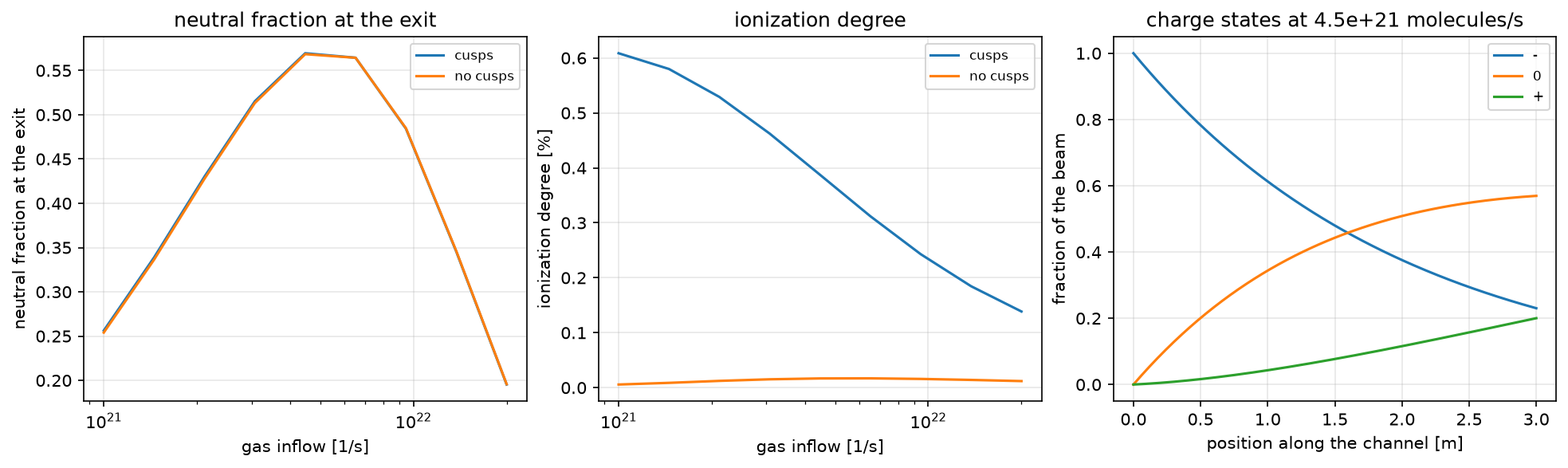
A beam-driven plasma neutralizer: the neutral fraction against the gas flow.
The beam-driven plasma neutralizer is a concept studied for DEMO, not the gas
neutralizer of ITER’s injectors, which is the same channel without the cusps
(cusp=None).
A 1 MeV, 10 A deuterium negative-ion beam crosses a 3 m channel. On the gas,
and on the plasma it makes itself, it changes charge state; the plasma is a
global model of the channel fed by the beam’s stripped and secondary electrons.
Magnetic cusps on the side walls confine the plasma: it is far denser, but its
ionization degree stays below a per cent, too little for stripping on the plasma
to raise the neutral fraction much over that of the gas alone. The cross sections
and rates are illustrative placeholders, not data (see
carafe.neutralizer.illustrative_deuterium_neutralizer): the curves show
what the model computes, not what a neutralizer achieves. Every scan is one
xarray dataset, plotted with plasma-plots.
Python source
Section titled “Python source”"""Neutralizer gas scan.
A beam-driven plasma neutralizer: the neutral fraction against the gas flow.
The beam-driven plasma neutralizer is a concept studied for DEMO, not the gasneutralizer of ITER's injectors, which is the same channel without the cusps(``cusp=None``).
A 1 MeV, 10 A deuterium negative-ion beam crosses a 3 m channel. On the gas,and on the plasma it makes itself, it changes charge state; the plasma is aglobal model of the channel fed by the beam's stripped and secondary electrons.Magnetic cusps on the side walls confine the plasma: it is far denser, but itsionization degree stays below a per cent, too little for stripping on the plasmato raise the neutral fraction much over that of the gas alone. The cross sectionsand rates are illustrative placeholders, not data (see``carafe.neutralizer.illustrative_deuterium_neutralizer``): the curves showwhat the model computes, not what a neutralizer achieves. Every scan is onexarray dataset, plotted with plasma-plots."""
import warnings
import numpy as npimport plasma_plotsimport xarray as xr
from carafe import stackfrom carafe.neutralizer import illustrative_deuterium_neutralizer
warnings.simplefilter("ignore", UserWarning) # the placeholder data warnflows = np.geomspace(1.0e21, 2.0e22, 9) # molecules/scases = {"cusps": {}, "no cusps": {"cusp": None}}scans = []for overrides in cases.values(): model = illustrative_deuterium_neutralizer(**overrides) results = model.scan("gas_inflow", list(flows)) scans.append( stack(results, "gas_inflow", flows, long_name="gas inflow", units="1/s") )result = xr.concat(scans, dim="case").assign_coords(case=list(cases))
electrons = result.density.sel(species="e")gas = result.density.sel(species="D2") + result.density.sel(species="D")ionization = 100 * electrons / (electrons + gas)ionization.attrs.update(long_name="ionization degree", units="%")
with plasma_plots.figure(1, 3, figsize=(13, 3.8)) as fig: result.neutral_fraction.plasma.plot.profiles( x="gas_inflow", over="case", logx=True, ax=fig[0] ) ionization.plasma.plot.profiles(x="gas_inflow", over="case", logx=True, ax=fig[1]) # the beam along the channel, cusps, at the flow nearest the best neutral fraction best = int(np.argmax(result.neutral_fraction.sel(case="cusps").values)) result.fraction.sel(case="cusps").isel(gas_inflow=best).plasma.plot.profiles( x="position", over="state", title=f"charge states at {flows[best]:.2g} molecules/s", ax=fig[2], )