Halos: stencils on patches
A field allocated with halo=h has h cells (or nodes) around every patch. Fill them with
exchange_halos, and a finite-difference stencil can be applied to each patch on its own,
right up to its edges. restrict goes the other way, from fine patches to the coarse points
under them.
import numpy as np
from patchwork import AMRHierarchy, plot_patches
Filling the halos
Section titled “Filling the halos”A halo point is filled from a patch of the same level where there is one, across periodic
faces too; elsewhere by bilinear interpolation of the level below. Halo points outside the
domain are left as they are, for the boundary condition. Here a linear function is set on the
patches’ own nodes only, and the halos start at NaN.
mesh = AMRHierarchy(base_shape=(16, 16))mesh.add_patch(level=1, box=((8, 20), (0, 32)))  # from wall to wall in ymesh.add_patch(level=1, box=((20, 28), (8, 20)))  # its neighbourmesh.add_patch(level=2, box=((24, 40), (16, 32)))mesh.allocate_field("u", halo=1, centering="node")

def u(x, y):    return 1.0 + 2.0 * x + 3.0 * y

for patch in mesh:    storage = patch.field("u").local_with_halos    storage[...] = np.nan    x, y = patch.local_node_coordinates(mesh, "u")    patch.field("u").local[...] = u(x, y)
mesh.exchange_halos("u")
fine = mesh.patches[-1].field("u").local_with_halosprint("NaN halo points left on the level-2 patch:", int(np.isnan(fine).sum()))print(    "NaN halo points on the base, outside the domain:",    int(np.isnan(mesh.patches[0].field("u").local_with_halos).sum()),)fig, ax = plot_patches(mesh, field="u")
NaN halo points left on the level-2 patch: 0NaN halo points on the base, outside the domain: 72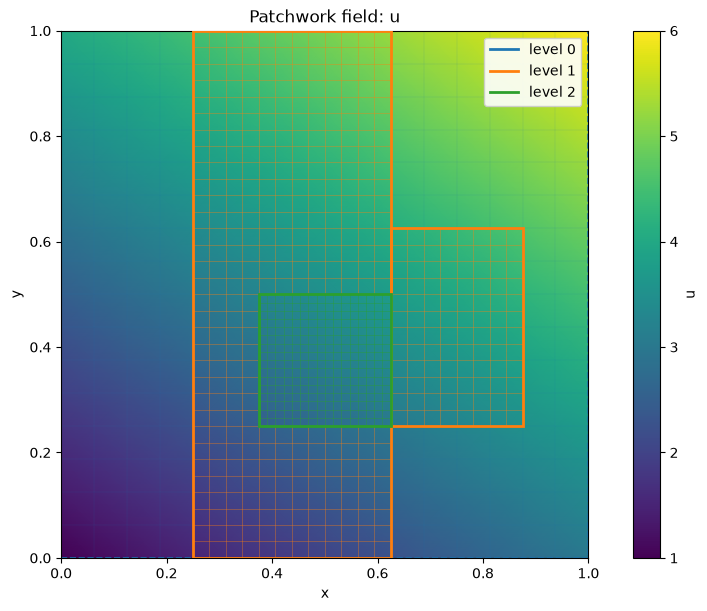
A stencil on every patch
Section titled “A stencil on every patch”With the halos filled, the centred difference can be taken on all of a patch’s own nodes. For it is 2 everywhere, also on the nodes at a patch’s edge, whose neighbour comes from another patch or from the level below.
Bilinear interpolation is exact for a linear function only. For a curved one, a halo point filled from the level below carries the coarse level’s interpolation error, and a stencil that reaches into it sees that error: place patch edges where the solution is smooth on the coarser level.
for patch in mesh.patches[1:]: dx, _ = mesh.spacing(patch.level) storage = patch.field("u").local_with_halos derivative = (storage[2:, 1:-1] - storage[:-2, 1:-1]) / (2 * dx) print( f"level {patch.level} {patch.box}: du/dx between " f"{derivative.min():.12f} and {derivative.max():.12f}" )level 1 ((8, 20), (0, 32)): du/dx between 2.000000000000 and 2.000000000000level 1 ((20, 28), (8, 20)): du/dx between 2.000000000000 and 2.000000000000level 2 ((24, 40), (16, 32)): du/dx between 2.000000000000 and 2.000000000000Restriction
Section titled “Restriction”restrict gives coarse cells the mean of the fine cells over them, and coarse nodes the fine
node at the same place, finest level first. Afterwards the coarse level agrees with the fine
one wherever they overlap; call exchange_halos after it if the halos are needed.
for patch in mesh:    if patch.level == 0:        patch.field("u").local[...] = 0.0  # forget the coarse values
mesh.restrict("u")
base = mesh.patches[0]x, y = base.local_node_coordinates(mesh, "u")restored = ~np.isclose(base.field("u").local, 0.0)print("base nodes under a finer patch, now with the fine value:", int(restored.sum()))print(    "largest difference to u there:",    float(np.abs(base.field("u").local - u(x, y))[restored].max()),)
base nodes under a finer patch, now with the fine value: 147largest difference to u there: 0.0Both calls are collective under MPI and work wherever the patches are: each patch can live
on its own ranks (add_patch(..., ranks=...)), and the data travel in one exchange over the
hierarchy’s communicator. The schedules are built at the first call for a field and kept until
a patch is added.