Poisson's equation on cells
solve_poisson solves with one value per cell, on all patches at
once: a conservative finite-volume scheme in which a coarse cell next to a patch exchanges
flux with the fine cells along their shared face. The boundary value is one constant on
the whole boundary.
import numpy as np
from patchwork import AMRHierarchy, plot_patches, solve_poisson
A problem with a known answer
Section titled “A problem with a known answer”On the unit square, vanishes on the boundary and has . The right-hand side is a cell-centered field, set from the cell centres.
def exact(x, y):    return np.sin(np.pi * x) * np.sin(np.pi * y)

def solve(base, patches=()):    mesh = AMRHierarchy(base_shape=(base, base))    for level, box in patches:        mesh.add_patch(level=level, box=box)    mesh.allocate_field("rhs")    for patch in mesh:        x, y = patch.local_cell_centers(mesh)        patch.field("rhs").local[...] = 2 * np.pi**2 * exact(x, y)    solve_poisson(mesh, "rhs", potential="phi")    error = max(        np.abs(patch.field("phi").local - exact(*patch.local_cell_centers(mesh))).max()        for patch in mesh    )    return mesh, error

mesh, error = solve(32, [(1, ((16, 48), (16, 48)))])print(f"largest error: {error:.2e}")fig, ax = plot_patches(mesh, field="phi")
largest error: 5.00e-03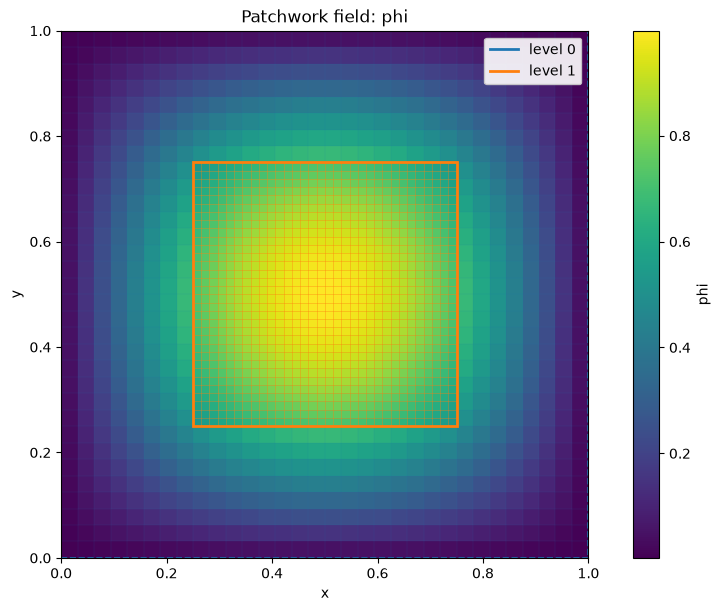
solve_poisson writes the solution into the field named by potential, allocating it
if needed. The cells of a coarse patch that a finer patch covers hold the mean of the fine
cells over them.
Convergence
Section titled “Convergence”Halving the cells divides the error by about four: the scheme is second order.
previous = Nonefor base in (16, 32, 64): _, error = solve(base) ratio = "" if previous is None else f", {previous / error:.1f} times smaller" print(f"{base} x {base} cells: error {error:.2e}{ratio}") previous = error16 x 16 cells: error 3.19e-0332 x 32 cells: error 8.02e-04, 4.0 times smaller64 x 64 cells: error 2.01e-04, 4.0 times smallerFor faces with different conditions, periodic axes or electrodes inside the domain, use the node-centered solver of the next tutorial.