Quickstart
Patchwork uses mpiarray for patch fields. It runs in serial without an MPI
launcher (or MPI installed), and supports distributed patch arrays when run
under mpiexec after installing the mpi extra.
Create a hierarchy
Section titled “Create a hierarchy”from patchwork import AMRHierarchy, solve_poisson
mesh = AMRHierarchy(base_shape=(32, 24), bounds=((0, 2), (-0.5, 1)))fine = mesh.add_patch(level=1, box=((16, 48), (12, 36)))mesh.allocate_field("density", halo=1)fine.field("density").local[:] = 1.0solve_poisson(mesh, "density", potential="phi")Patch bounds are half-open cell-index intervals at that patch’s level. Fine patch bounds align to their parent grid and must be contained in a parent patch. The root level is the full domain and is created automatically.
Plot the patch layout and cells
Section titled “Plot the patch layout and cells”Install the plotting extra, then:
from patchwork import plot_patches
fig, ax = plot_patches(mesh, field="density")fig.savefig("patches.png", dpi=180)
The plot overlays the active level grids and colors each patch by its field. solve_poisson assembles a conservative finite-volume operator across coarse-fine faces and applies a constant Dirichlet value on the domain boundary. See examples/composite_poisson.py for a manufactured solution.
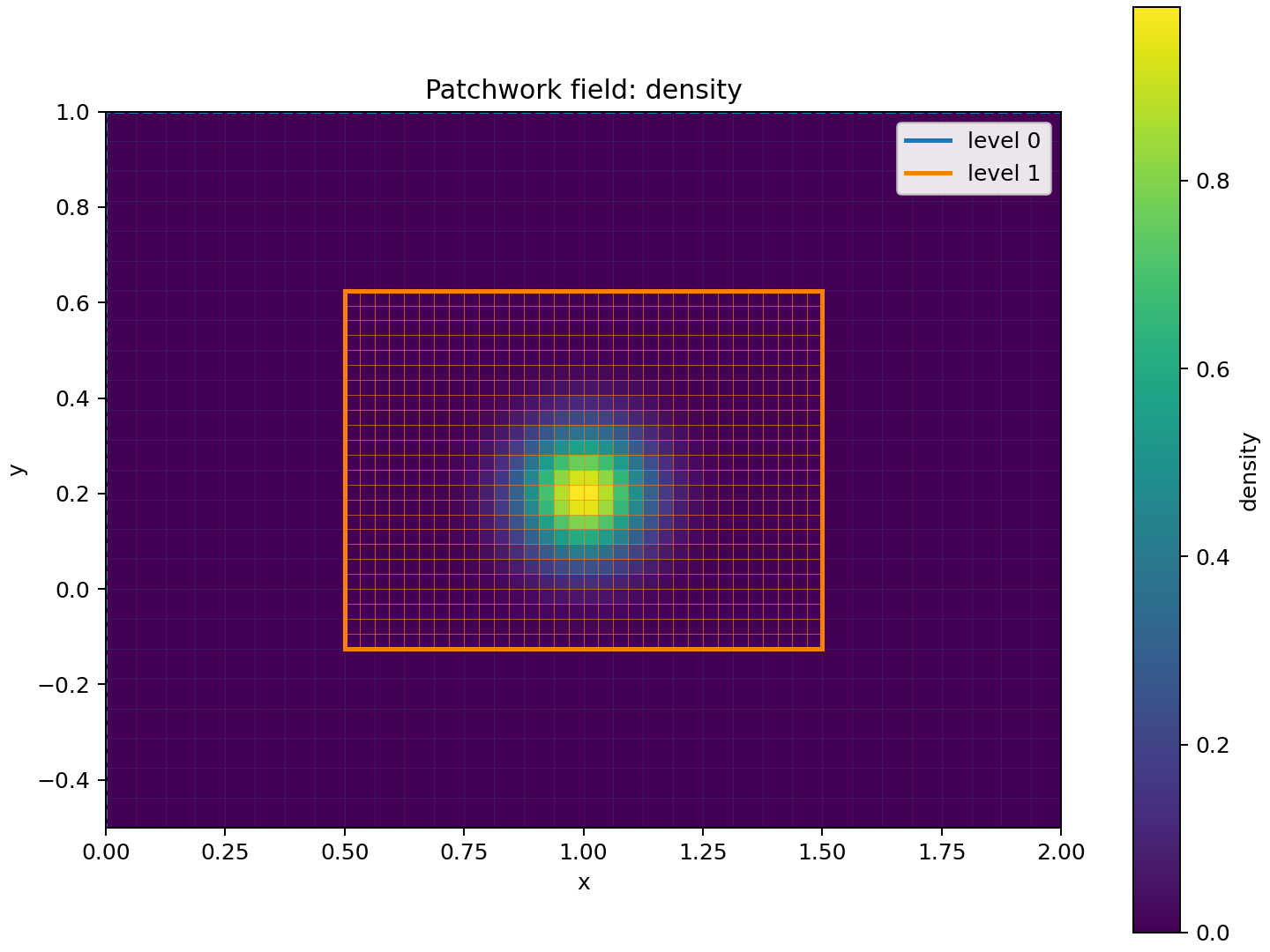
The composite Poisson example solves a smooth source across the coarse-fine interface:
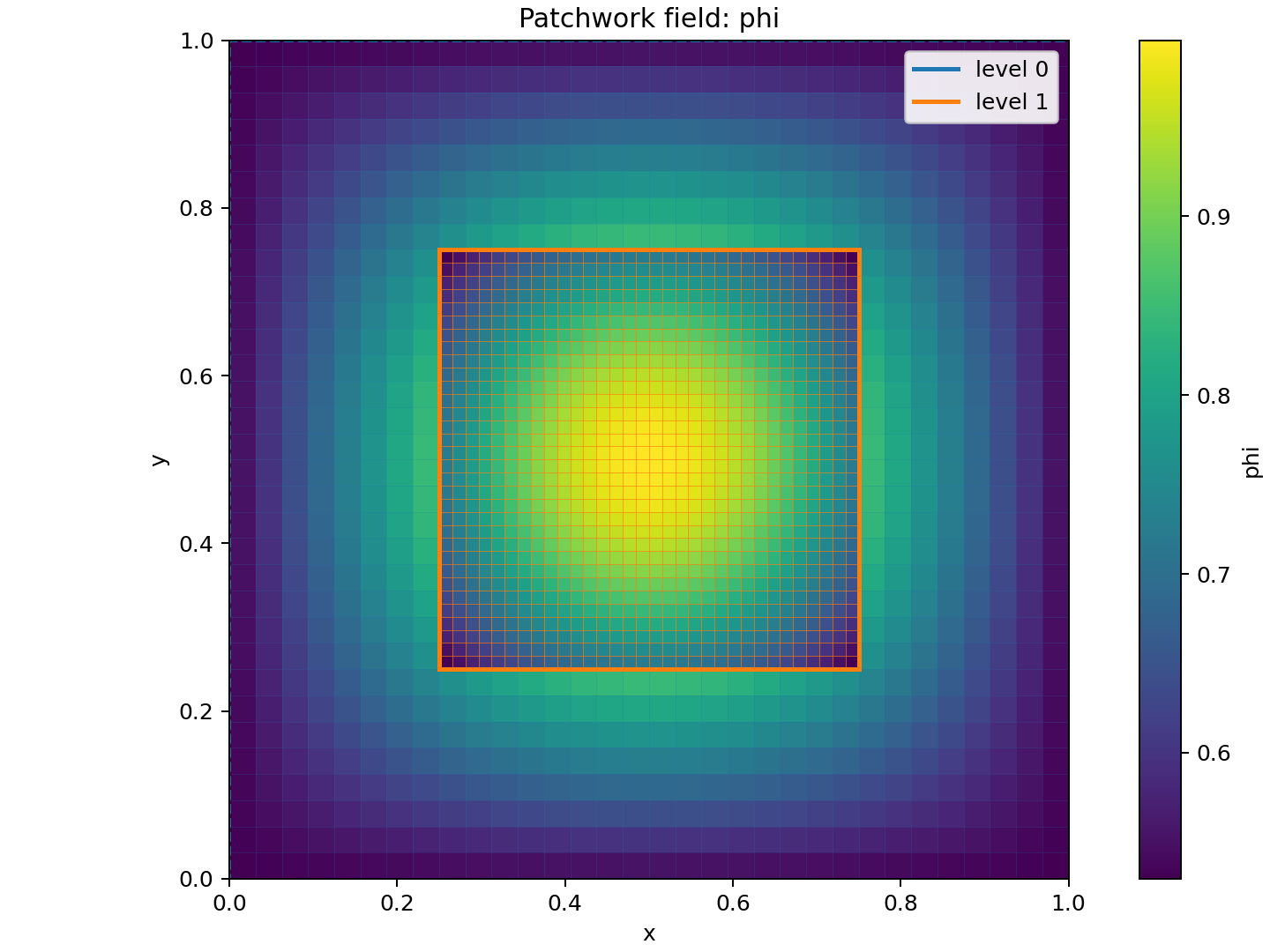 For nested levels and a complete script, run
 python examples/nested_patches.py.
The tutorials go further, step by step: fields on patches, the cell-centered and node-centered Poisson solves (faces with different conditions, periodic axes, electrodes), domains that are not rectangles, halos, and regridding.
MPI and serial use
Section titled “MPI and serial use”No MPI setup is required for a normal Python run. Under MPI, launch the same
script on every rank, for example mpiexec -n 2 python examples/two_level_mesh.py. All ranks must construct the same hierarchy and
allocate fields in the same order.
Each patch lives on some of the ranks and has a communicator of its own for them, over which mpiarray splits its fields:
mesh = AMRHierarchy(base_shape=(64, 64))  # the base: on every ranksmall = mesh.add_patch(level=1, box=((32, 64), (32, 64)), ranks=3)  # one ranklarge = mesh.add_patch(level=1, box=((64, 128), (0, 64)), ranks=(0, 1))  # two ranksmesh.allocate_field("density")
for patch in mesh.local_patches: # the patches this rank holds a part of patch.field("density").local[...] = 1.0whole = mesh.gather(small, "density") # the whole patch, on every rankranksis one rank or several. Without it the hierarchy’splacementdecides:"all"(the default) puts a patch on every rank,"balanced"on the one rank that holds the fewest cells so far.base_ranksdoes the same for the base boxes.patch.ranksis the same on every rank;patch.is_localsays whether this rank holds a part, andpatch.commis then the patch’s communicator. Patches on the same group of ranks share one communicator.mesh.gather(patch, name, root=None)is collective over the hierarchy’s communicator and returns the whole field on every rank, or onrootonly.- A field split over several ranks needs at least one cell per rank along its first axis.
The Poisson solves and plot_patches gather the patch fields and work
wherever the patches are; the solve itself runs on every rank.
Halos of patches
Section titled “Halos of patches”A field allocated with halo=h has h cells (or nodes) around every patch.
exchange_halos fills them from the rest of the hierarchy, so that a stencil
can be applied to each patch on its own:
mesh.allocate_field("u", halo=2, centering="node")# ... the patches' own points of "u" are set ...mesh.restrict("u") # coarse points under finer patches take the fine valuesmesh.exchange_halos("u") # every patch's halo, on every rank that holds itfor patch in mesh.local_patches: u = patch.field("u").local_with_halos # own points and halo- A halo point inside another patch of the same level gets its value, across a periodic face too.
- Elsewhere it is the bilinear interpolation of the level below (renormalised where some of the four coarse points are not on any patch).
- Between the ranks of one patch, mpiarray’s
update_halosfills the halo. - Halo points outside the domain are left as they are: set them for your boundary condition.
restrict gives coarse cells the mean of the fine cells over them, and coarse
nodes the fine node at the same place, finest level first. Both are collective;
their schedules are built at the first call for a field and kept until a patch
is added. Each call sends its data in one Alltoallv over the hierarchy’s
communicator (mpiarray.CopyPlan), whichever ranks the patches are on.