Domains that are not rectangles
The base level can be several boxes of cells instead of the whole rectangle. Their union is
the domain: an L, a T, a rectangle with a notch. The edges inside the bounding rectangle are a
boundary of their own, "inner", which takes a condition like the faces do.
import numpy as np
from patchwork import AMRHierarchy, Dirichlet, Neumann, NodalPoisson, plot_patches
FACES = ("x_lower", "x_upper", "y_lower", "y_upper")base_boxes lists the boxes of base cells: here the left half of the square and the upper
half of its right half. A patch must lie inside the domain, so a patch around the inner
corner is made of two boxes side by side; a patch may lie over several base boxes.
def ell(base, levels):    half = base // 2    mesh = AMRHierarchy(        base_shape=(base, base),        bounds=((-1.0, 1.0), (-1.0, 1.0)),        base_boxes=[((0, half), (0, base)), ((half, base), (half, base))],    )    for level in range(1, levels + 1):        centre, width = base * 2**level // 2, base // 4        mesh.add_patch(            level=level,            box=((centre - width, centre), (centre - width, centre + width)),        )        mesh.add_patch(            level=level, box=((centre, centre + width), (centre, centre + width))        )    return mesh

fig, ax = plot_patches(ell(16, 2))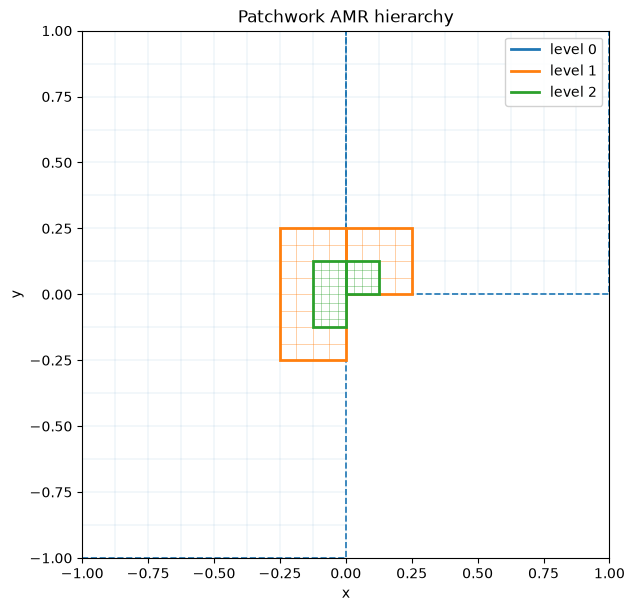
The corner of the L
Section titled “The corner of the L”The potential is harmonic on the L and zero on its two inner
edges, but its gradient is unbounded at the inner corner. A uniform mesh converges slowly
there; nested patches at the corner do much better for the same number of unknowns. The
inner edges are grounded, the default for "inner".
def corner(x, y):    theta = np.arctan2(y, x) % (2 * np.pi)    return np.hypot(x, y) ** (2 / 3) * np.sin(2 * theta / 3)

for base, levels in ((32, 0), (64, 0), (128, 0), (32, 2), (32, 4)):    mesh = ell(base, levels)    solver = NodalPoisson(mesh, faces={face: Dirichlet(corner) for face in FACES})    nodes = solver.nodes    result = solver.solve(np.zeros(nodes.num_nodes), potential="potential")    on_coarse = np.all(np.abs(nodes.coordinates / (2 / 32) % 1) < 1e-9, axis=1)    error = np.abs(result - corner(*nodes.coordinates.T))[on_coarse].max()    print(        f"{base:3d} x {base:<3d} cells, {levels} levels: {solver.free.size:6d} unknowns, error {error:.1e}"    )
32 x 32 cells, 0 levels: 705 unknowns, error 1.3e-02 64 x 64 cells, 0 levels: 2945 unknowns, error 5.2e-03128 x 128 cells, 0 levels: 12033 unknowns, error 1.9e-03 32 x 32 cells, 2 levels: 961 unknowns, error 1.9e-03 32 x 32 cells, 4 levels: 1217 unknowns, error 8.0e-04fig, ax = plot_patches(mesh, field="potential", show_grid=False)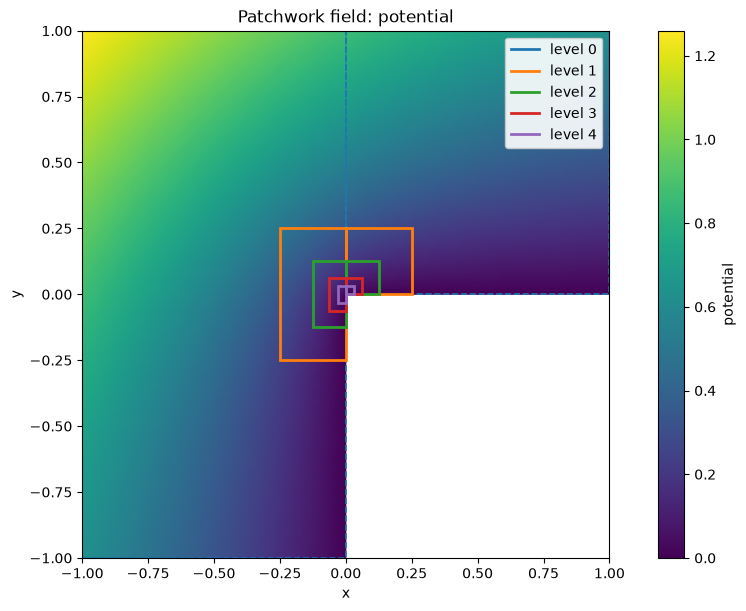
A T-shaped conductor
Section titled “A T-shaped conductor”A bar with a stem, the foot of the stem at 1 V and the ends of the bar grounded. No current
leaves through the other walls: "y_upper" and "inner" (the stem’s walls and the bar’s
underside) take Neumann(0.0).
mesh = AMRHierarchy(    base_shape=(48, 32),    bounds=((-1.5, 1.5), (-1.0, 1.0)),    base_boxes=[((0, 48), (16, 32)), ((16, 32), (0, 16))],)# at the two inner corners: in the bar across the corner, and in the stem beside itfor level in (1, 2):    fine = 2**level    for corner, inward in ((16, 1), (32, -1)):        x, y = corner * fine, 16 * fine        mesh.add_patch(level=level, box=((x - 8, x + 8), (y, y + 8)))        stem = (x, x + 8) if inward == 1 else (x - 8, x)        mesh.add_patch(level=level, box=(stem, (y - 8, y)))
solver = NodalPoisson(    mesh,    faces={        "y_lower": Dirichlet(1.0),        "x_lower": Dirichlet(0.0),        "x_upper": Dirichlet(0.0),        "y_upper": Neumann(0.0),        "inner": Neumann(0.0),    },)solver.solve(np.zeros(solver.nodes.num_nodes), potential="potential")fig, ax = plot_patches(mesh, field="potential", show_grid=False)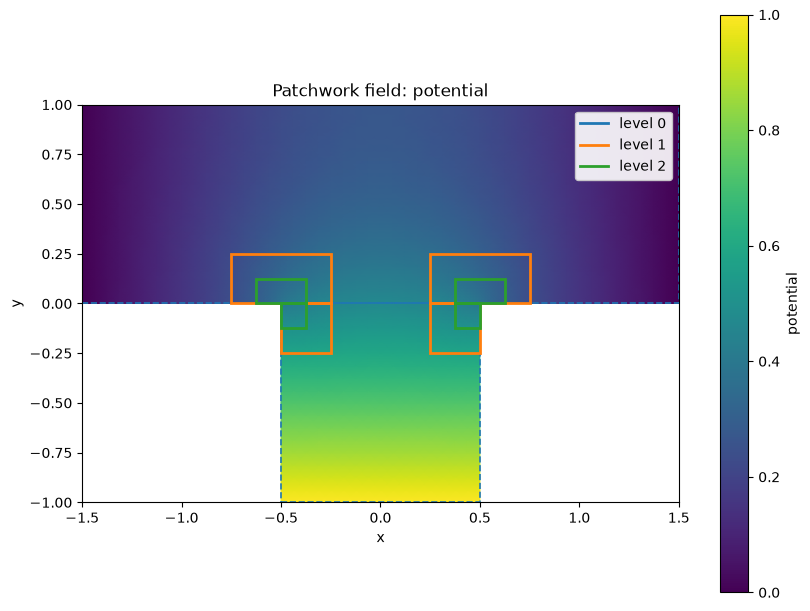
On a uniform lattice (to_level, sample_patches) the nodes outside the domain are
zero. The cell-centered solve_poisson takes such domains too, with its boundary value on the
inner edges as well.