Electron energy distribution
Hot electrons in a gas lose energy slowly in elastic collisions and quickly by excitation and ionization, until no inelastic channel is open. This tutorial reads a cross-section set in LXCat format and follows the electron energy distribution function (EEDF) in a 0D reactor.
The LXCat file is written here with synthetic model numbers. With real data downloaded from LXCat, only the file name changes.
from pathlib import Path
import cunumpy as xpimport numpy as np
import plasmacollfrom plasmacoll.constants import (    ATOMIC_MASS,    ELECTRON_MASS,    ELEMENTARY_CHARGE,    ev_to_kelvin,)
energy = np.round(np.geomspace(1e-2, 1e3, 60), 4)

def block(kind, target, parameter, sigma, process):    lines = [kind, target]    if parameter is not None:        lines.append(f" {parameter:.4e}")    lines += [f"PROCESS: {process}", "-----------------------------"]    lines += [f" {e:.4e}\t{s:.4e}" for e, s in zip(energy, sigma, strict=True)]    lines.append("-----------------------------")    return "\n".join(lines)

elastic = 8e-20 / (1 + (energy / 10) ** 0.8)excitation = np.where(    energy > 11.5, 2e-21 * (energy - 11.5) / (1 + (energy / 30) ** 1.5), 0)x = np.clip(energy / 15.8, 1, None)ionization = np.where(energy > 15.8, 3e-20 * np.log(x) / x, 0)Path("model_gas.txt").write_text(    "\n\n".join(        [            "SYNTHETIC MODEL GAS: these numbers are not measured data.",            block("ELASTIC", "Gas", 1.37e-5, elastic, "E + Gas -> E + Gas, Elastic"),            block(                "EXCITATION",                "Gas -> Gas*",                11.5,                excitation,                "E + Gas -> E + Gas*, Excitation",            ),            block(                "IONIZATION",                "Gas -> Gas^+",                15.8,                ionization,                "E + Gas -> E + E + Gas+, Ionization",            ),        ]    ))
table = plasmacoll.read_lxcat("model_gas.txt")for process in table:    print(        f"{process.kind:11s} {process.target:>4s} -> {process.product:5s} threshold {process.threshold:5.1f} eV"    )
ELASTIC Gas -> threshold 0.0 eVEXCITATION Gas -> Gas* threshold 11.5 eVIONIZATION Gas -> Gas^+ threshold 15.8 eVfind_lxcat_process picks a block by kind or by its PROCESS comment, and
its cross_section goes straight into a CollisionProcess. Electron
cross-section sets are tabulated against the electron energy in the gas frame,
so the processes use energy_frame="lab".
M = 40 * ATOMIC_MASSgas = plasmacoll.NeutralBackground("gas", 1e22, 300.0, M)products = {"electron": "e", "ion": "ion"}processes = [    plasmacoll.CollisionProcess(        "elastic",        "gas",        plasmacoll.find_lxcat_process(table, "ELASTIC").cross_section,        name="elastic",        energy_frame="lab",    ),    plasmacoll.CollisionProcess(        "excitation",        "gas",        plasmacoll.find_lxcat_process(table, "EXCITATION").cross_section,        name="excitation",        energy_frame="lab",    ),    plasmacoll.CollisionProcess(        "ionization",        "gas",        plasmacoll.find_lxcat_process(table, "IONIZATION").cross_section,        name="ionization",        energy_frame="lab",        products=products,    ),]mcc = plasmacoll.MonteCarloCollisions(    {"e": ELECTRON_MASS, "ion": M}, [gas], {"e": processes}, seed=7)electrons = plasmacoll.ParticleArrays.maxwellian(    50_000, ELECTRON_MASS, ev_to_kelvin(20.0), seed=8)reactor = plasmacoll.ZeroDReactor(mcc, {"e": electrons}, volume=1e-9)
dt = 0.05 / mcc.frequency_bound("e", 1.0e7)snapshots = {}for steps in (0, 10, 40, 160, 640):    while reactor.iteration < steps:        reactor.step(dt)    e = reactor.species["e"]    snapshots[reactor.time] = xp.to_numpy(        0.5 * ELECTRON_MASS * xp.sum(e.velocities**2, axis=1) / ELEMENTARY_CHARGE    )
bins = np.linspace(0, 80, 81)centers = 0.5 * (bins[1:] + bins[:-1])fig, ax = plt.subplots()for color, (time, energies) in zip(COLORS, snapshots.items(), strict=False): eedf, _ = np.histogram(energies, bins=bins, density=True) ax.semilogy( centers, np.where(eedf > 0, eedf, np.nan), color=color, label=f"t = {time * 1e9:.1f} ns", )ax.axvline(11.5, color=MUTED, linewidth=1, linestyle=":")ax.annotate( "excitation threshold", (11.5, 0.2), xytext=(4, -12), textcoords="offset points", color=MUTED,)ax.set_ylim(1e-5, 0.3)ax.set_xlabel("electron energy (eV)")ax.set_ylabel("EEDF (1/eV)")ax.set_title("Inelastic collisions deplete the tail above threshold", loc="left")ax.legend(loc="upper right");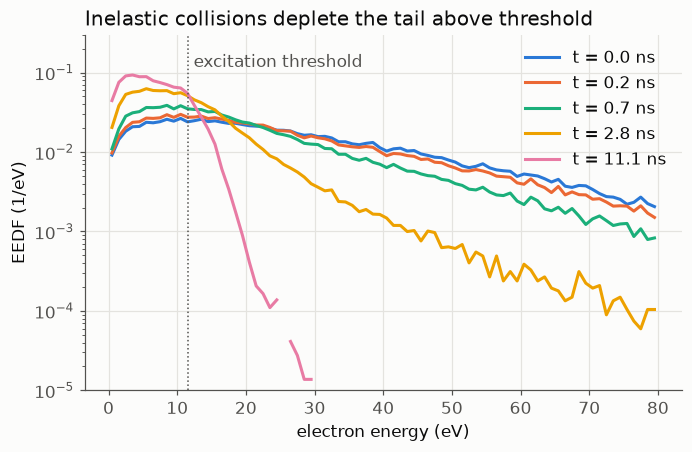
history = reactor.state()print("collisions per process:", history.collisions)print(f"electrons {history.num_markers['e']}, ions {history.num_markers['ion']}")print(f"mean electron energy {history.mean_energy_ev['e']:.2f} eV")collisions per process: {'elastic': 514816, 'excitation': 56732, 'ionization': 22754}electrons 72754, ions 22754mean electron energy 6.73 eVPath("model_gas.txt").unlink()