Ionization and attachment
A zero-dimensional reactor has no field, push or walls. Only collisions change the species, so it is the place to check rates.
With Maxwell-molecule cross sections the ionization frequency and the attachment frequency are constants, and the electron density follows .
import numpy as np
import plasmacollfrom plasmacoll.constants import ATOMIC_MASS, ELECTRON_MASS, ev_to_kelvin
M = 2 * 1.008 * ATOMIC_MASSdensity = 1e20gas = plasmacoll.NeutralBackground("H2", density, 300.0, M)

def maxwell(rate):    return plasmacoll.CrossSection.maxwell_molecule(rate, ELECTRON_MASS)

def build(k_iz, k_a, seed=0):    processes = [        plasmacoll.CollisionProcess(            "ionization",            "H2",            maxwell(k_iz),            name="ionization",            energy_frame="lab",            products={"electron": "e", "ion": "H2+"},        ),        plasmacoll.CollisionProcess(            "attachment",            "H2",            maxwell(k_a),            name="attachment",            energy_frame="lab",            products={"negative_ion": "H-"},        ),    ]    mcc = plasmacoll.MonteCarloCollisions(        {"e": ELECTRON_MASS, "H2+": M, "H-": M / 2}, [gas], {"e": processes}, seed=seed    )    electrons = plasmacoll.ParticleArrays.maxwellian(        20_000, ELECTRON_MASS, ev_to_kelvin(3.0), seed=seed + 1    )    return plasmacoll.ZeroDReactor(mcc, {"e": electrons}, volume=1e-6)
Three species from one reaction set
Section titled “Three species from one reaction set”Ionization at s⁻¹ competes with attachment at s⁻¹. Every ionization adds an electron and an H₂⁺, and every attachment turns an electron into an H⁻. Charge is conserved: .
k_iz, k_a = 1.5e-15, 0.5e-15nu_iz, nu_a = density * k_iz, density * k_adt = 0.01 / (nu_iz + nu_a)history = build(k_iz, k_a).run(dt, 1000, every=25)t = history.time * 1e6n0 = history.density["e"][0]
fig, ax = plt.subplots()for color, name in zip(COLORS, ("e", "H2+", "H-"), strict=False):    ax.plot(t, history.density[name], "o", color=color, label=name)ax.plot(    t,    n0 * np.exp((nu_iz - nu_a) * history.time),    "--",    color=INK,    linewidth=1.5,    label="n₀ exp((ν_iz − ν_a) t)",)ax.set_yscale("log")ax.set_xlabel("time (µs)")ax.set_ylabel("density (m⁻³)")ax.set_title("Electron growth with ionization and attachment", loc="left")ax.legend()
charge = history.density["e"] + history.density["H-"] - history.density["H2+"]print("charge balance n_e + n_H- - n_H2+ - n0:", np.max(np.abs(charge - n0)))
charge balance n_e + n_H- - n_H2+ - n0: 0.0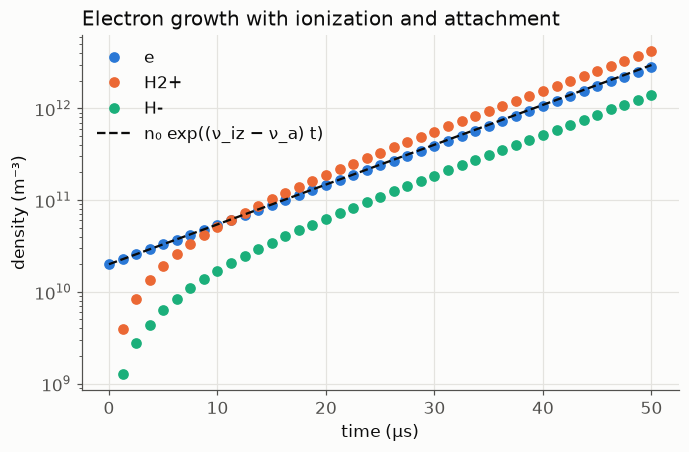
The time-step error
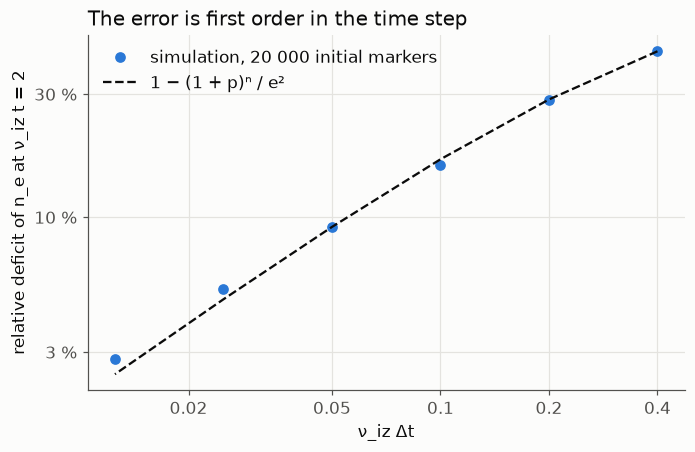
Section titled “The time-step error”The null-collision method lets a marker collide at most once per step, and the new electrons do not collide in the step that created them. The electron count therefore grows by per step, with , instead of . Over a fixed time the relative deficit is first order in . In practice the step is chosen by the field solver and the plasma frequency, and it is usually already small enough.
final_time = 2.0 / (density * k_iz)steps_per_run = np.array([5, 10, 20, 40, 80, 160])errors = []for steps in steps_per_run:    reactor = build(k_iz, 0.0, seed=int(steps))    history = reactor.run(final_time / steps, int(steps), every=int(steps))    errors.append(1 - history.density["e"][-1] / history.density["e"][0] / np.exp(2.0))
# the discrete expectation: (1 + p) per step, with the operator's default bound safety 1.02nu_dt = 2.0 / steps_per_runp = (1 - np.exp(-1.02 * nu_dt)) / 1.02expected = 1 - (1 + p) ** steps_per_run / np.exp(2.0)
fig, ax = plt.subplots()ax.loglog(    nu_dt, errors, "o", color=COLORS[0], label="simulation, 20 000 initial markers")ax.loglog(nu_dt, expected, "--", color=INK, linewidth=1.5, label="1 − (1 + p)ⁿ / e²")ax.set_xticks([0.02, 0.05, 0.1, 0.2, 0.4], labels=["0.02", "0.05", "0.1", "0.2", "0.4"])ax.set_yticks([0.03, 0.1, 0.3], labels=["3 %", "10 %", "30 %"])ax.minorticks_off()ax.set_xlabel("ν_iz Δt")ax.set_ylabel("relative deficit of n_e at ν_iz t = 2")ax.set_title("The error is first order in the time step", loc="left")ax.legend();
/home/runner/work/plasmacoll/plasmacoll/src/plasmacoll/mcc.py:846: RuntimeWarning: e collision probability per step 0.335 exceeds 0.1 (nu_max dt = 0.408); markers collide at most once per step, so collisions are lost. Reduce dt. result = self.collide(/home/runner/work/plasmacoll/plasmacoll/src/plasmacoll/mcc.py:846: RuntimeWarning: e collision probability per step 0.185 exceeds 0.1 (nu_max dt = 0.204); markers collide at most once per step, so collisions are lost. Reduce dt. result = self.collide(