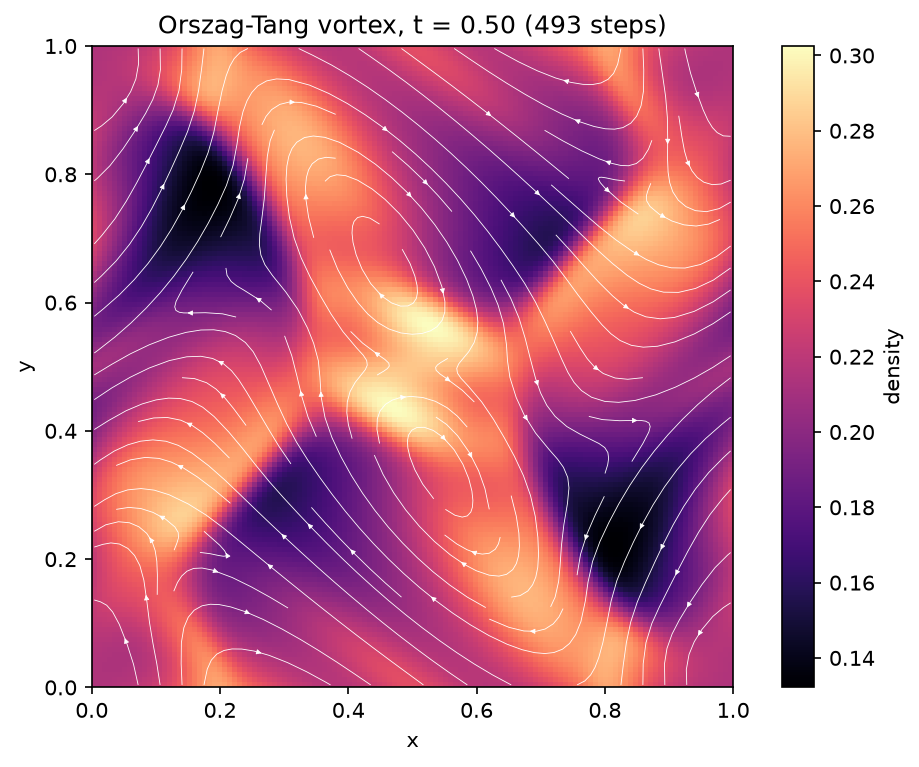
Run the Orszag-Tang vortex.
The standard 2D ideal MHD test: smooth, periodic vortices in the velocity and magnetic field steepen into shocks that interact. The figure shows the density at t = 0.5 on a 128 x 128 grid, with the magnetic field lines.
Python source
Section titled “Python source”"""Run the Orszag-Tang vortex.
The standard 2D ideal MHD test: smooth, periodic vortices in the velocity and magnetic fieldsteepen into shocks that interact. The figure shows the density at t = 0.5 on a 128 x 128 grid,with the magnetic field lines."""
import matplotlib.pyplot as pltimport numpy as np
from mhd_sandbox import Grid, IdealMHD2DSolver
grid = Grid(lower_bound=(0.0, 0.0), upper_bound=(1.0, 1.0), num_gridpoints=(128, 128))solver = IdealMHD2DSolver(grid, cfl=0.3)solver.set_state(IdealMHD2DSolver.orszag_tang_initial_state(grid))result = solver.solve(t_end=0.5)
primitives = solver.primitive_variables()nx, ny = grid.num_gridpointsx = (np.arange(nx) + 0.5) * solver.dxy = (np.arange(ny) + 0.5) * solver.dy
fig, ax = plt.subplots(figsize=(6, 5), layout="constrained")image = ax.imshow( primitives["density"].T, origin="lower", extent=(0, 1, 0, 1), cmap="magma")ax.streamplot( x, y, primitives["magnetic_field"][..., 0].T, primitives["magnetic_field"][..., 1].T, color="white", density=1.0, linewidth=0.4, arrowsize=0.5,)fig.colorbar(image, ax=ax, label="density")ax.set( xlabel="x", ylabel="y", title=f"Orszag-Tang vortex, t = {result.time:.2f} ({result.steps} steps)",)