Sampling, export and diagnostics
Sample interior and boundary points, export contours and surface meshes, and inspect geometric resolution before running a simulation. All meshes and quadrature results carry a sampling resolution; they should be refined for small features.
from pathlib import Pathfrom tempfile import TemporaryDirectory
import matplotlib.pyplot as pltimport numpy as np
from simgeometry import Circle, GeometryCollection, Grid, Sphere
sphere = Sphere((0, 0, 0), 1)inside = sphere.sample_interior(1000, rng=7)assert sphere.contains_points(inside).all()np.testing.assert_array_equal(inside, sphere.sample_interior(1000, rng=7))surface = sphere.sample_surface(600, rng=7, resolution=32)print(    "Largest radial mesh sampling error:",    np.max(abs(np.linalg.norm(surface, axis=0) - 1)),)fig = plt.figure(figsize=(10, 4), layout="constrained")for index, points, title in (    (1, inside, "Uniform interior samples"),    (2, surface, "Samples by mesh surface area"),):    ax = fig.add_subplot(1, 2, index, projection="3d")    ax.scatter(*points, s=3, alpha=0.5)    ax.set_box_aspect((1, 1, 1))    ax.set_title(title)plt.show()
Largest radial mesh sampling error: 0.0017257751355151951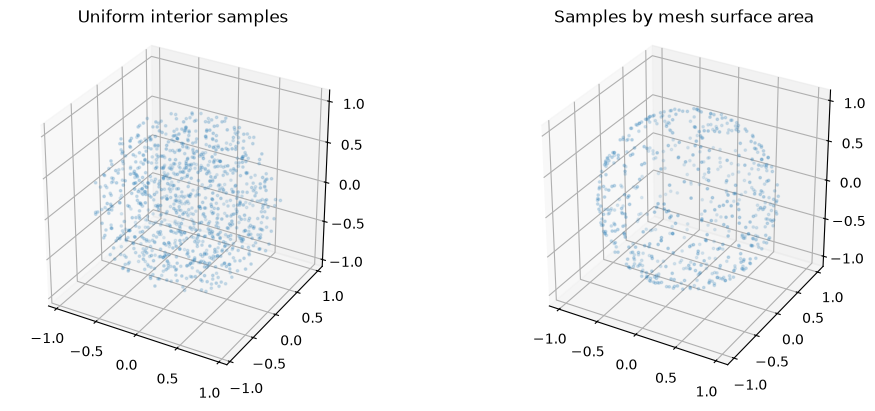
Interior sampling uses rejection sampling with a finite draw budget. Pass a seed or NumPy Generator for reproducibility, and explicit bounds for inverted/unbounded objects. Exhausting max_draws raises an error instead of returning too few points.
Surface sampling is uniform by segment length in 2D and triangle area in 3D, on the extracted mesh. Those points approximate the mathematical surface; they need not satisfy exact boundary membership.
Distance queries
Section titled “Distance queries”Balls, boxes and simple polygons have exact closest-point and signed-distance queries. The sign is negative inside. Composite shapes, arbitrary functions and general affine images use the nearest point on a sampled boundary mesh. This is a distance approximation, and it can miss unresolved pieces.
ring = Circle((0, 0), 1.0) - Circle((0, 0), 0.4)points = np.array([[0.0, 0.7, 1.3], [0.0, 0.0, 0.0]])print("Approximate ring distances:", ring.signed_distance(points, resolution=128))print("Closest ring points:", ring.closest_point(points, resolution=128))np.testing.assert_allclose( ring.signed_distance(points, resolution=128), [0.4, -0.3, 0.3], atol=0.03)Approximate ring distances: [ 0.39244919 -0.3015748 0.29527559]Closest ring points: [[-1.47244094e-01 3.98425197e-01 1.00472441e+00] [-3.63779528e-01 0.00000000e+00 1.73472348e-18]]Portable mesh export
Section titled “Portable mesh export”to_mesh() returns physical vertices, connectivity and grid spacing. NPZ preserves arrays; OBJ supports 2D segments and 3D triangles; STL supports 3D triangles. Sampling bounds can clip a surface, leaving it open. Export does not automatically cap it or certify a watertight solid.
mesh = sphere.to_mesh(resolution=32)print("Vertices:", mesh.vertices.shape, "Triangles:", mesh.cells.shape)print("Sampling spacing:", mesh.spacing)with TemporaryDirectory() as directory: for suffix in ("npz", "obj", "stl"): path = mesh.save(Path(directory) / f"sphere.{suffix}") print(path.name, path.stat().st_size, "bytes") restored = np.load(Path(directory) / "sphere.npz") np.testing.assert_array_equal(restored["cells"], mesh.cells)# To keep a mesh: sphere.export("sphere.stl", resolution=64)Vertices: (3696, 3) Triangles: (7388, 3)Sampling spacing: (0.07096774193548394, 0.07096774193548394, 0.07096774193548394)sphere.npz 222446 bytessphere.obj 353700 bytessphere.stl 2262046 bytesDiagnose overlaps and resolution
Section titled “Diagnose overlaps and resolution”Diagnostics report overlapping solid nodes, objects with no solid node, multiple hits on an edge and hits very close to an endpoint. These are sampled observations, not proof that a geometry is resolved. A tiny object away from all grid edges may still escape detection.
grid = Grid(ndim=2, lower_bound=(-1, -1), upper_bound=(1, 1), num_gridpoints=(13, 13))geometry = GeometryCollection( { "left": Circle((-0.15, 0), 0.4), "right": Circle((0.15, 0), 0.4), "small": Circle((0.74, 0.74), 0.01), })report = geometry.diagnose(grid)print(report)assert report["overlap_nodes"]["left / right"] > 0assert "small" in report["objects_without_solid_nodes"]geometry.show(grid=grid, display=False)plt.title("Overlapping objects and an unresolved small component")plt.show(){'overlap_nodes': {'left / right': 11}, 'objects_without_solid_nodes': ['small'], 'multiple_hit_edges': 0, 'short_distance_hits': 0, 'intersection_search_exact': True, 'scope': 'node and edge samples; does not certify feature resolution'}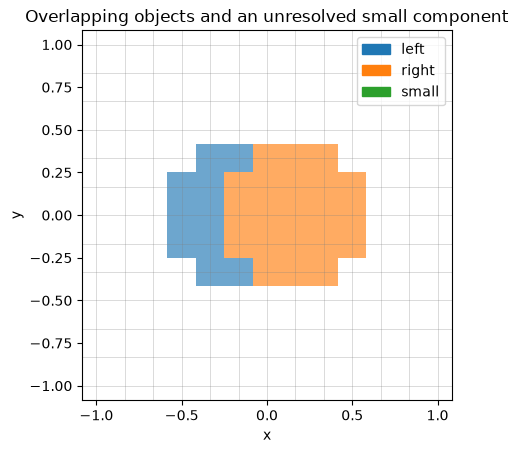
Repeat the diagnostics on a finer grid, then vary the sampling used for a function-defined shape. For finite-volume experiments, compare cell_fractions() estimates at several subcell resolutions before using them in a conservation calculation.