mhd-sandbox
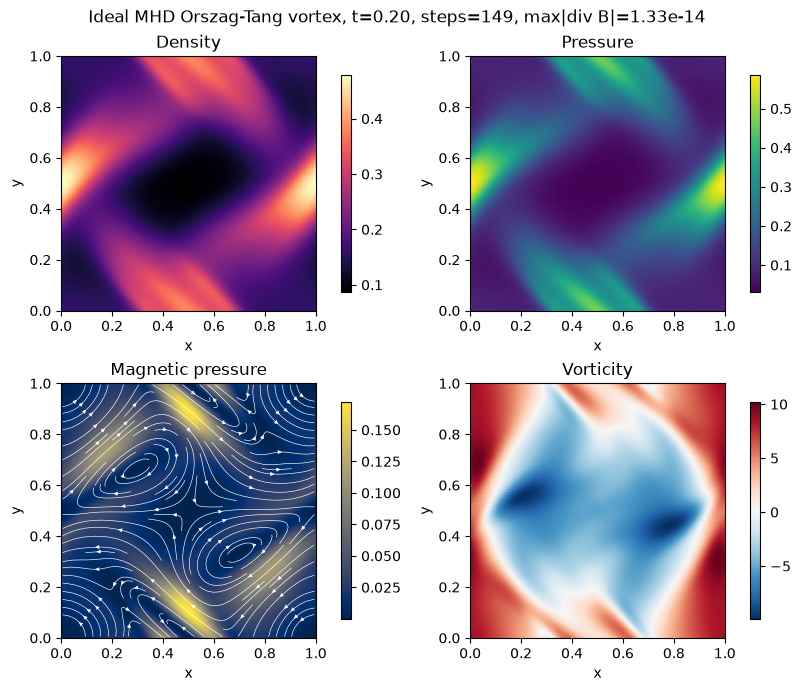
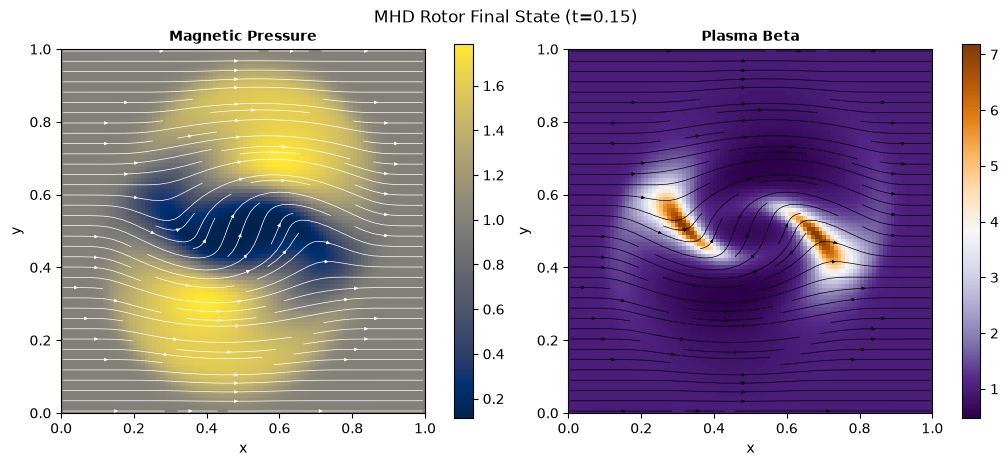
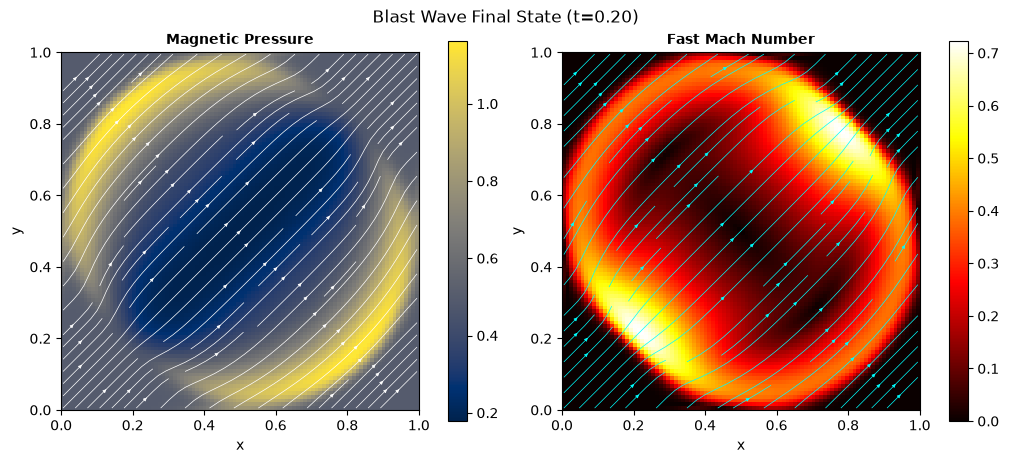
A small NumPy-based solver for ideal MHD on a periodic 2D grid, with notebooks for the Orszag–Tang vortex, MHD rotor, and magnetized blast wave.
The solver uses first-order Rusanov fluxes, forward Euler time stepping, and a Fourier projection to keep the magnetic field divergence-free. Its intentionally compact implementation makes it useful for learning and experimenting with finite-volume MHD.
Run the Orszag–Tang vortex in a few lines:
from mhd_sandbox import Grid, IdealMHD2DSolver
grid = Grid(lower_bound=(0.0, 0.0), upper_bound=(1.0, 1.0), num_gridpoints=(128, 128))solver = IdealMHD2DSolver(grid, cfl=0.3)solver.set_state(IdealMHD2DSolver.orszag_tang_initial_state(grid))result = solver.solve(t_end=0.5)print(result.steps, result.max_divergence_b)
Documentation: max-models.github.io/mhd-sandbox
View the code on GitHub · PyPI