MPI communication
patchwork runs the same way on one process and on many: without an MPI launcher, mpiarray hands it a serial stand-in of a communicator, and every call below does its local work and skips the messages. Under MPI, three ideas organise all of the communication:
- The hierarchy is the same on every rank; the data is not. Every rank builds the same patches with the same calls in the same order, so each rank knows every patch, its level, its box and its ranks. A patch’s field lives only on the patch’s ranks, as an mpiarray array split over them.
- Schedules, built once and executed as one
Alltoallv. Every exchange between patches (halos, restriction, the transfer of a regrid) is a list of box copies between arrays on different groups of ranks. mpiarray’s copy plan turns the list into oneAlltoallvover the hierarchy’s communicator, after a singleallgatherat the build. patchwork keeps the plans per field until the patches change. - Two kinds of halo. The halo at the walls of a patch is filled from the rest of the hierarchy by patchwork; the halo between the blocks of one patch is mpiarray’s business, with point-to-point messages inside the patch’s own communicator.
The rest of this page goes through the operations one by one. The explorer in the middle lets you change the number of ranks, the placement and the periodicity of a small hierarchy and shows what the halo exchange then sends. A table at the end lists every operation with its MPI calls, and a checklist gives the rules for code that uses patchwork under MPI.
Ranks, patches and communicators
Section titled “Ranks, patches and communicators”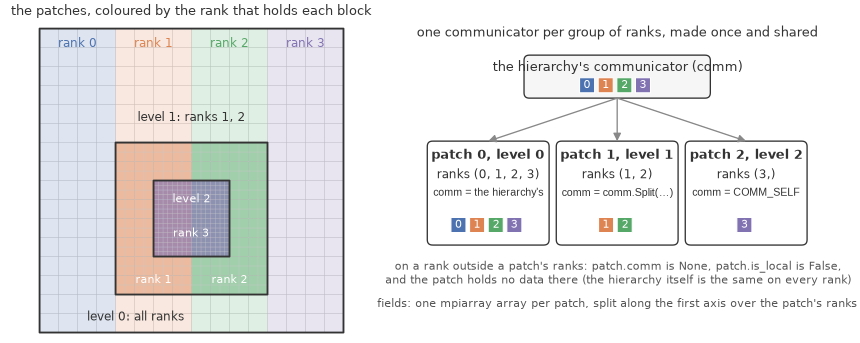
AMRHierarchy(..., comm=...) takes the communicator of all ranks that take part (by default
MPI.COMM_WORLD, or the serial stand-in). Each patch then lives on a group of those ranks:
placement="all"(the default) puts every patch on every rank;placement="balanced"puts a patch on the one rank that holds the fewest cells so far (ties go to the lower rank), and withmax_cells_per_rank=na patch of more thanncells is split over as many of the least loaded ranks as it needs;- a function
placement(level, box)returns the ranks, andadd_patch(..., ranks=...)orbase_ranksname them outright.
The placement is a pure function of the calls made so far, so every rank arrives at the same answer without a message. For each group of ranks the hierarchy makes one communicator, the first time the group is used, and keeps it in a cache that the patches share (and that the new hierarchy of a regrid inherits):
| group of ranks | communicator | collective? |
|---|---|---|
| all ranks | the hierarchy’s own comm | no |
| one rank | MPI.COMM_SELF on that rank | no |
| some ranks | comm.Split(color, key=rank) | yes, over comm, once per group |
On a rank outside the group, patch.comm is None, patch.is_local is False and
patch.field(name) raises: the patch exists there as a description only.
hierarchy.local_patches lists the patches this rank holds a part of.
allocate_field(name, halo=h, split=0) creates, on every patch this rank holds, an
mpiarray array over the patch’s communicator: split along the first axis over the patch’s
ranks (split=0, the default; a rank then needs at least one cell along that axis) or
replicated on all of them (split=None, every rank holding all of it). Both carry h
halo cells (or nodes) around the array. gather(patch, name) returns the whole array of one
patch on every rank, or on root only: it is collective over the hierarchy, as the first rank
of the patch broadcasts the array (bcast) or sends it to root (send/recv).
Blocks and the two kinds of halo
Section titled “Blocks and the two kinds of halo”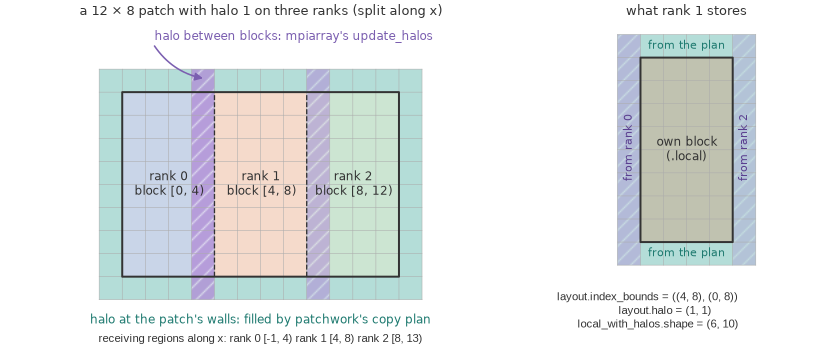
Within a patch, mpiarray gives each rank a block: a near-even share of the first axis (the
first nx mod size blocks have one cell more), layout.index_bounds in the patch’s indices.
local is the block, local_with_halos the block with its halo. The halo cells of a block
are of two kinds, and two different pieces of code fill them:
- at the walls of the patch, where the block’s halo lies outside the patch: patchwork fills them from the other patches (see below), through the copy plan;
- along the seams between blocks: mpiarray’s
update_haloscopies the neighbour’s boundary layer across, with one non-blocking send and receive per direction and per seam on the patch’s communicator (Isend/Irecvof a subarray datatype, in place; corners travel with the faces because the layer spans the whole storage along the other axes).
The copy plan writes halo cells at the walls on the rank whose block touches that wall: a rank’s receiving region is its block, extended by the halo width where the block is at the start or the end of the patch along an axis. So the halo along the unsplit axis belongs to every block, and the halo along the split axis to the first and the last block only; the corners at the seams come with the second kind of halo.
The transport: mpiarray’s copy plan
Section titled “The transport: mpiarray’s copy plan”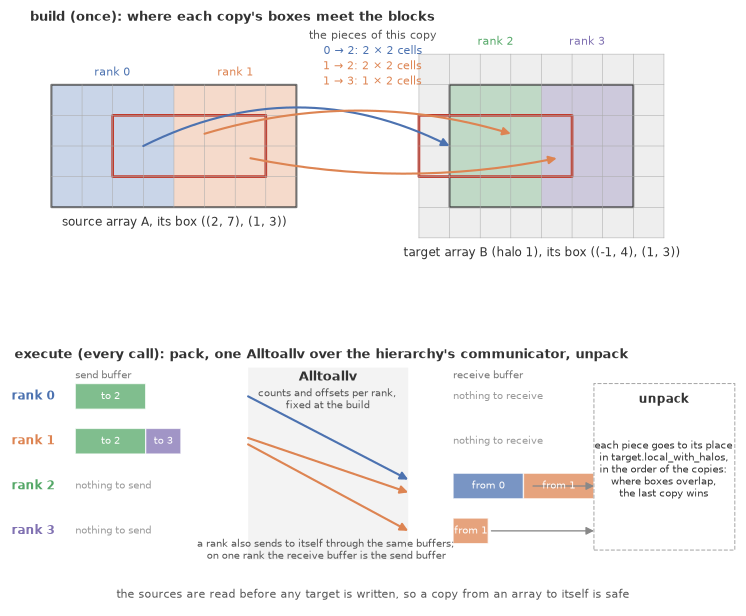
Every exchange between patches is a list of copies, each a
(source, source_box, target, target_box): two mpiarray arrays (or None on a rank that
does not hold one) and a box of each, in its global indices, of the same extents. The target
box may reach into the target’s halo at its walls. mpiarray.CopyPlan(copies, comm) is
built collectively over the hierarchy’s communicator, with the same list on every rank:
- For each copy, a rank works out the block it sends from (its block of the source; a replicated source sends from its first rank only) and the region it receives into (its receiving region of the target; every rank of a replicated target receives all of it).
- One
allgathertells every rank these blocks and regions of all the others. Their overlaps, shifted from the source box to the target box, are the pieces: which cells of which array go from which rank to which rank. Their sizes give the counts and offsets of theAlltoallv, fixed from now on. - An error (a box outside its array, boxes of different shapes, different numbers of copies
on different ranks, different dtypes) is raised on every rank, after the
allgather, so no rank is left waiting.
plan.execute() then does the same thing every time: it packs its pieces into one send
buffer, ordered by destination rank, makes one Alltoallv, and unpacks the receive
buffer, piece by piece, into target.local_with_halos, in the order of the copies (where the
target boxes of several copies overlap, the last copy wins). All sources are read before any
target is written, so a copy from an array to itself is safe. On one rank the receive buffer
is the send buffer and no MPI call is made. The arrays can be on the GPU: the buffers are the
backend’s, and the exchange goes through staging buffers where MPI is not CUDA-aware.
patchwork builds these plans:
| schedule | built by | plans |
|---|---|---|
HaloExchange (exchange_halos) | first call for a field | one |
Restriction (restrict, reflux) | first call for a field | one per fine level |
transfer (regrid) | every regrid, for every field | one per level |
The schedules of a field are kept in the hierarchy under their kind and name, and dropped when
a patch is added: the next call builds them again. The build has its own profiling region,
patchwork.build_schedule.
Filling the halos
Section titled “Filling the halos”exchange_halos(name) fills the halo of every patch of a field. The schedule it builds finds,
for every halo cell (or node) of every patch, where the value comes from:
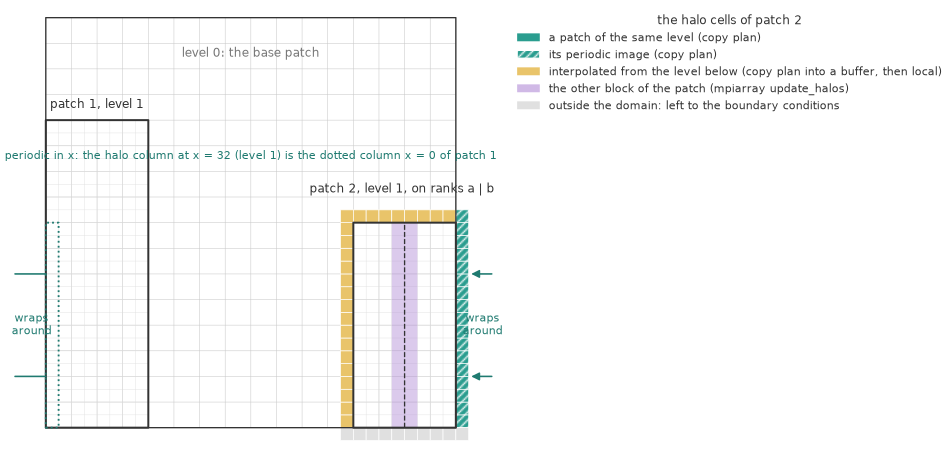
- A patch of the same level that covers the halo cell, periodic images included (a patch that spans a whole periodic axis takes its halo from itself): a copy of the cell.
- Otherwise, inside the domain and on a refined level, the interpolation of the level below: bilinear (linear in 1D) for the halo exchange, with the weights of coarse points on no patch dropped and the rest renormalised, and the two inside points extrapolated next to a wall.
- Outside the domain the halo cell is left as it is, for the boundary conditions.
- The halo cells along the seams between the blocks of a patch are not in the schedule: mpiarray fills them afterwards.
The interpolation needs coarse values on the ranks of the fine patch, and those ranks may hold
none of the coarse patch. For each fine patch, the schedule allocates a buffer: a
replicated array (split=None) on the fine patch’s communicator, of the bounding box of the
coarse stencils of the uncovered halo cells. The copies that fill it, from every coarse patch
that overlaps the box (across periodic faces too), go into the same plan as the copies of the
first kind. Each rank of the fine patch receives the whole buffer and computes the weighted
sums for the halo cells it stores, with no further message:
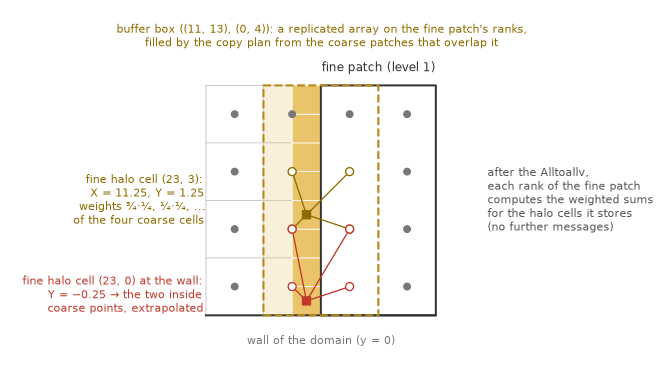
So execute is three steps, in this order: the plan’s one Alltoallv, the local
interpolation from the buffers, then update_halos on every local patch’s array. The
level= and below= arguments of exchange_halos (the halos of one level only, or the
level below taken from another field, for subcycling) are separate schedules, kept under their
own keys.
Try it
Section titled “Try it”The explorer below runs the rules above in your browser on a small two-dimensional hierarchy:
a 12 × 12 base level, two level-1 patches that touch, one of them at the right wall, and a
level-2 patch inside the first. Choose the number of ranks and the placement, make the x axis
periodic, and pick a patch to see where each of its halo cells comes from. The table on the
right is the message matrix of the one Alltoallv of exchange_halos for all four patches, as
the schedule would build it for this layout; the diagonal is what a rank copies to itself
through the same buffers.
Things to look for: with placement="all" every patch is split over all ranks and most halo
cells travel between ranks; with "balanced" every patch sits on one rank, the buffers of the
interpolation are sent to one rank each, and the only messages are between patches on
different ranks. The level-2 patch takes its right halo from two different level-1 patches
through one buffer. With a periodic x axis the base level fills its own halo from its other
end, and patch 2, at the right wall, interpolates across the seam from the far side of the
base level.
Hover a halo cell to see where it comes from; click a patch to select it.
Patches on the ranks
The one Alltoallv of exchange_halos
Cells from the rank of a row to the rank of a column, all patches together: the copies between patches of one level and those into the interpolation buffers.
Inside each patch: update_halos
Collective calls
The explorer is a model of the schedule’s geometry, checked against patchwork’s own
HaloExchange for this hierarchy; it does not run MPI.
Restriction
Section titled “Restriction”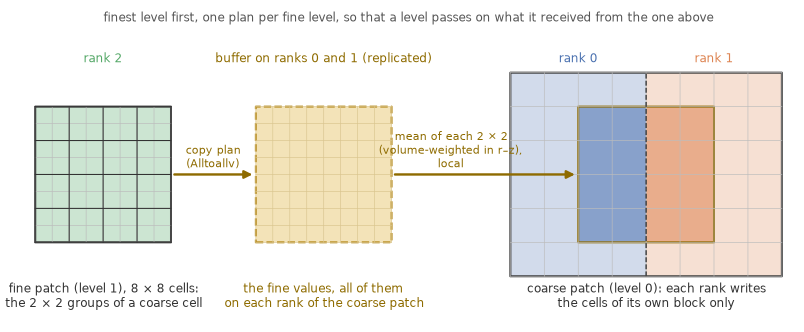
restrict(name) gives the coarse points under finer patches the fine values: the mean of the
fine cells of each coarse cell (weighted by their volumes in ), or the coinciding fine
node. It runs finest level first, with one plan per fine level, so that a level hands on
what it received from the level above. For every fine patch and every coarse patch under it,
the schedule allocates a replicated buffer on the coarse patch’s communicator for the fine
region, and one copy fills it. After the plan’s Alltoallv, every rank of the coarse patch
holds the fine values and averages them, but writes only the cells of its own block; the
halos are left for exchange_halos. restrict(name, level=L) runs the plan of level
only.
Deposit, migration and accumulation
Section titled “Deposit, migration and accumulation”A particle code keeps its markers on the ranks that hold their patches, deposits their charge patch by patch, and then sums the copies of every node. Three methods, with three kinds of communication:
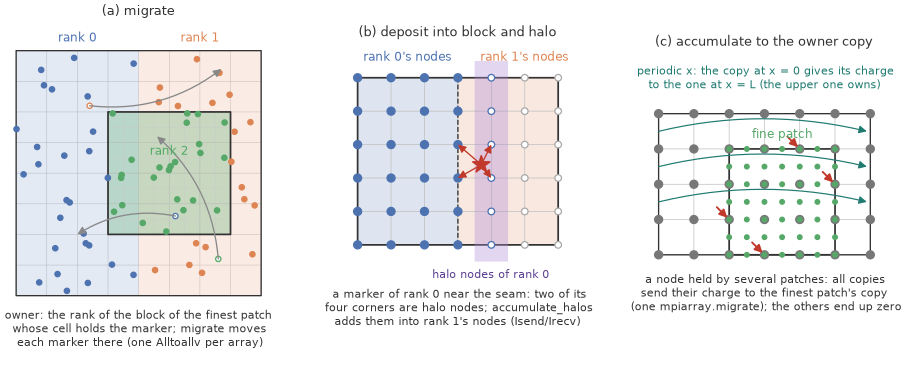
Owners. owner(x, y, name) gives the rank each marker belongs to: the rank that holds the
block of field name in which the lower corner of the marker’s cell lies, in the finest
patch that holds it. The patch comes from the locator tables, built on every rank from the
hierarchy alone; the block comes from a table of every rank’s index_bounds for the field,
gathered with one allgather the first time a field is used (kept as a schedule, like
the others). The same points give the same owners on every rank.
Migration. migrate(x, y, *arrays, name=...) sends each marker, with any per-marker
arrays, to its owner, with mpiarray.migrate: an alltoall of the row counts, then one
Alltoallv per array, as raw buffers without pickling. Markers outside the domain are
counted with an allreduce and raise on every rank (or are dropped with outside="drop").
Call it again on the hierarchy a regrid returns, for the markers whose patch changed ranks.
Deposit. deposit(x, y, charge, name) is local work: each marker spreads its charge over
the corners of its cell with mpifield’s compiled kernels, in this rank’s block of the finest
patch that holds it, halo nodes included. Its one collective call is the check that every
marker is on its owner (an allreduce of a count), so that no deposit is silently lost.
interpolate is the transpose and has the same check; it needs the halos filled first.
Accumulation. After the deposit, a node’s charge is spread over several copies: the halo
nodes of the blocks, and the copies of a node that several patches hold (the corners that
touch or nest, and the two copies of a node on a periodic seam). accumulate_halos(name)
brings it all to one copy, in two steps:
- on every local patch, mpiarray’s
accumulate_halosadds the halo nodes of each block into the neighbouring blocks and zeroes them (Isend/Irecvon the patch’s communicator; at the walls of the patch the halo is dropped); - the charge of every copy of a node goes to the owner copy: the one in the finest patch
that holds the node (the last of that level in the order of the patches; on a periodic
seam, the upper copy). The owners come from one table of the finest lattice of the whole
domain, painted patch by patch from the coarsest, built on every rank without a message.
The moving charges, with their patch numbers and node indices, travel in one
mpiarray.migrateto the rank that holds the owner’s block, and are added there.
The other copies end up zero, the total is kept, and CompositeNodes.from_patches then reads
the owner copies. On one rank the same paths are followed without MPI.
Regridding
Section titled “Regridding”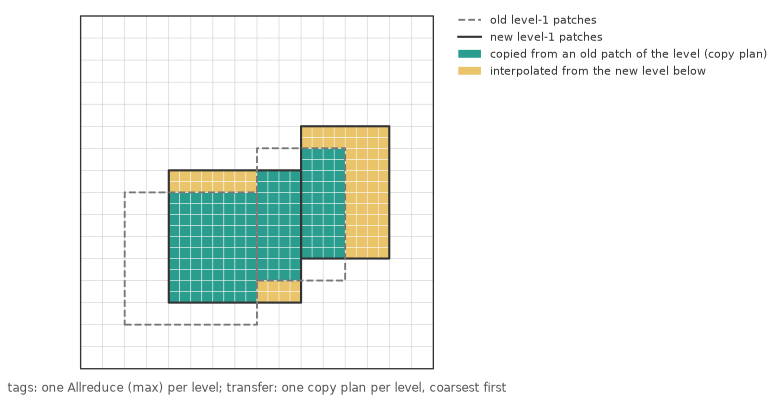
regrid(tags) builds a new hierarchy and moves every field to it:
- Tags. Each rank tags from the data it holds;
combine_tagscombines them with oneAllreduce(max) per level, so every rank clusters the same cells. - The new hierarchy. Every rank clusters the tags into the same boxes and adds the same
patches, placed by the hierarchy’s
placement(the largest first), so the new hierarchy is again identical everywhere. It shares the cache of communicators, so a group of ranks that already had one makes no newSplit. - The transfer, level by level from the coarsest: a point of a new patch takes the value of an old patch of the same level that has it, else the interpolation of the new level below (bilinear, or the conservative fill for a conservative field, which is first restricted on the old hierarchy). The copies from the old patches and those into the interpolation buffers make one plan per level, executed before the next level is built, since that level interpolates from this one.
Halos are not filled unless fill_halos=True; markers are moved with migrate on the new
hierarchy by the caller.
Refluxing, integrals and the composite solves
Section titled “Refluxing, integrals and the composite solves”Refluxing. FluxRegister.advance is local: each rank advances its blocks and records
the fluxes through the coarse-fine faces of its cells, times their weight. reflux sums the
records of all ranks with one allreduce of a vector with one value per coarse face
(the coarse and the fine side of a face can be on different ranks), corrects the coarse cells
each rank holds, and then restricts.
Integrals. integral(name) sums the leaf cells of this rank’s blocks (a replicated field
counts once, on the first rank of its patch) and allreduces the total.
Composite solves. CompositeNodes and CompositeCells are built from the description of
the hierarchy, the same on every rank, without a message. from_patches(name) gathers the
field of every patch to every rank (gather: one bcast per patch that is not on all
ranks), so that the right-hand side of a solve is complete everywhere. With the "lu" and
"fft" backends every rank then assembles and solves the whole system; to_patches writes the
solution back into the blocks locally. With the "petsc" backend, each node has an owner,
node_ranks: the lowest rank among those that hold the leaf cells around it. Every rank
assembles only the rows of the nodes it owns, in a numbering in which each rank’s unknowns
are contiguous (an allgather of the row counts gives the offsets), into a PETSc MPIAIJ
matrix over the hierarchy’s communicator, and PETSc’s Krylov solve and multigrid
preconditioner do the rest; a Scatter.toAll brings the solution to every rank at the end.
Summary
Section titled “Summary”| operation | once | every call |
|---|---|---|
AMRHierarchy, add_patch | comm.Split per new group of some ranks | none (the same calls on every rank) |
allocate_field | none | none |
gather | none | bcast from the first rank of the patch, or send/recv to root |
exchange_halos | allgather (the plan) | one Alltoallv; Isend/Irecv inside each split patch |
restrict | allgather per fine level | one Alltoallv per fine level |
owner | allgather (the blocks of the field) | none |
migrate | as owner | allreduce (markers outside), alltoall, one Alltoallv per array |
deposit, interpolate | as owner | allreduce (the check of the owners) |
accumulate_halos | as owner | Isend/Irecv inside each split patch; alltoall + Alltoallvs |
regrid | Allreduce per tagged level; allgather + Alltoallv per level | |
FluxRegister.reflux | as restrict | allreduce of the face records, then as restrict |
integral | none | allreduce |
CompositeNodes.from_patches | none | bcast per patch |
NodalPoisson(backend="petsc") | allgather of the row counts; PETSc’s setup | PETSc’s solve; Scatter.toAll |
Every row is collective: all ranks of the hierarchy’s communicator call it, whether they hold the patches involved or not.
Writing code that runs under MPI
Section titled “Writing code that runs under MPI”- Build the hierarchy with the same calls in the same order on every rank:
add_patch,allocate_field,regridand the methods of the table above are collective. A rank that skips one deadlocks the others. - Loop over
local_patchesfor data and overpatchesfor geometry; testpatch.is_localbeforepatch.field(name). Usegatherfor the whole array of a patch (every rank calls it) andlocal_node_coordinatesorlocal_cell_centersfor the points of this rank’s block. - Fields that markers are deposited into need
split=0(the default): a replicated field has no owner for a point. A replicated field is counted once byintegral,restrictand the flux register (its first rank). - Keep the hierarchy object: its schedules are built at the first call for each field and
reused until a patch is added.
regridreturns a new hierarchy and leaves the old one intact; move the markers withmigrateafterwards. - Compute on
local, read halos fromlocal_with_halosafterexchange_halos; write only the block, the halos belong to the exchange. - Launch with
mpirun -n 4 python script.pyafterpip install patchwork-amr[mpi], and profile the regionspatchwork.exchange_halos,patchwork.restrict,patchwork.build_schedule,patchwork.migrate,patchwork.deposit,patchwork.accumulate_halos,patchwork.mesh.regridandpatchwork.regrid_transferwith scope-profiler (--enable-tag patchwork).
The figures of this page are drawn by docs/mpi_figures.py (make docs-figures); the cell
classifications in them are computed with patchwork’s own geometry and checked against the
schedules it builds.