Debye shielding
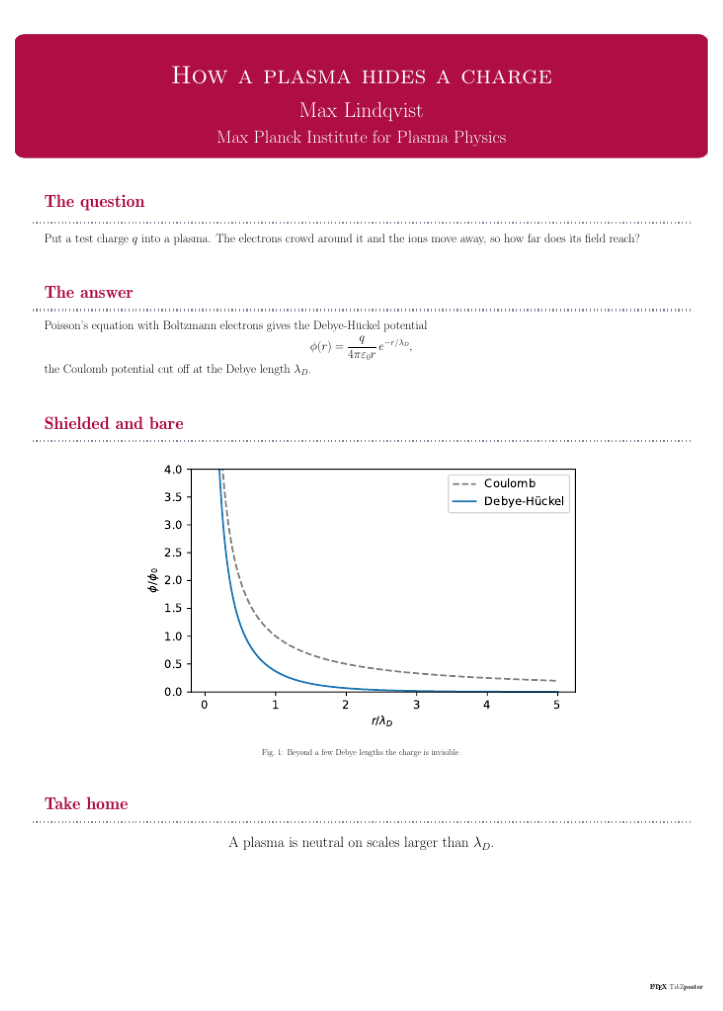
A one-column A1 poster: a short story told top to bottom, with an equation, a figure and a take-home message. The figure compares the Coulomb potential of a test charge with the shielded Debye-Hückel potential.
Python source
Section titled “Python source”"""Debye shielding.
A one-column A1 poster: a short story told top to bottom, with an equation, a figure and atake-home message. The figure compares the Coulomb potential of a test charge with theshielded Debye-Hückel potential."""
from pathlib import Path
import matplotlib.pyplot as pltimport numpy as np
from plasma_posters import Poster, preview
HERE = Path(__file__).resolve().parent
r = np.linspace(0.05, 5, 400) # in Debye lengthsfig, ax = plt.subplots(figsize=(6, 3.5))ax.plot(r, 1 / r, "--", color="gray", label="Coulomb")ax.plot(r, np.exp(-r) / r, label="Debye-Hückel")ax.set(xlabel=r"$r / \lambda_D$", ylabel=r"$\phi / \phi_0$", ylim=(0, 4))ax.legend()fig.savefig(HERE / "shielding.pdf", bbox_inches="tight")plt.close(fig)
poster = Poster( "How a plasma hides a charge", authors="Max Lindqvist", institute="Max Planck Institute for Plasma Physics", size="a1", columns=1,)poster.block( "The question", r""" Put a test charge $q$ into a plasma. The electrons crowd around it and the ions move away, so how far does its field reach? """,)poster.block( "The answer", r""" Poisson's equation with Boltzmann electrons gives the Debye-Hückel potential \[ \phi(r) = \frac{q}{4 \pi \varepsilon_0 r}\, e^{-r / \lambda_D}, \] the Coulomb potential cut off at the Debye length $\lambda_D$. """,)poster.figure( "Shielded and bare", "shielding.pdf", caption="Beyond a few Debye lengths the charge is invisible.", width=0.7,)poster.block( "Take home", r""" \begin{center} \Large A plasma is neutral on scales larger than $\lambda_D$. \end{center} """,)pdf = poster.build(HERE / "debye_shielding.pdf")
# the poster, as the docs show itfig, ax = plt.subplots(figsize=(6, 8.5))ax.imshow(plt.imread(preview(pdf)))ax.set_axis_off()