Moments and binning
The velocity distribution of the markers is summarised by its moments, the sums of every order : the total weight, the momentum over the mass, , … velocity_moments sums them over the markers of all ranks, and phase_space_density bins the markers on one to three phase-space axes. Both are collective on the communicator they get; without one they make no MPI call. This tutorial loads two counter-streaming beams into a store and looks at them both ways.
import matplotlib.pyplot as pltimport numpy as np
from mpiparticles import (    ParticleStore,    moment_indices,    moment_name,    moment_values,    phase_space_density,    velocity_moments,)
rng = np.random.default_rng(0)count = 100_000beam = np.where(rng.uniform(size=count) < 0.5, -1.0, 1.0)  # two beams, at -1 and +1velocities = np.stack(    [beam + 0.3 * rng.normal(size=count), 0.5 * rng.normal(size=count)])positions = rng.uniform(0.0, 1.0, (1, count))store = ParticleStore(ndim=1, nvel=2)_ = store.add(positions, velocities, np.full(count, 1.0 / count))
Moments
Section titled “Moments”moment_indices(nvel, max_order) lists the moments in the order the functions return them: order by order, each symmetric moment once ((0, 1) but not (1, 0)). moment_name spells an index with the letters of its velocity components.
indices = moment_indices(store.nvel, 2)sums = velocity_moments(store.active_velocities(), store.active_weights(), max_order=2)for index, value in zip(indices, sums, strict=True): print(f"{moment_name(index) or '1':>3}: {value: .4f}") 1: 1.0000 x: -0.0012 y: -0.0001 xx: 1.0922 xy: -0.0019 yy: 0.2506Divided by the total weight they are averages. The mean velocity vanishes, but : the spread between the beams counts as temperature in a fluid description, which is why the second moment alone cannot tell a hot plasma from two cold beams.
averages = dict(zip(map(moment_name, indices), sums / sums[0], strict=True))temperature_x = averages["xx"] - averages["x"] ** 2print(f"<v_x> = {averages['x']:.4f}, T_x / m = {temperature_x:.4f}")<v_x> = -0.0012, T_x / m = 1.0922moment_values gives the per-marker products instead of their sums, (num_moments, N). Deposited on a grid they are the moments on the nodes; mpifield’s Field.deposit_density(positions, moment_values(...)) does that, with the halo exchange on a split field.
print(moment_values(store.active_velocities(), store.active_weights(), 2).shape)(6, 100000)Phase-space density
Section titled “Phase-space density”phase_space_density sums the weights in each bin and divides by the bin volume. The axes are a mapping {name: (lower, upper, num_bins)} (or BinAxis objects), with the names x, y, z, vx, vy, vz, in the order of the dimensions of the result. Markers outside the ranges are left out, so the integral over the bins is the weight inside them.
axes = {"vx": (-2.5, 2.5, 100), "vy": (-2.0, 2.0, 80)}density = phase_space_density(    store.active_positions(), store.active_velocities(), store.active_weights(), axes)print(f"weight inside: {density.sum() * 0.05 * 0.05:.4f}")
fig, ax = plt.subplots(figsize=(6, 3.5), layout="constrained")mesh = ax.pcolormesh(    np.linspace(-2.5, 2.5, 101), np.linspace(-2.0, 2.0, 81), density.T, cmap="magma")ax.set(xlabel="$v_x$", ylabel="$v_y$")fig.colorbar(mesh, label="$f$")plt.show()
weight inside: 1.0000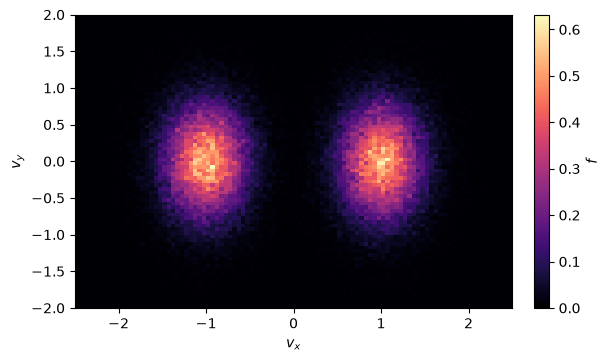
Under MPI
Section titled “Under MPI”Each rank passes its own markers and the communicator: velocity_moments(..., comm=comm) and phase_space_density(..., comm=comm) return the sums over all ranks, the same on every rank (one Allreduce).