Particles: migration and deposition
Particle-in-cell codes keep particles with the rank that owns the grid cell they are in, and deposit their charge on the grid. This tutorial moves particles in a periodic 2D box, sends each one to its new owner with Layout.owners and mpa.migrate, deposits the charge with cloud-in-cell weights into the blocks and their halo cells, and folds the halo contributions into the neighbours with accumulate_halos. The particle arrays are the backend’s (NumPy or CuPy, through cunumpy), so the same code runs on GPUs. Run it serially or with mpiexec -n 4 python particles.py.
import cunumpy as xpimport matplotlib.pyplot as pltimport numpy as np
import mpiarray as mpa
n = 64  # cells per axis of the unit boxdx = 1.0 / nrho = mpa.zeros((n, n), split=(0, 1), halo=1, periodic=True)layout = rho.layoutcomm, rank = layout.comm, layout.rankprint(f"rank {rank} owns cells {layout.index_bounds}")
rank 0 owns cells ((0, 64), (0, 64))Particles in each block
Section titled “Particles in each block”Every rank starts with particles inside its own block of cells. The positions are in box units, .
rng = np.random.default_rng(rank)(i0, i1), (j0, j1) = layout.index_boundscount = 2000positions = xp.asarray( # drawn on the host, then moved to the backend np.column_stack( [rng.uniform(i0 * dx, i1 * dx, count), rng.uniform(j0 * dx, j1 * dx, count)] ))velocities = xp.asarray(rng.normal(0.0, 0.05, (count, 2)))total = comm.allreduce(len(positions))if rank == 0: print("particles:", total)particles: 2000Moving and migrating
Section titled “Moving and migrating”After a push, some particles have left the block. owners maps their cells to ranks for all particles at once; mpa.migrate then sends every row of the position and velocity arrays to its rank, as raw buffers in one Alltoallv per array.
for _ in range(20):    positions = (positions + 0.02 * velocities) % 1.0    destination = layout.owners(xp.floor(positions / dx).astype(int) % n)    positions, velocities = mpa.migrate(destination, positions, velocities, comm=comm)
cells = xp.floor(positions / dx).astype(int)everyone_home = comm.allreduce(    bool((layout.owners(cells) == rank).all()), op=mpa.layout.MPI.LAND)total_now = comm.allreduce(len(positions))if rank == 0:    print("all particles with their owner:", everyone_home, "| particles:", total_now)
all particles with their owner: True | particles: 2000Depositing the charge
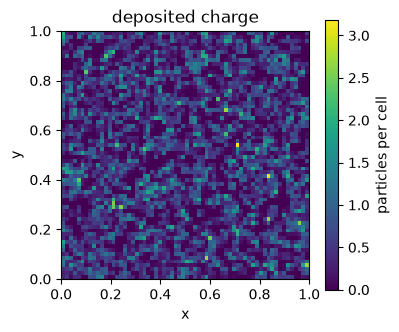
Section titled “Depositing the charge”Cloud-in-cell spreads each particle over the four cells around it, with weights that add up to one. A particle near the edge of a block also writes into the halo cells. bincount adds the weights per cell (on NumPy or CuPy, with repeated cells counted correctly). accumulate_halos then adds the halo contributions to the neighbouring blocks (wrapping around the periodic box) and clears the halos, so no charge is lost.
def cloud_in_cell(grid, positions, start, wrap=False):    """Add one unit of charge per particle to ``grid``, a storage array."""    shape = grid.shape    p = positions / dx - 0.5  # in cell units, cell centres at integers    corner = xp.floor(p).astype(int)    weight = p - corner    index = corner - xp.asarray(start)  # into the storage    for di in (0, 1):        for dj in (0, 1):            w = (weight[:, 0] if di else 1 - weight[:, 0]) * (                weight[:, 1] if dj else 1 - weight[:, 1]            )            i, j = index[:, 0] + di, index[:, 1] + dj            if wrap:                i, j = i % shape[0], j % shape[1]            cell = i * shape[1] + j            grid += xp.bincount(cell, weights=w, minlength=grid.size).reshape(shape)

def deposit(rho, positions):    rho.local_with_halos[...] = 0    cloud_in_cell(rho.local_with_halos, positions, (i0 - 1, j0 - 1))  # halo layer    rho.accumulate_halos()

deposit(rho, positions)deposited = rho.sum()if rank == 0:    print(f"deposited charge: {deposited:.6f} (particles: {total_now})")
deposited charge: 2000.000000 (particles: 2000)Every particle lies within one cell of its own block, so with one halo layer all its four cells are in the storage. After accumulate_halos the deposited charge equals the number of particles.
The same with a replicated grid
Section titled “The same with a replicated grid”Codes that split only the particles keep the whole grid on every rank (split=None): each rank deposits its own particles on its copy, and allreduce_replicated adds the copies up. The result is the same density.
full = mpa.zeros((n, n), split=None)cloud_in_cell(full.local, positions, (0, 0), wrap=True)full.allreduce_replicated()density = rho.to_numpy(root=0) # NumPy on rank 0, for plottingif rank == 0: print("same density:", np.allclose(density, xp.to_numpy(full.local))) fig, ax = plt.subplots(figsize=(4, 3.5)) image = ax.imshow(density.T, origin="lower", extent=(0, 1, 0, 1), cmap="viridis") fig.colorbar(image, ax=ax, label="particles per cell") ax.set(xlabel="x", ylabel="y", title="deposited charge")same density: True